 Add to Chrome
 Add to Firefox
 Add to Edge
Reversibility and Composition of Rewriting in Hierarchies
Dec 03, 2020

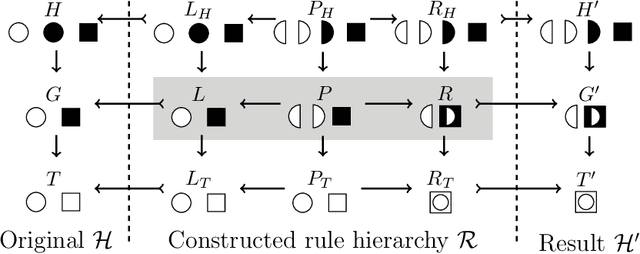


In this paper, we study how graph transformations based on sesqui-pushout rewriting can be reversed and how the composition of rewrites can be constructed. We illustrate how such reversibility and composition can be used to design an audit trail system for individual graphs and graph hierarchies. This provides us with a compact way to maintain the history of updates of an object, including its multiple versions. The main application of the designed framework is an audit trail of updates to knowledge represented by hierarchies of graphs. Therefore, we introduce the notion of rule hierarchy that represents a transformation of the entire hierarchy, study how rule hierarchies can be applied to hierarchies and analyse the conditions under which this application is reversible. We then present a theory for constructing the composition of consecutive hierarchy rewrites. The prototype audit trail system for transformations in hierarchies of simple graphs with attributes is implemented as part of the ReGraph Python library.
* In Proceedings GCM 2020, arXiv:2012.01181

Knowledge representation and update in hierarchies of graphs
Feb 05, 2020A mathematical theory is presented for the representation of knowledge in the form of a directed acyclic hierarchy of objects in a category where all paths between any given pair of objects are required to be equal. The conditions under which knowledge update, in the form of the sesqui-pushout rewriting of an object in a hierarchy, can be propagated to the rest of the hierarchy, in order to maintain all required path equalities, are analysed: some rewrites must be propagated forwards, in the direction of the arrows, while others must be propagated backwards, against the direction of the arrows, and, depending on the precise form of the hierarchy, certain composability conditions may also be necessary. The implementation of this theory, in the ReGraph Python library for (simple) directed graphs with attributes on nodes and edges, is then discussed in the context of two significant use cases.
A knowledge representation meta-model for rule-based modelling of signalling networks
Mar 03, 2016The study of cellular signalling pathways and their deregulation in disease states, such as cancer, is a large and extremely complex task. Indeed, these systems involve many parts and processes but are studied piecewise and their literatures and data are consequently fragmented, distributed and sometimes--at least apparently--inconsistent. This makes it extremely difficult to build significant explanatory models with the result that effects in these systems that are brought about by many interacting factors are poorly understood. The rule-based approach to modelling has shown some promise for the representation of the highly combinatorial systems typically found in signalling where many of the proteins are composed of multiple binding domains, capable of simultaneous interactions, and/or peptide motifs controlled by post-translational modifications. However, the rule-based approach requires highly detailed information about the precise conditions for each and every interaction which is rarely available from any one single source. Rather, these conditions must be painstakingly inferred and curated, by hand, from information contained in many papers--each of which contains only part of the story. In this paper, we introduce a graph-based meta-model, attuned to the representation of cellular signalling networks, which aims to ease this massive cognitive burden on the rule-based curation process. This meta-model is a generalization of that used by Kappa and BNGL which allows for the flexible representation of knowledge at various levels of granularity. In particular, it allows us to deal with information which has either too little, or too much, detail with respect to the strict rule-based meta-model. Our approach provides a basis for the gradual aggregation of fragmented biological knowledge extracted from the literature into an instance of the meta-model from which we can define an automated translation into executable Kappa programs.
* In Proceedings DCM 2015, arXiv:1603.00536