 Add to Chrome
 Add to Firefox
 Add to Edge
LSTM Variants for Chaotic Dynamical Systems: An Empirical Study on the Lorenz Attractor
Jun 21, 2026
Forecasting chaotic dynamical systems such as the Lorenz attractor is notoriously difficult: small numerical errors are amplified exponentially over long autoregressive rollouts. We study seven recurrent and convolutional architectures for the AI-DEEDS 2026 Chaotic Systems Challenge: a vanilla LSTM, an LSTM with additive attention, a Bidirectional LSTM (BiLSTM), a BiLSTM trained with the Huber loss, a Temporal Convolutional Network (TCN), a CNN front-end followed by an LSTM, and a CNN front-end followed by a BiLSTM. All models share the same pre-processing, sequence length, and rollout procedure, isolating the contribution of each design choice. The challenge scores predictions on a 0-100 scale where higher is better. We obtain leaderboard scores between 45.72 and 58.81, with the BiLSTM trained with Huber loss being the strongest configuration. Two findings stand out: (i) adding additive attention to the unidirectional baseline degraded performance by over ten points, and (ii) prepending a CNN front-end to either an LSTM or a BiLSTM did not help and slightly hurt the score. Per-pair RMSE measurements confirm that the BiLSTM family generalizes better in the harder pairs (6-7), while the LSTM + Attention model collapses there (RMSE up to 8.94 on pair 6). We discuss why bidirectional context and a robust loss help in chaotic regimes while attention and CNN front-ends fail in this setting.

UrbanAI 2025 Challenge: Linear vs Transformer Models for Long-Horizon Exogenous Temperature Forecasting
Dec 11, 2025
We study long-horizon exogenous-only temperature forecasting - a challenging univariate setting where only the past values of the indoor temperature are used for prediction - using linear and Transformer-family models. We evaluate Linear, NLinear, DLinear, Transformer, Informer, and Autoformer under standardized train, validation, and test splits. Results show that linear baselines (Linear, NLinear, DLinear) consistently outperform more complex Transformer-family architectures, with DLinear achieving the best overall accuracy across all splits. These findings highlight that carefully designed linear models remain strong baselines for time series forecasting in challenging exogenous-only settings.
Automatic Teaching Platform on Vision Language Retrieval Augmented Generation
Mar 07, 2025Automating teaching presents unique challenges, as replicating human interaction and adaptability is complex. Automated systems cannot often provide nuanced, real-time feedback that aligns with students' individual learning paces or comprehension levels, which can hinder effective support for diverse needs. This is especially challenging in fields where abstract concepts require adaptive explanations. In this paper, we propose a vision language retrieval augmented generation (named VL-RAG) system that has the potential to bridge this gap by delivering contextually relevant, visually enriched responses that can enhance comprehension. By leveraging a database of tailored answers and images, the VL-RAG system can dynamically retrieve information aligned with specific questions, creating a more interactive and engaging experience that fosters deeper understanding and active student participation. It allows students to explore concepts visually and verbally, promoting deeper understanding and reducing the need for constant human oversight while maintaining flexibility to expand across different subjects and course material.
SparrowVQE: Visual Question Explanation for Course Content Understanding
Nov 12, 2024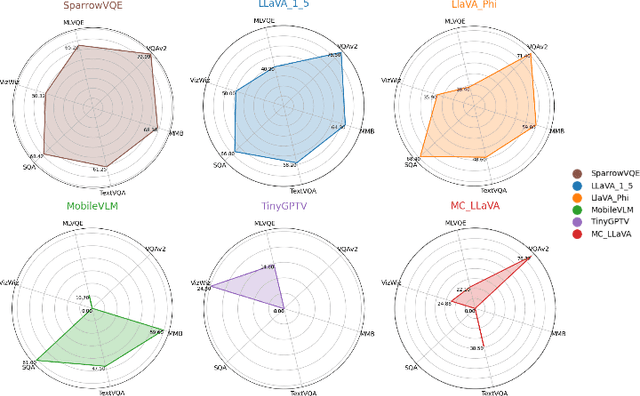


Visual Question Answering (VQA) research seeks to create AI systems to answer natural language questions in images, yet VQA methods often yield overly simplistic and short answers. This paper aims to advance the field by introducing Visual Question Explanation (VQE), which enhances the ability of VQA to provide detailed explanations rather than brief responses and address the need for more complex interaction with visual content. We first created an MLVQE dataset from a 14-week streamed video machine learning course, including 885 slide images, 110,407 words of transcripts, and 9,416 designed question-answer (QA) pairs. Next, we proposed a novel SparrowVQE, a small 3 billion parameters multimodal model. We trained our model with a three-stage training mechanism consisting of multimodal pre-training (slide images and transcripts feature alignment), instruction tuning (tuning the pre-trained model with transcripts and QA pairs), and domain fine-tuning (fine-tuning slide image and QA pairs). Eventually, our SparrowVQE can understand and connect visual information using the SigLIP model with transcripts using the Phi-2 language model with an MLP adapter. Experimental results demonstrate that our SparrowVQE achieves better performance in our developed MLVQE dataset and outperforms state-of-the-art methods in the other five benchmark VQA datasets. The source code is available at \url{https://github.com/YoushanZhang/SparrowVQE}.