 Add to Chrome
 Add to Firefox
 Add to Edge
When the Prompt Becomes Visual: Vision-Centric Jailbreak Attacks for Large Image Editing Models
Feb 10, 2026
Recent advances in large image editing models have shifted the paradigm from text-driven instructions to vision-prompt editing, where user intent is inferred directly from visual inputs such as marks, arrows, and visual-text prompts. While this paradigm greatly expands usability, it also introduces a critical and underexplored safety risk: the attack surface itself becomes visual. In this work, we propose Vision-Centric Jailbreak Attack (VJA), the first visual-to-visual jailbreak attack that conveys malicious instructions purely through visual inputs. To systematically study this emerging threat, we introduce IESBench, a safety-oriented benchmark for image editing models. Extensive experiments on IESBench demonstrate that VJA effectively compromises state-of-the-art commercial models, achieving attack success rates of up to 80.9% on Nano Banana Pro and 70.1% on GPT-Image-1.5. To mitigate this vulnerability, we propose a training-free defense based on introspective multimodal reasoning, which substantially improves the safety of poorly aligned models to a level comparable with commercial systems, without auxiliary guard models and with negligible computational overhead. Our findings expose new vulnerabilities, provide both a benchmark and practical defense to advance safe and trustworthy modern image editing systems. Warning: This paper contains offensive images created by large image editing models.

Data Augmentation in Time Series Forecasting through Inverted Framework
Jul 16, 2025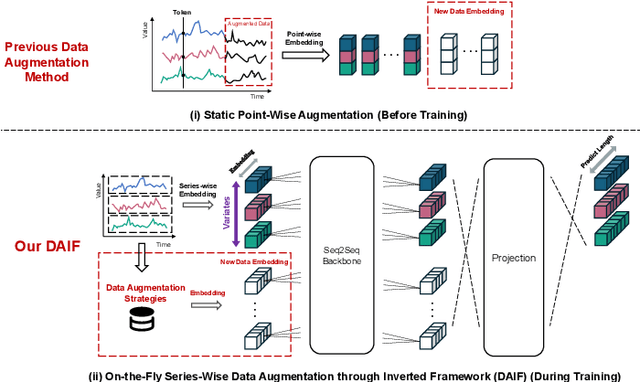
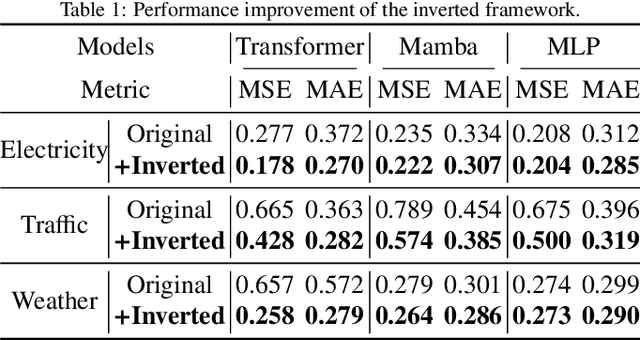
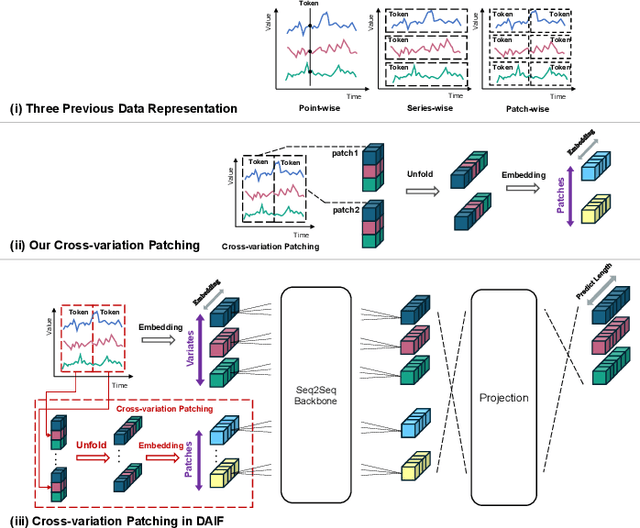

Currently, iTransformer is one of the most popular and effective models for multivariate time series (MTS) forecasting. Thanks to its inverted framework, iTransformer effectively captures multivariate correlation. However, the inverted framework still has some limitations. It diminishes temporal interdependency information, and introduces noise in cases of nonsignificant variable correlation. To address these limitations, we introduce a novel data augmentation method on inverted framework, called DAIF. Unlike previous data augmentation methods, DAIF stands out as the first real-time augmentation specifically designed for the inverted framework in MTS forecasting. We first define the structure of the inverted sequence-to-sequence framework, then propose two different DAIF strategies, Frequency Filtering and Cross-variation Patching to address the existing challenges of the inverted framework. Experiments across multiple datasets and inverted models have demonstrated the effectiveness of our DAIF.