 Add to Chrome
 Add to Firefox
 Add to Edge
Skills Are Not Islands: Measuring Dependency and Risk in Agent Skill Supply Chains
Jul 01, 2026
Agent skills package reusable operational knowledge for Large Language Model (LLM) agents, yet as they grow in scope, they become dependency-bearing artifacts whose identities, versions, and provenance remain implicit. This opacity already causes duplicated dependencies and inconsistent installations, exposing a gap that dependency management has yet to close. We introduce Agent Skill Supply Chains (ASSCs) to characterize mixed skill-package-service dependency graphs and help close this gap. Borrowing from Software Bill of Materials (SBOMs), we design SkillDepAnalyzer to capture natural-language dependency evidence and model skills as dependency-bearing artifacts. On the SKILL-DEP benchmark, SkillDepAnalyzer recovers skill metadata and dependency graphs accurately and comprehensively, substantially outperforming an LLM-based baseline and package-centric SBOM tools. Applying SkillDepAnalyzer to over 1.43 million skills, we obtain ASSCs and explore their structural diversity and security signals. We find four structural patterns: skill metadata is activation-ready but governance-poor; dependency graphs span skill, package, and service dependencies with concentrated reuse; recursive skill reuse expands dependency graphs and creates hidden package inventory; and skill dependency clusters form around related workflows. We also find that inspecting a skill alone misses security-relevant signals hiding in its dependencies. By analyzing ASSCs, we identify and report known malicious skills persisting in ASSCs to their developers. Based on these findings, we recommend typed dependency manifests, first-class dependency-cluster management, risk-warning audit commands for skill infrastructure maintainers, and lockfile-like records for skill developers.

Characterising Open Source Co-opetition in Company-hosted Open Source Software Projects: The Cases of PyTorch, TensorFlow, and Transformers
Oct 23, 2024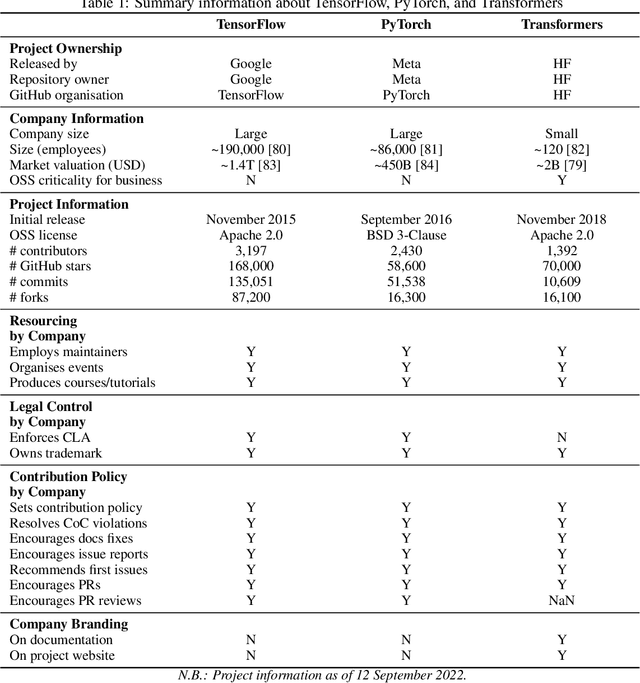
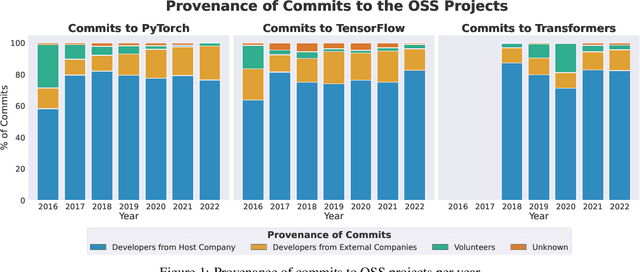
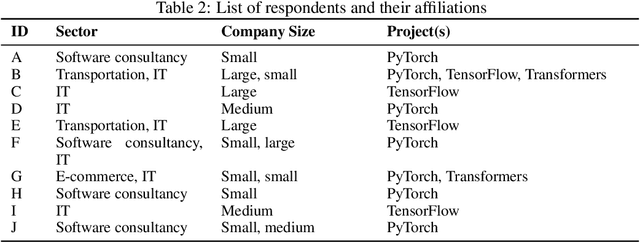
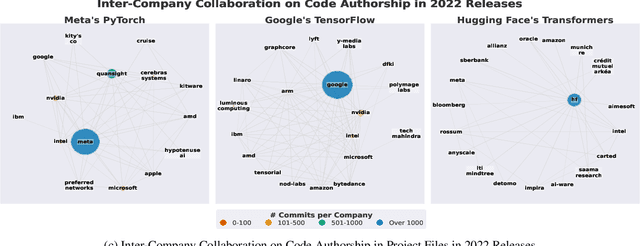
Companies, including market rivals, have long collaborated on the development of open source software (OSS), resulting in a tangle of co-operation and competition known as "open source co-opetition". While prior work investigates open source co-opetition in OSS projects that are hosted by vendor-neutral foundations, we have a limited understanding thereof in OSS projects that are hosted and governed by one company. Given their prevalence, it is timely to investigate open source co-opetition in such contexts. Towards this end, we conduct a mixed-methods analysis of three company-hosted OSS projects in the artificial intelligence (AI) industry: Meta's PyTorch (prior to its donation to the Linux Foundation), Google's TensorFlow, and Hugging Face's Transformers. We contribute three key findings. First, while the projects exhibit similar code authorship patterns between host and external companies (80%/20% of commits), collaborations are structured differently (e.g., decentralised vs. hub-and-spoke networks). Second, host and external companies engage in strategic, non-strategic, and contractual collaborations, with varying incentives and collaboration practices. Some of the observed collaborations are specific to the AI industry (e.g., hardware-software optimizations or AI model integrations), while others are typical of the broader software industry (e.g., bug fixing or task outsourcing). Third, single-vendor governance creates a power imbalance that influences open source co-opetition practices and possibilities, from the host company's singular decision-making power (e.g., the risk of license change) to their community involvement strategy (e.g., from over-control to over-delegation). We conclude with recommendations for future research.