 Add to Chrome
 Add to Firefox
 Add to Edge
FedSUM Family: Efficient Federated Learning Methods under Arbitrary Client Participation
Dec 20, 2025
Federated Learning (FL) methods are often designed for specific client participation patterns, limiting their applicability in practical deployments. We introduce the FedSUM family of algorithms, which supports arbitrary client participation without additional assumptions on data heterogeneity. Our framework models participation variability with two delay metrics, the maximum delay $τ_{\max}$ and the average delay $τ_{\text{avg}}$. The FedSUM family comprises three variants: FedSUM-B (basic version), FedSUM (standard version), and FedSUM-CR (communication-reduced version). We provide unified convergence guarantees demonstrating the effectiveness of our approach across diverse participation patterns, thereby broadening the applicability of FL in real-world scenarios.

Distributed Learning over Arbitrary Topology: Linear Speed-Up with Polynomial Transient Time
Mar 20, 2025

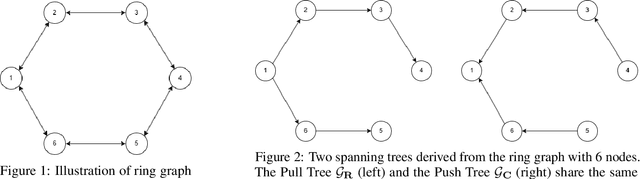
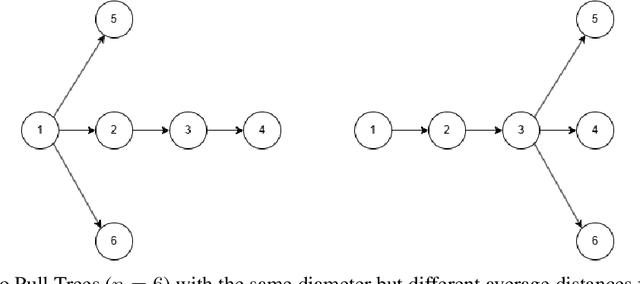
We study a distributed learning problem in which $n$ agents, each with potentially heterogeneous local data, collaboratively minimize the sum of their local cost functions via peer-to-peer communication. We propose a novel algorithm, Spanning Tree Push-Pull (STPP), which employs two spanning trees extracted from a general communication graph to distribute both model parameters and stochastic gradients. Unlike prior approaches that rely heavily on spectral gap properties, STPP leverages a more flexible topological characterization, enabling robust information flow and efficient updates. Theoretically, we prove that STPP achieves linear speedup and polynomial transient iteration complexity, up to $O(n^7)$ for smooth nonconvex objectives and $\tilde{O}(n^3)$ for smooth strongly convex objectives, under arbitrary network topologies. Moreover, compared with the existing methods, STPP achieves faster convergence rates on sparse and non-regular topologies (e.g., directed ring) and reduces communication overhead on dense networks (e.g., static exponential graph). These results significantly advance the state of the art, especially when $n$ is large. Numerical experiments further demonstrate the strong performance of STPP and confirm the practical relevance of its theoretical convergence rates across various common graph architectures. Our code is available at https://anonymous.4open.science/r/SpanningTreePushPull-5D3E.