 Add to Chrome
 Add to Firefox
 Add to Edge
Quanvolutional Neural Networks for Spectrum Peak-Finding
Dec 15, 2025
The analysis of spectra, such as Nuclear Magnetic Resonance (NMR) spectra, for the comprehensive characterization of peaks is a challenging task for both experts and machines, especially with complex molecules. This process, also known as deconvolution, involves identifying and quantifying the peaks in the spectrum. Machine learning techniques have shown promising results in automating this process. With the advent of quantum computing, there is potential to further enhance these techniques. In this work, inspired by the success of classical Convolutional Neural Networks (CNNs), we explore the use of Quanvolutional Neural Networks (QuanvNNs) for the multi-task peak finding problem, involving both peak counting and position estimation. We implement a simple and interpretable QuanvNN architecture that can be directly compared to its classical CNN counterpart, and evaluate its performance on a synthetic NMR-inspired dataset. Our results demonstrate that QuanvNNs outperform classical CNNs on challenging spectra, achieving an 11\% improvement in F1 score and a 30\% reduction in mean absolute error for peak position estimation. Additionally, QuanvNNs appear to exhibit better convergence stability for harder problems.

Multiple Query Optimization using a Hybrid Approach of Classical and Quantum Computing
Jul 22, 2021
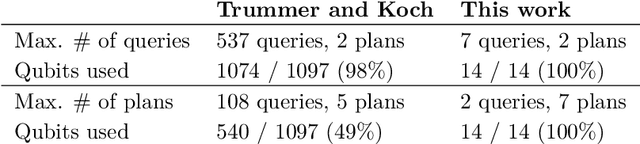
Quantum computing promises to solve difficult optimization problems in chemistry, physics and mathematics more efficiently than classical computers, but requires fault-tolerant quantum computers with millions of qubits. To overcome errors introduced by today's quantum computers, hybrid algorithms combining classical and quantum computers are used. In this paper we tackle the multiple query optimization problem (MQO) which is an important NP-hard problem in the area of data-intensive problems. We propose a novel hybrid classical-quantum algorithm to solve the MQO on a gate-based quantum computer. We perform a detailed experimental evaluation of our algorithm and compare its performance against a competing approach that employs a quantum annealer -- another type of quantum computer. Our experimental results demonstrate that our algorithm currently can only handle small problem sizes due to the limited number of qubits available on a gate-based quantum computer compared to a quantum computer based on quantum annealing. However, our algorithm shows a qubit efficiency of close to 99% which is almost a factor of 2 higher compared to the state of the art implementation. Finally, we analyze how our algorithm scales with larger problem sizes and conclude that our approach shows promising results for near-term quantum computers.