 Add to Chrome
 Add to Firefox
 Add to Edge
Same Payload, Different Channel: Measuring Trust Asymmetry in Tool-Using Language Models
May 30, 2026
As language models take on agentic roles that span calling external APIs, reading tool outputs, and acting on instructions embedded in third-party content, their attack surface expands well beyond what users type. Whether a model treats a malicious instruction the same way regardless of where it arrives has not been systematically studied. We introduce the Safety Asymmetry Score (SAS), which measures how much a model's susceptibility to adversarial content shifts depending on whether that content arrives in the user message, tool metadata, or tool output, using matched payload pairs that keep the malicious text identical and vary only the context of delivery. Evaluated across 6 production LLMs and three attack families, we find a consistent and informative asymmetry: agent-native models are substantially more vulnerable when adversarial content arrives via tool descriptions than via user messages, while general-purpose models show the reverse. This asymmetry further inverts when the same content is delivered through tool outputs rather than descriptions, suggesting models implicitly treat tool metadata as trusted instructions and tool results as ordinary data. A mechanistic study on Llama 3.3 70B reveals that the safety-relevant representation is causally present at mid-to-late network depths but non-linearly encoded, explaining why linear probes fail to detect it. These findings expose a systematic, channel-dependent blind spot in how current tool-using models handle adversarial content.

H2-Golden-Retriever: Methodology and Tool for an Evidence-Based Hydrogen Research Grantsmanship
Nov 16, 2022Hydrogen is poised to play a major role in decarbonizing the economy. The need to discover, develop, and understand low-cost, high-performance, durable materials that can help maximize the cost of electrolysis as well as the need for an intelligent tool to make evidence-based Hydrogen research funding decisions relatively easier warranted this study.In this work, we developed H2 Golden Retriever (H2GR) system for Hydrogen knowledge discovery and representation using Natural Language Processing (NLP), Knowledge Graph and Decision Intelligence. This system represents a novel methodology encapsulating state-of-the-art technique for evidence-based research grantmanship. Relevant Hydrogen papers were scraped and indexed from the web and preprocessing was done using noise and stop-words removal, language and spell check, stemming and lemmatization. The NLP tasks included Named Entity Recognition using Stanford and Spacy NER, topic modeling using Latent Dirichlet Allocation and TF-IDF. The Knowledge Graph module was used for the generation of meaningful entities and their relationships, trends and patterns in relevant H2 papers, thanks to an ontology of the hydrogen production domain. The Decision Intelligence component provides stakeholders with a simulation environment for cost and quantity dependencies. PageRank algorithm was used to rank papers of interest. Random searches were made on the proposed H2GR and the results included a list of papers ranked by relevancy score, entities, graphs of relationships between the entities, ontology of H2 production and Causal Decision Diagrams showing component interactivity. Qualitative assessment was done by the experts and H2GR is deemed to function to a satisfactory level.
Golden Reference-Free Hardware Trojan Localization using Graph Convolutional Network
Jul 14, 2022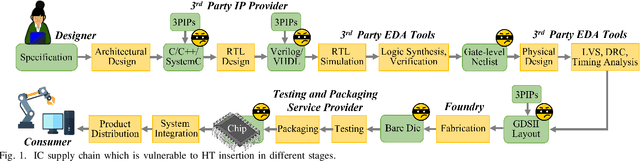
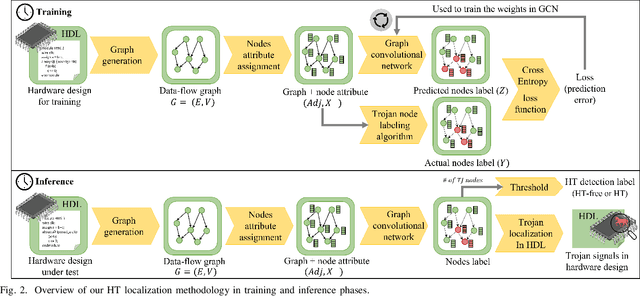
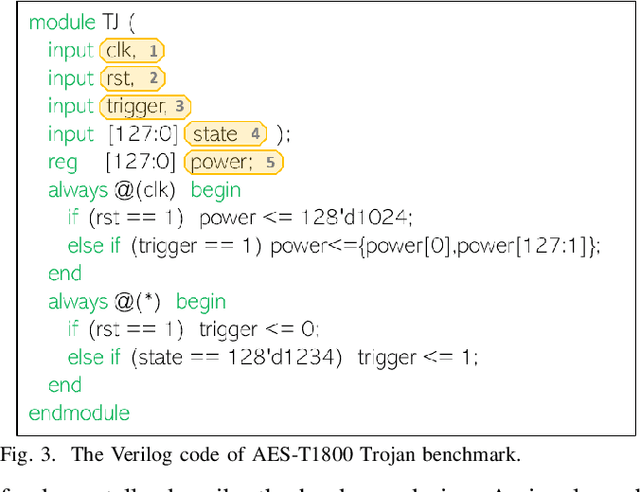
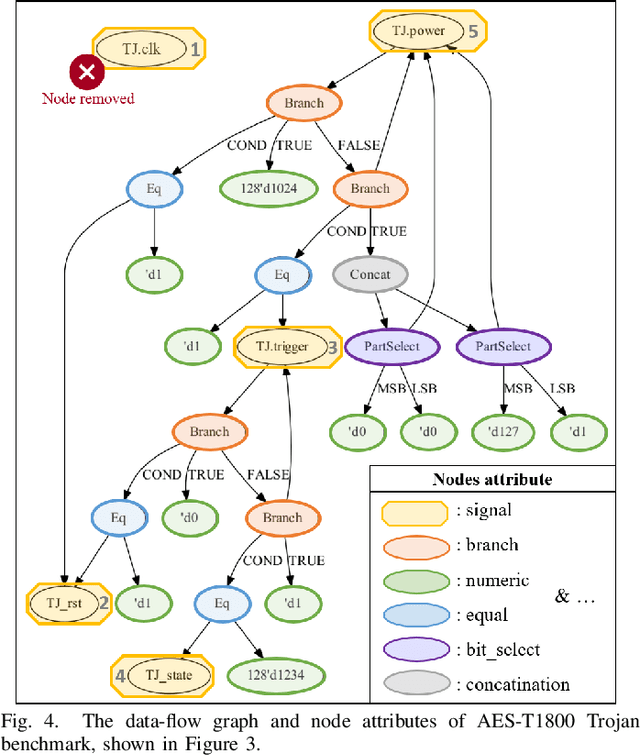
The globalization of the Integrated Circuit (IC) supply chain has moved most of the design, fabrication, and testing process from a single trusted entity to various untrusted third-party entities worldwide. The risk of using untrusted third-Party Intellectual Property (3PIP) is the possibility for adversaries to insert malicious modifications known as Hardware Trojans (HTs). These HTs can compromise the integrity, deteriorate the performance, deny the service, and alter the functionality of the design. While numerous HT detection methods have been proposed in the literature, the crucial task of HT localization is overlooked. Moreover, a few existing HT localization methods have several weaknesses: reliance on a golden reference, inability to generalize for all types of HT, lack of scalability, low localization resolution, and manual feature engineering/property definition. To overcome their shortcomings, we propose a novel, golden reference-free HT localization method at the pre-silicon stage by leveraging Graph Convolutional Network (GCN). In this work, we convert the circuit design to its intrinsic data structure, graph and extract the node attributes. Afterward, the graph convolution performs automatic feature extraction for nodes to classify the nodes as Trojan or benign. Our automated approach does not burden the designer with manual code review. It locates the Trojan signals with 99.6% accuracy, 93.1% F1-score, and a false-positive rate below 0.009%.
HW2VEC: A Graph Learning Tool for Automating Hardware Security
Jul 26, 2021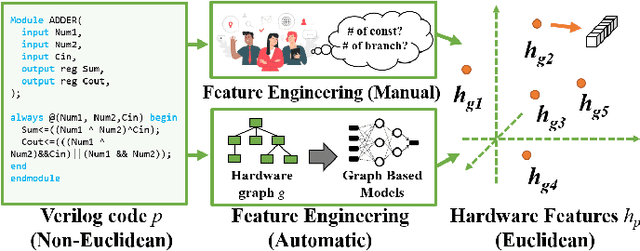
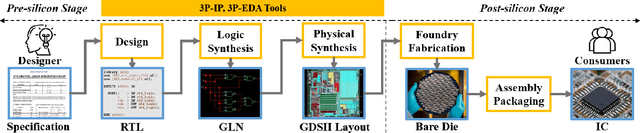
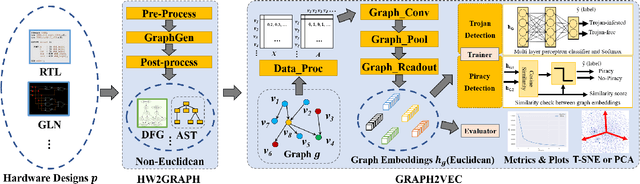
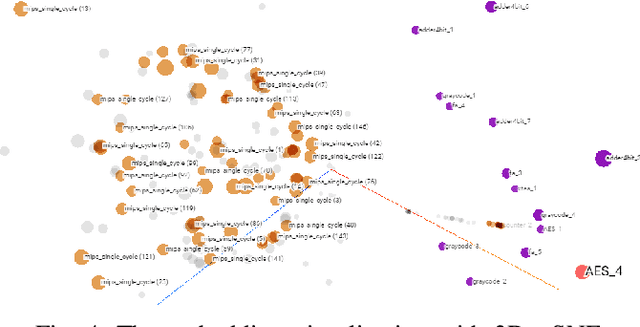
The time-to-market pressure and continuous growing complexity of hardware designs have promoted the globalization of the Integrated Circuit (IC) supply chain. However, such globalization also poses various security threats in each phase of the IC supply chain. Although the advancements of Machine Learning (ML) have pushed the frontier of hardware security, most conventional ML-based methods can only achieve the desired performance by manually finding a robust feature representation for circuits that are non-Euclidean data. As a result, modeling these circuits using graph learning to improve design flows has attracted research attention in the Electronic Design Automation (EDA) field. However, due to the lack of supporting tools, only a few existing works apply graph learning to resolve hardware security issues. To attract more attention, we propose HW2VEC, an open-source graph learning tool that lowers the threshold for newcomers to research hardware security applications with graphs. HW2VEC provides an automated pipeline for extracting a graph representation from a hardware design in various abstraction levels (register transfer level or gate-level netlist). Besides, HW2VEC users can automatically transform the non-Euclidean hardware designs into Euclidean graph embeddings for solving their problems. In this paper, we demonstrate that HW2VEC can achieve state-of-the-art performance on two hardware security-related tasks: Hardware Trojan Detection and Intellectual Property Piracy Detection. We provide the time profiling results for the graph extraction and the learning pipelines in HW2VEC.
GNN4IP: Graph Neural Network for Hardware Intellectual Property Piracy Detection
Jul 19, 2021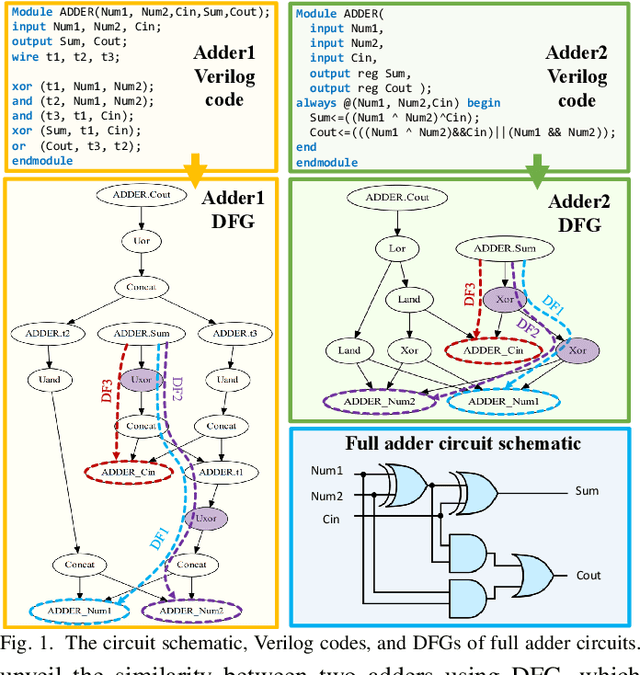
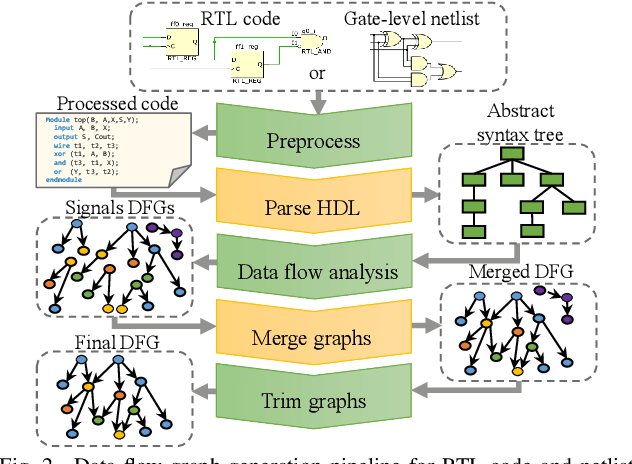
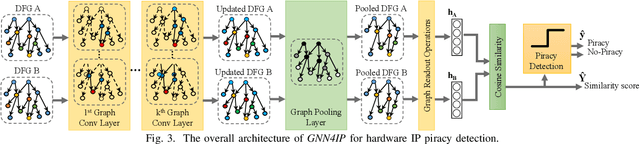
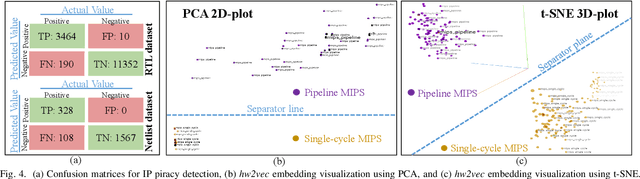
Aggressive time-to-market constraints and enormous hardware design and fabrication costs have pushed the semiconductor industry toward hardware Intellectual Properties (IP) core design. However, the globalization of the integrated circuits (IC) supply chain exposes IP providers to theft and illegal redistribution of IPs. Watermarking and fingerprinting are proposed to detect IP piracy. Nevertheless, they come with additional hardware overhead and cannot guarantee IP security as advanced attacks are reported to remove the watermark, forge, or bypass it. In this work, we propose a novel methodology, GNN4IP, to assess similarities between circuits and detect IP piracy. We model the hardware design as a graph and construct a graph neural network model to learn its behavior using the comprehensive dataset of register transfer level codes and gate-level netlists that we have gathered. GNN4IP detects IP piracy with 96% accuracy in our dataset and recognizes the original IP in its obfuscated version with 100% accuracy.