 Add to Chrome
 Add to Firefox
 Add to Edge
BDI-Kit Demo: A Toolkit for Programmable and Conversational Data Harmonization
Apr 07, 2026
Data harmonization remains a major bottleneck for integrative analysis due to heterogeneity in schemas, value representations, and domain-specific conventions. BDI-Kit provides an extensible toolkit for schema and value matching. It exposes two complementary interfaces tailored to different user needs: a Python API enabling developers to construct harmonization pipelines programmatically, and an AI-assisted chat interface allowing domain experts to harmonize data through natural language dialogue. This demonstration showcases how users interact with BDI-Kit to iteratively explore, validate, and refine schema and value matches through a combination of automated matching, AI-assisted reasoning, and user-driven refinement. We present two scenarios: (i) using the Python API to programmatically compose primitives, examine intermediate outputs, and reuse transformations; and (ii) conversing with the AI assistant in natural language to access BDI-Kit's capabilities and iteratively refine outputs based on the assistant's suggestions.

Interactive Data Harmonization with LLM Agents
Feb 10, 2025
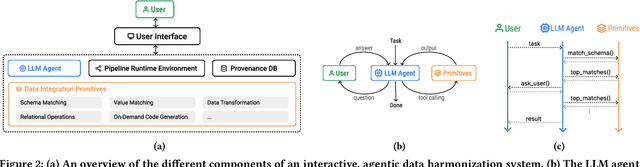
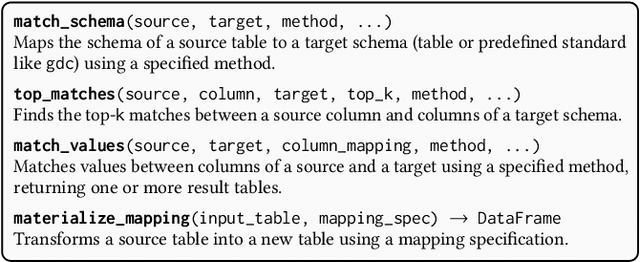
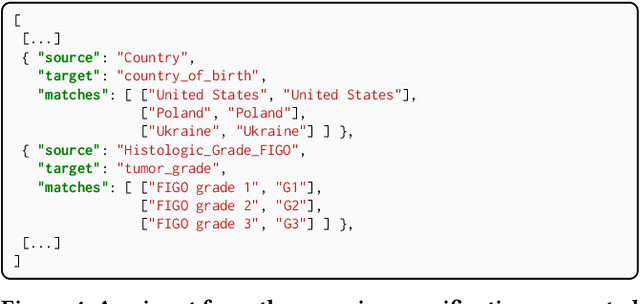
Data harmonization is an essential task that entails integrating datasets from diverse sources. Despite years of research in this area, it remains a time-consuming and challenging task due to schema mismatches, varying terminologies, and differences in data collection methodologies. This paper presents the case for agentic data harmonization as a means to both empower experts to harmonize their data and to streamline the process. We introduce Harmonia, a system that combines LLM-based reasoning, an interactive user interface, and a library of data harmonization primitives to automate the synthesis of data harmonization pipelines. We demonstrate Harmonia in a clinical data harmonization scenario, where it helps to interactively create reusable pipelines that map datasets to a standard format. Finally, we discuss challenges and open problems, and suggest research directions for advancing our vision.