 Add to Chrome
 Add to Firefox
 Add to Edge
From Uncertainty to Determinism: Coarse-to-Fine Visual Floorplan Localization without Ray Matching
Jul 29, 2026
Visual Floorplan Localization (FLoc) has emerged as a promising solution for indoor localization by matching egocentric images against minimalist structural maps. However, due to cross-modal information asymmetry and repetitive indoor layouts, visual FLoc is fundamentally challenged by multimodal pose distributions, where visually identical observations map to distinct, spatially separated locations. Existing ray-matching-based methods tackle this by explicitly predicting sparse geometric or semantic rays, which inherently incur information loss and demand resource-intensive preprocessing alongside exhaustive matching during inference. In this paper, we bypass the intermediate ray-matching paradigm and propose a coarse-to-fine visual FLoc framework that progresses from uncertainty to determinism. In the coarse stage, we design an image-conditioned pose diffusion model to parameterize the continuous multimodal pose distribution, effectively routing stochastically initialized pose particles toward distinct candidate modes. In the refinement stage, we propose a localized refiner that predicts bounded sub-meter pose residuals from candidate-centered floorplan crops, where structural ambiguities are largely eliminated. Our method effectively balances global multi-hypothesis tracking and local sub-meter refinement without requiring any offline map preprocessing or test-time lookup tables. Comprehensive results on the S3D (full) and ZInD benchmarks demonstrate that our approach achieves state-of-the-art accuracy and robustness.

Super-resolution based generative adversarial network using visual perceptual loss function
Apr 24, 2019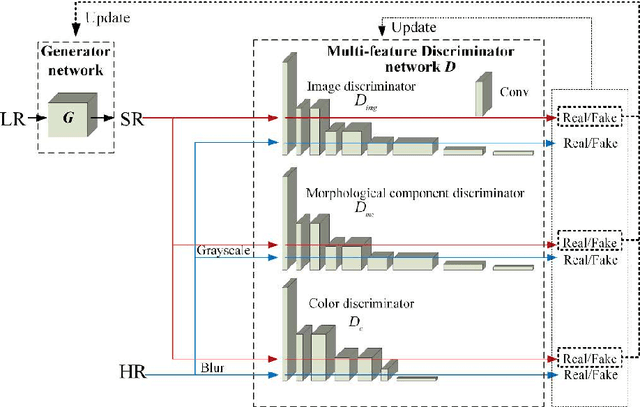
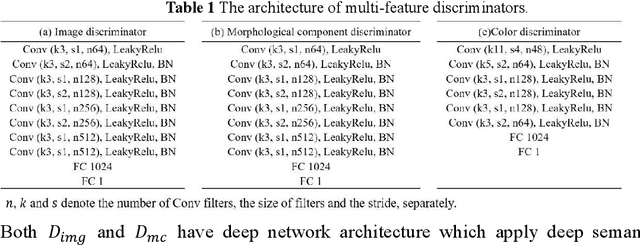
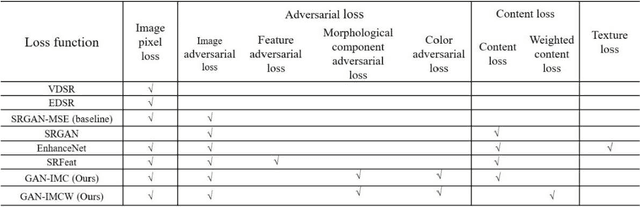
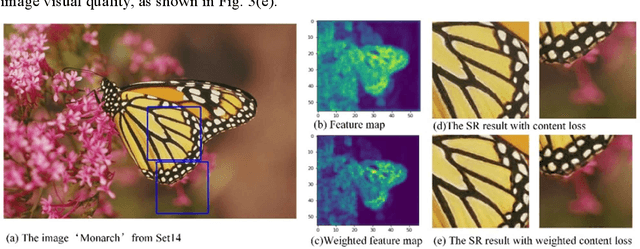
In recent years, perceptual-quality driven super-resolution methods show satisfactory results. However, super-resolved images have uncertain texture details and unpleasant artifact. We build a novel perceptual loss function composed of morphological components adversarial loss and color adversarial loss and salient content loss to ameliorate these problems. The adversarial loss is applied to constrain color and morphological components distribution of super-resolved images and the salient content loss highlights the perceptual similarity of feature-rich regions. Experiments show that proposed method achieves significant improvements in terms of perceptual index and visual quality compared with the state-of-the-art methods.