 Add to Chrome
 Add to Firefox
 Add to Edge
Model-Based Learning for Network Clock Synchronization in Half-Duplex TDMA Networks
Jun 21, 2024
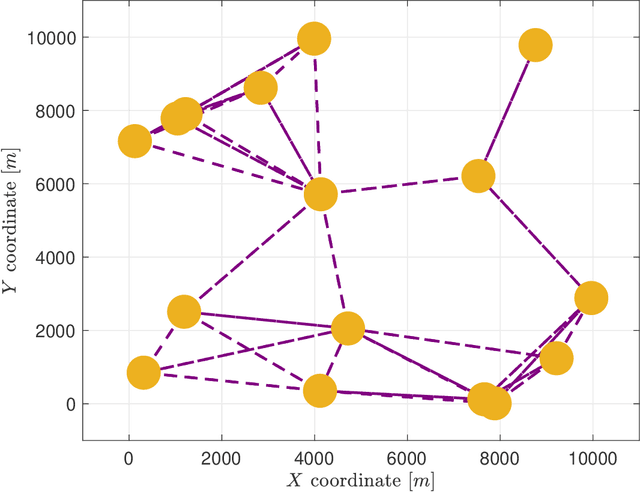
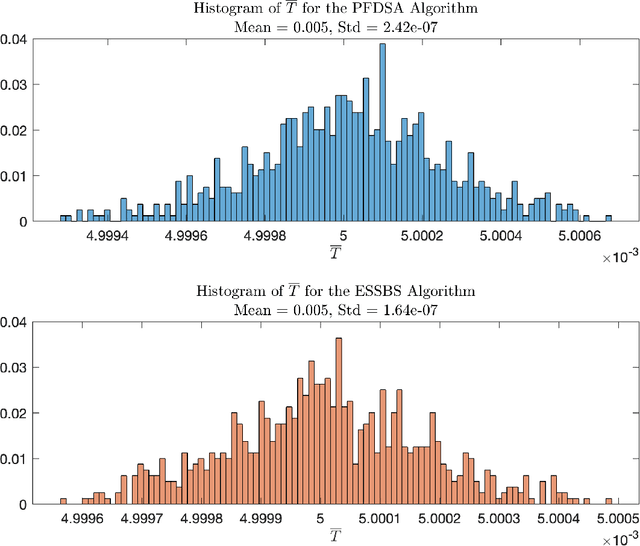
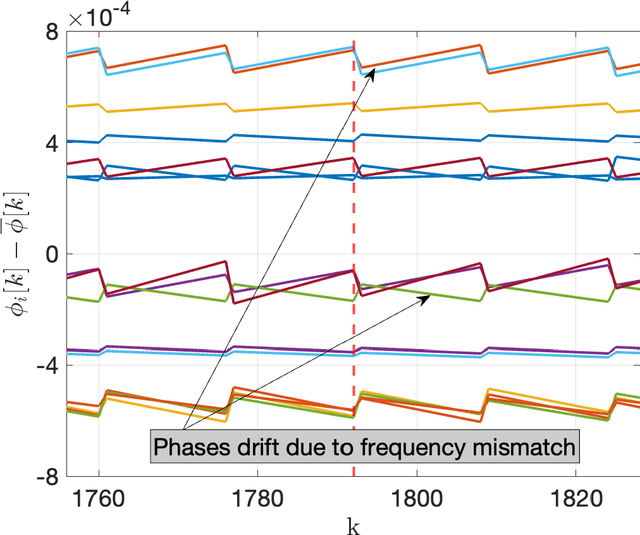
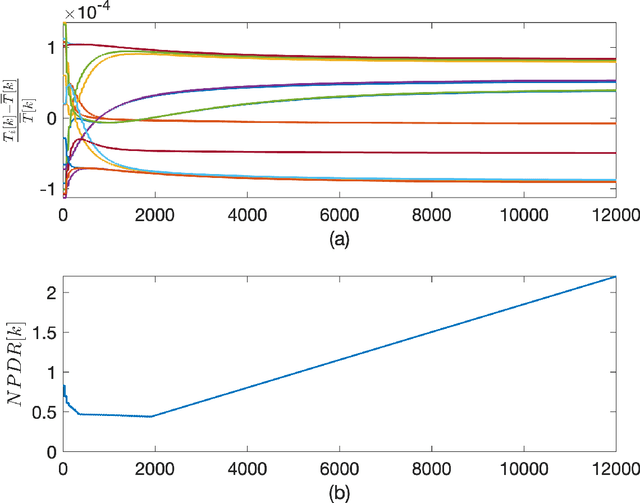
Supporting increasingly higher rates in wireless networks requires highly accurate clock synchronization across the nodes. Motivated by this need, in this work we consider distributed clock synchronization for half-duplex (HD) TDMA wireless networks. We focus on pulse-coupling (PC)-based synchronization as it is practically advantageous for high-speed networks using low-power nodes. Previous works on PC-based synchronization for TDMA networks assumed full-duplex communications, and focused on correcting the clock phase at each node, without synchronizing clocks' frequencies. However, as in the HD regime corrections are temporally sparse, uncompensated clock frequency differences between the nodes result in large phase drifts between updates. Moreover, as the clocks determine the processing rates at the nodes, leaving the clocks' frequencies unsynchronized results in processing rates mismatch between the nodes, leading to a throughput reduction. Our goal in this work is to synchronize both clock frequency and clock phase across the clocks in HD TDMA networks, via distributed processing. The key challenges are the coupling between frequency correction and phase correction, and the lack of a computationally efficient analytical framework for determining the optimal correction signal at the nodes. We address these challenges via a DNN-aided nested loop structure in which the DNN are used for generating the weights applied to the loop input for computing the correction signal. This loop is operated in a sequential manner which decouples frequency and phase compensations, thereby facilitating synchronization of both parameters. Performance evaluation shows that the proposed scheme significantly improves synchronization accuracy compared to the conventional approaches.

Deep-Learning-Aided Distributed Clock Synchronization for Wireless Networks
Jun 24, 2022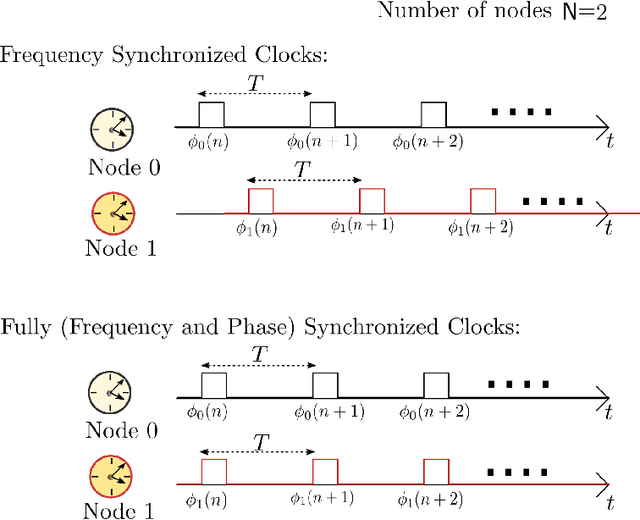
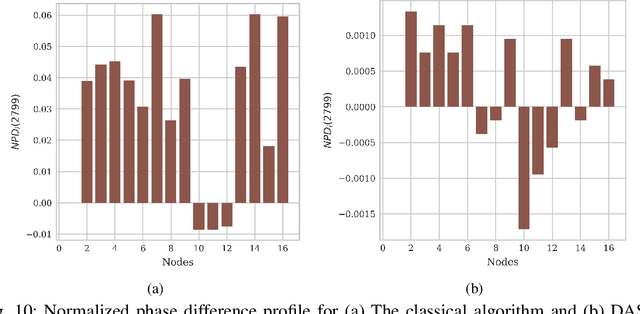
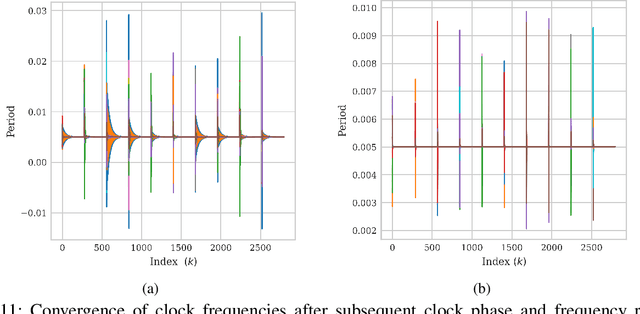
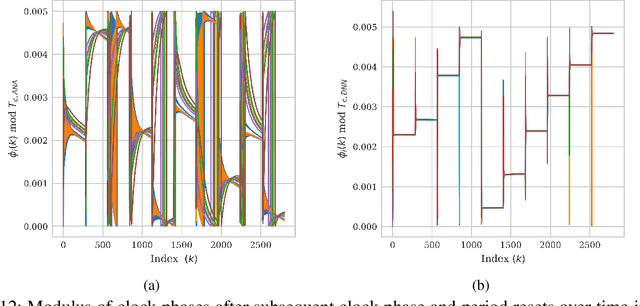
The proliferation of wireless communications networks over the past decades, combined with the scarcity of the wireless spectrum, have motivated a significant effort towards increasing the throughput of wireless networks. One of the major factors which limits the throughput in wireless communications networks is the accuracy of the time synchronization between the nodes in the network, as a higher throughput requires higher synchronization accuracy. Existing time synchronization schemes, and particularly, methods based on pulse-coupled oscillators (PCOs), which are the focus of the current work, have the advantage of simple implementation and achieve high accuracy when the nodes are closely located, yet tend to achieve poor synchronization performance for distant nodes. In this study, we propose a robust PCO-based time synchronization algorithm which retains the simple structure of existing approaches while operating reliably and converging quickly for both distant and closely located nodes. This is achieved by augmenting PCO-based synchronization with deep learning tools that are trainable in a distributed manner, thus allowing the nodes to train their neural network component of the synchronization algorithm without requiring additional exchange of information or central coordination. The numerical results show that our proposed deep learning-aided scheme is notably robust to propagation delays resulting from deployments over large areas, and to relative clock frequency offsets. It is also shown that the proposed approach rapidly attains full (i.e., clock frequency and phase) synchronization for all nodes in the wireless network, while the classic model-based implementation does not.
Deep Reinforcement Learning for Simultaneous Sensing and Channel Access in Cognitive Networks
Oct 24, 2021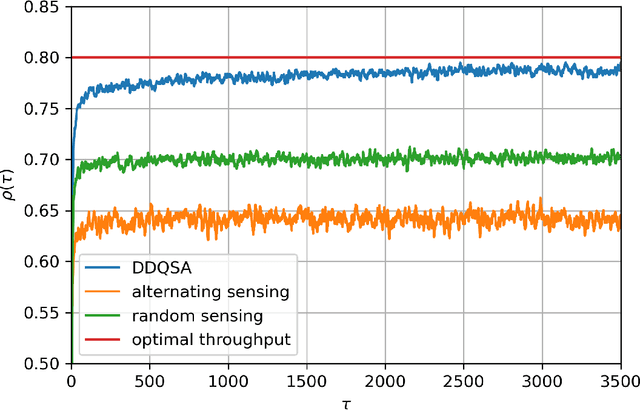
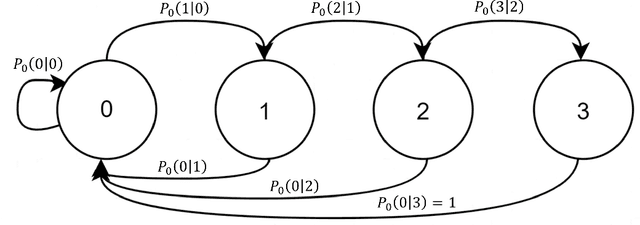
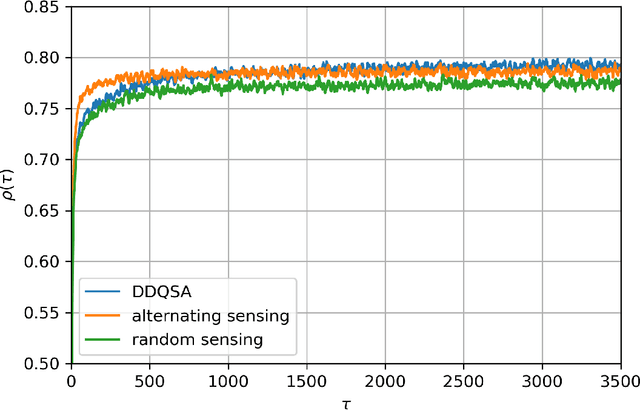
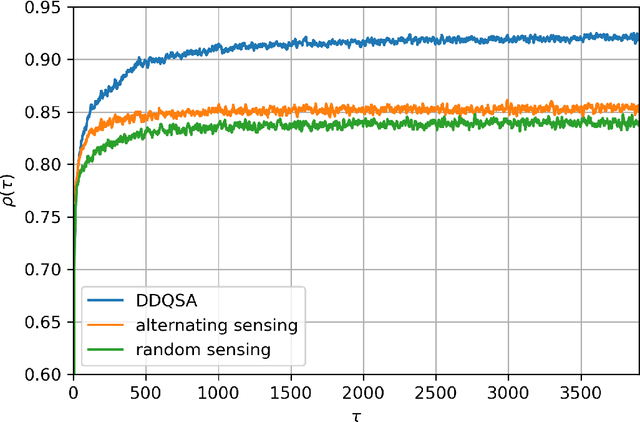
We consider the problem of dynamic spectrum access (DSA) in cognitive wireless networks, where only partial observations are available to the users due to narrowband sensing and transmissions. The cognitive network consists of primary users (PUs) and a secondary user (SU), which operate in a time duplexing regime. The traffic pattern for each PU is assumed to be unknown to the SU and is modeled as a finite-memory Markov chain. Since observations are partial, then both channel sensing and access actions affect the throughput. The objective is to maximize the SU's long-term throughput. To achieve this goal, we develop a novel algorithm that learns both access and sensing policies via deep Q-learning, dubbed Double Deep Q-network for Sensing and Access (DDQSA). To the best of our knowledge, this is the first paper that solves both sensing and access policies for DSA via deep Q-learning. Second, we analyze the optimal policy theoretically to validate the performance of DDQSA. Although the general DSA problem is P-SPACE hard, we derive the optimal policy explicitly for a common model of a cyclic user dynamics. Our results show that DDQSA learns a policy that implements both sensing and channel access, and significantly outperforms existing approaches.