 Add to Chrome
 Add to Firefox
 Add to Edge
Interpretable machine learning of halo gas density profiles: a sensitivity analysis of cosmological hydrodynamical simulations
Dec 12, 2025
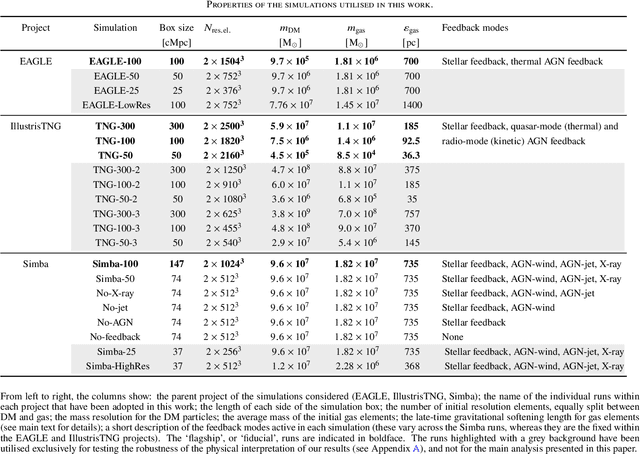
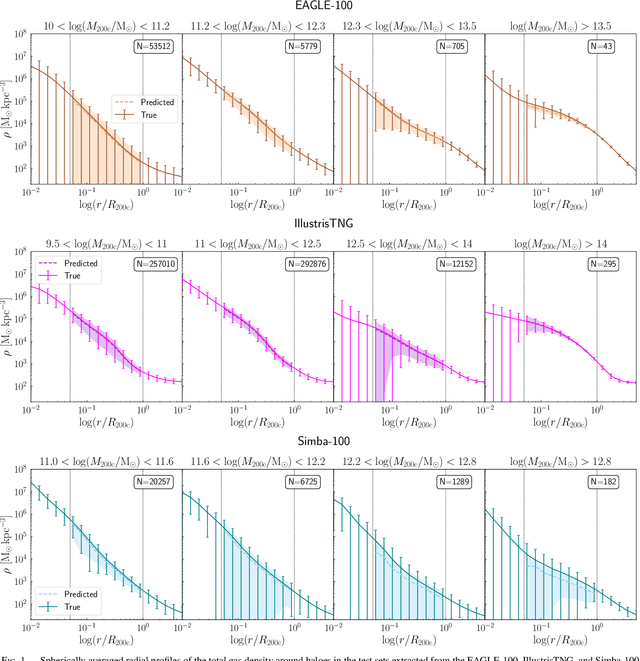
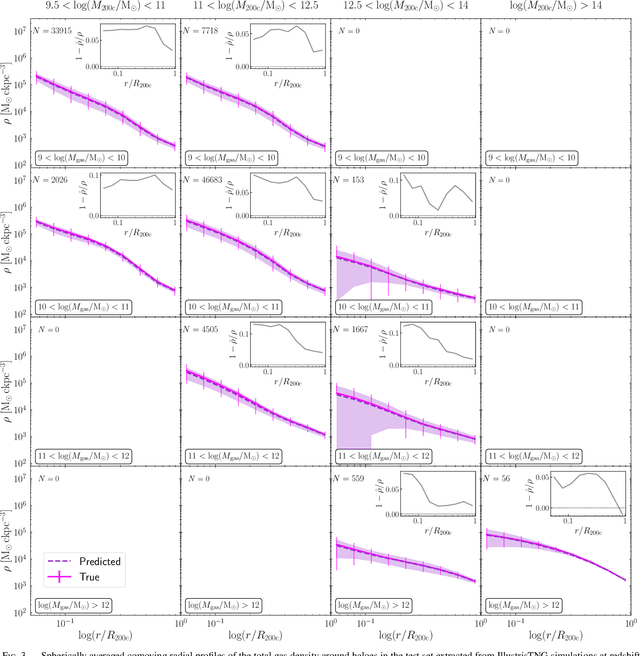
Stellar and AGN-driven feedback processes affect the distribution of gas on a wide range of scales, from within galaxies well into the intergalactic medium. Yet, it remains unclear how feedback, through its connection to key galaxy properties, shapes the radial gas density profile in the host halo. We tackle this question using suites of the EAGLE, IllustrisTNG, and Simba cosmological hydrodynamical simulations, which span a variety of feedback models. We develop a random forest algorithm that predicts the radial gas density profile within haloes from the total halo mass and five global properties of the central galaxy: gas and stellar mass; star formation rate; mass and accretion rate of the central black hole (BH). The algorithm reproduces the simulated gas density profiles with an average accuracy of $\sim$80-90% over the halo mass range $10^{9.5} \, \mathrm{M}_{\odot} < M_{\rm 200c} < 10^{15} \, \mathrm{M}_{\odot}$ and redshift interval $0<z<4$. For the first time, we apply Sobol statistical sensitivity analysis to full cosmological hydrodynamical simulations, quantifying how each feature affects the gas density as a function of distance from the halo centre. Across all simulations and redshifts, the total halo mass and the gas mass of the central galaxy are the most strongly tied to the halo gas distribution, while stellar and BH properties are generally less informative. The exact relative importance of the different features depends on the feedback scenario and redshift. Our framework can be readily embedded in semi-analytic models of galaxy formation to incorporate halo gas density profiles consistent with different hydrodynamical simulations. Our work also provides a proof of concept for constraining feedback models with future observations of galaxy properties and of the surrounding gas distribution.

Hybrid analytic and machine-learned baryonic property insertion into galactic dark matter haloes
Dec 10, 2020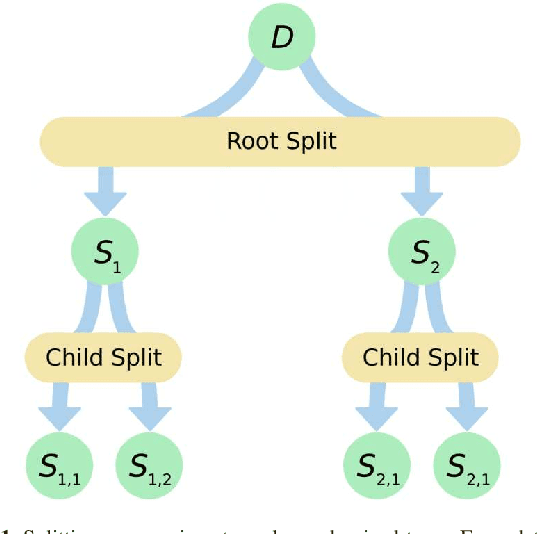
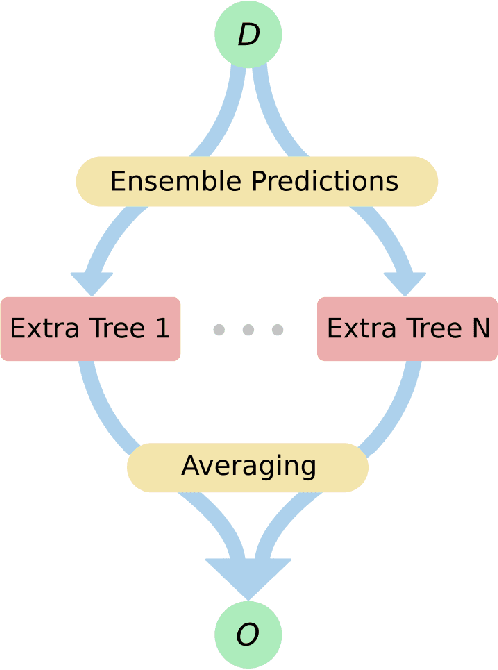
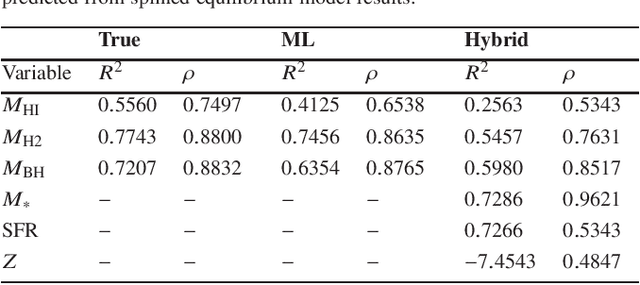
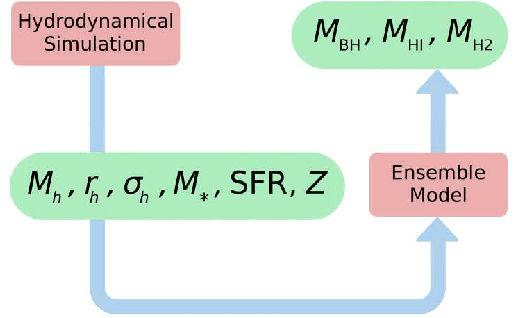
While cosmological dark matter-only simulations relying solely on gravitational effects are comparably fast to compute, baryonic properties in simulated galaxies require complex hydrodynamic simulations that are computationally costly to run. We explore the merging of an extended version of the equilibrium model, an analytic formalism describing the evolution of the stellar, gas, and metal content of galaxies, into a machine learning framework. In doing so, we are able to recover more properties than the analytic formalism alone can provide, creating a high-speed hydrodynamic simulation emulator that populates galactic dark matter haloes in N-body simulations with baryonic properties. While there exists a trade-off between the reached accuracy and the speed advantage this approach offers, our results outperform an approach using only machine learning for a subset of baryonic properties. We demonstrate that this novel hybrid system enables the fast completion of dark matter-only information by mimicking the properties of a full hydrodynamic suite to a reasonable degree, and discuss the advantages and disadvantages of hybrid versus machine learning-only frameworks. In doing so, we offer an acceleration of commonly deployed simulations in cosmology.