 Add to Chrome
 Add to Firefox
 Add to Edge
NAVIRA: Decoupled Stochastic Remasking for Masked Diffusion Language Models
Jun 04, 2026
Masked diffusion language models generate text by iteratively unmasking many tokens in parallel, but this speed comes with a correction problem: tokens generated in the same step are predicted from marginal distributions, and early local dependency errors can later contaminate the context. PRISM addresses this by learning token-level quality scores and remasking unreliable tokens, but its inference rule is coupled: the same forward pass both detects low-quality tokens and computes logits for their replacements, so the erroneous tokens still condition regeneration. We propose NAVIRA, an inference-time decoding policy that separates these two operations and samples remasking positions stochastically. A first forward pass scores tokens; selected tokens are masked; a second forward pass regenerates from the cleaned context. Temperature-controlled remasking reduces repeated correction of the same positions and balances fluency against diversity. In controlled experiments with a 170M masked diffusion language model, decoupling improves fluency, while scheduled stochastic remasking preserves entropy and achieves stronger LLM-judge scores under larger forward-pass budgets. These results show that remasking policy, not only the learned quality signal, is central to reliable masked-diffusion text generation.

Soft Sequence Policy Optimization
Feb 26, 2026A significant portion of recent research on Large Language Model (LLM) alignment focuses on developing new policy optimization methods based on Group Relative Policy Optimization (GRPO). Two prominent directions have emerged: (i) a shift toward sequence-level importance sampling weights that better align with the sequence-level rewards used in many tasks, and (ii) alternatives to PPO-style clipping that aim to avoid the associated loss of training signal and entropy collapse. We introduce Soft Sequence Policy Optimization, an off-policy reinforcement learning objective that incorporates soft gating functions over token-level probability ratios within sequence-level importance weights. We provide theoretical motivation for SSPO and investigate practical modifications to improve optimization behavior. Empirically, we show that SSPO improves training stability and performance in mathematical reasoning tasks.
Smooth Gate Functions for Soft Advantage Policy Optimization
Feb 22, 2026Group Relative Policy Optimization (GRPO) has significantly advanced the training of large language models and enhanced their reasoning capabilities, while it remains susceptible to instability due to the use of hard clipping. Soft Adaptive Policy Optimization (SAPO) addresses this limitation by replacing clipping with a smooth sigmoid-based gate function, which leads to more stable updates. We have decided to push this theory further and investigate the impact of different gate functions on both training stability and final model performance. We formalize the key properties that admissible gates should satisfy and identify several families of such functions for empirical evaluation. This paper presents an analysis of our findings based on experiments conducted with the Qwen2.5-7B-Instruct model on mathematical reasoning tasks. These results provide practical guidance for designing smoother and more robust policy optimization objectives for large language model training.
Reinforcement Networks: novel framework for collaborative Multi-Agent Reinforcement Learning tasks
Dec 28, 2025Modern AI systems often comprise multiple learnable components that can be naturally organized as graphs. A central challenge is the end-to-end training of such systems without restrictive architectural or training assumptions. Such tasks fit the theory and approaches of the collaborative Multi-Agent Reinforcement Learning (MARL) field. We introduce Reinforcement Networks, a general framework for MARL that organizes agents as vertices in a directed acyclic graph (DAG). This structure extends hierarchical RL to arbitrary DAGs, enabling flexible credit assignment and scalable coordination while avoiding strict topologies, fully centralized training, and other limitations of current approaches. We formalize training and inference methods for the Reinforcement Networks framework and connect it to the LevelEnv concept to support reproducible construction, training, and evaluation. We demonstrate the effectiveness of our approach on several collaborative MARL setups by developing several Reinforcement Networks models that achieve improved performance over standard MARL baselines. Beyond empirical gains, Reinforcement Networks unify hierarchical, modular, and graph-structured views of MARL, opening a principled path toward designing and training complex multi-agent systems. We conclude with theoretical and practical directions - richer graph morphologies, compositional curricula, and graph-aware exploration. That positions Reinforcement Networks as a foundation for a new line of research in scalable, structured MARL.
Topic Modelling Black Box Optimization
Dec 18, 2025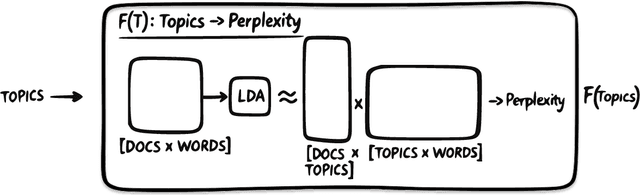
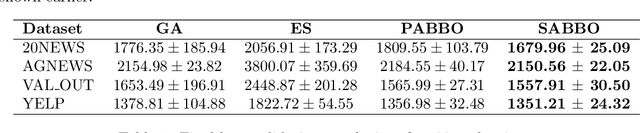
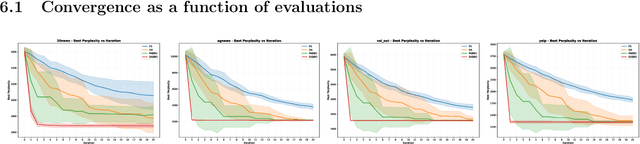

Choosing the number of topics $T$ in Latent Dirichlet Allocation (LDA) is a key design decision that strongly affects both the statistical fit and interpretability of topic models. In this work, we formulate the selection of $T$ as a discrete black-box optimization problem, where each function evaluation corresponds to training an LDA model and measuring its validation perplexity. Under a fixed evaluation budget, we compare four families of optimizers: two hand-designed evolutionary methods - Genetic Algorithm (GA) and Evolution Strategy (ES) - and two learned, amortized approaches, Preferential Amortized Black-Box Optimization (PABBO) and Sharpness-Aware Black-Box Optimization (SABBO). Our experiments show that, while GA, ES, PABBO, and SABBO eventually reach a similar band of final perplexity, the amortized optimizers are substantially more sample- and time-efficient. SABBO typically identifies a near-optimal topic number after essentially a single evaluation, and PABBO finds competitive configurations within a few evaluations, whereas GA and ES require almost the full budget to approach the same region.