 Add to Chrome
 Add to Firefox
 Add to Edge
Local MixVR: Breaking the Communication-Sample Dependence in Distributed Learning
May 31, 2026
Communication overhead is a crucial bottleneck in scalable distributed learning. While existing methods aim to efficiently utilize data points, such as Local SGD, Minibatch SGD, and their accelerated variants, they still exhibit communication-round complexity that scales with the total number of samples $N$. In this paper, we introduce Local MixVR, a distributed framework that integrates local updates with variance-reduction techniques to mitigate local noise. We show that Local MixVR is the first distributed method to eliminate the dependence of communication complexity on $N$, achieving a complexity that scales only with the number of workers $M$. In common regimes where $M<O\left(N^{1/4}\right)$, Local MixVR outperforms the state-of-the-art Minibatch Accelerated SGD baseline, bridging a long-standing gap in distributed optimization and establishing a new paradigm for communication-efficient training.

Bringing Order to Asynchronous SGD: Towards Optimality under Data-Dependent Delays with Momentum
May 03, 2026Asynchronous stochastic gradient descent (SGD) enables scalable distributed training but suffers from gradient staleness. Existing mitigation strategies, such as delay-adaptive learning rates and staleness-aware filtering, typically attenuate or discard delayed gradients, introducing systematic bias: updates from simpler or faster-to-process samples are overrepresented, while gradients from more complex samples are delayed or suppressed. In contrast, prior approaches to data-dependent delays rely on a Lipschitz assumption that yields suboptimal rates or leave the smooth, convex case unaddressed. We propose a momentum-based asynchronous framework designed to preserve information from delayed gradients while mitigating the effects of staleness. We establish the first optimal convergence rates for data-dependent delays in both convex and non-convex smooth setups, providing a new result for asynchronous optimization under standard assumptions. Additionally, we derive robust learning-rate schedules that simplify hyperparameter tuning in practice.
Private and Federated Stochastic Convex Optimization: Efficient Strategies for Centralized Systems
Jul 17, 2024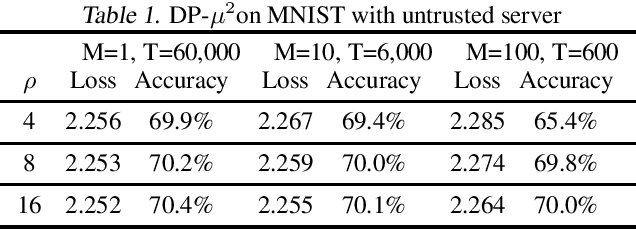
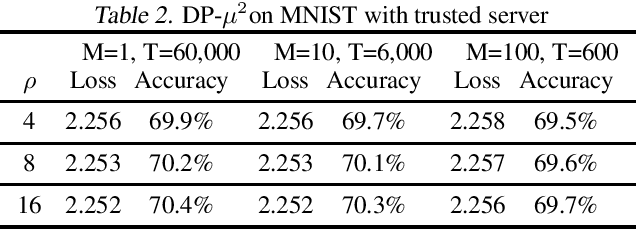
This paper addresses the challenge of preserving privacy in Federated Learning (FL) within centralized systems, focusing on both trusted and untrusted server scenarios. We analyze this setting within the Stochastic Convex Optimization (SCO) framework, and devise methods that ensure Differential Privacy (DP) while maintaining optimal convergence rates for homogeneous and heterogeneous data distributions. Our approach, based on a recent stochastic optimization technique, offers linear computational complexity, comparable to non-private FL methods, and reduced gradient obfuscation. This work enhances the practicality of DP in FL, balancing privacy, efficiency, and robustness in a variety of server trust environment.
Verification of Neural Networks Local Differential Classification Privacy
Oct 31, 2023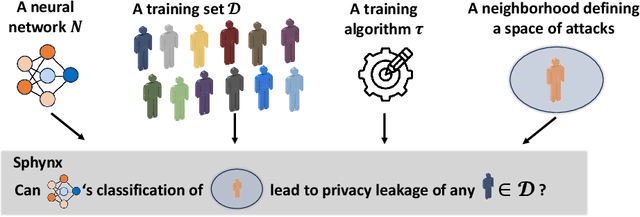
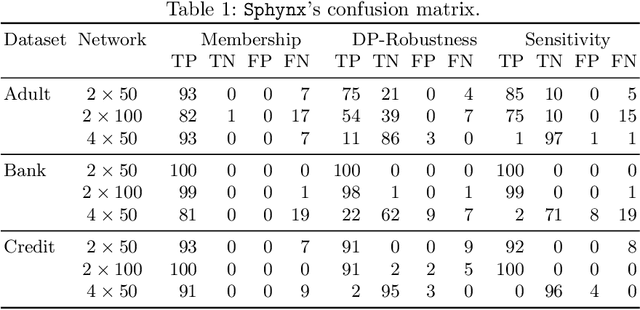
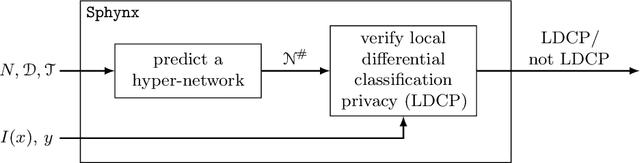
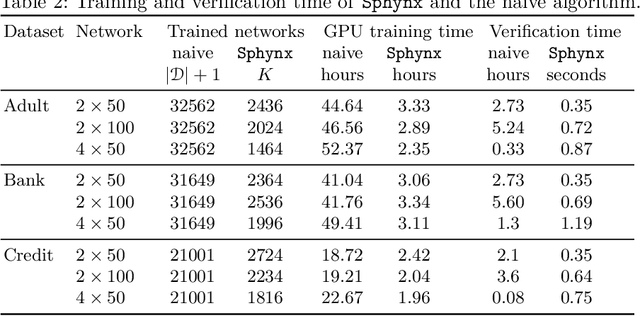
Neural networks are susceptible to privacy attacks. To date, no verifier can reason about the privacy of individuals participating in the training set. We propose a new privacy property, called local differential classification privacy (LDCP), extending local robustness to a differential privacy setting suitable for black-box classifiers. Given a neighborhood of inputs, a classifier is LDCP if it classifies all inputs the same regardless of whether it is trained with the full dataset or whether any single entry is omitted. A naive algorithm is highly impractical because it involves training a very large number of networks and verifying local robustness of the given neighborhood separately for every network. We propose Sphynx, an algorithm that computes an abstraction of all networks, with a high probability, from a small set of networks, and verifies LDCP directly on the abstract network. The challenge is twofold: network parameters do not adhere to a known distribution probability, making it difficult to predict an abstraction, and predicting too large abstraction harms the verification. Our key idea is to transform the parameters into a distribution given by KDE, allowing to keep the over-approximation error small. To verify LDCP, we extend a MILP verifier to analyze an abstract network. Experimental results show that by training only 7% of the networks, Sphynx predicts an abstract network obtaining 93% verification accuracy and reducing the analysis time by $1.7\cdot10^4$x.