 Add to Chrome
 Add to Firefox
 Add to Edge
Refine and Align: Confidence Calibration through Multi-Agent Interaction in VQA
Nov 14, 2025
In the context of Visual Question Answering (VQA) and Agentic AI, calibration refers to how closely an AI system's confidence in its answers reflects their actual correctness. This aspect becomes especially important when such systems operate autonomously and must make decisions under visual uncertainty. While modern VQA systems, powered by advanced vision-language models (VLMs), are increasingly used in high-stakes domains like medical diagnostics and autonomous navigation due to their improved accuracy, the reliability of their confidence estimates remains under-examined. Particularly, these systems often produce overconfident responses. To address this, we introduce AlignVQA, a debate-based multi-agent framework, in which diverse specialized VLM -- each following distinct prompting strategies -- generate candidate answers and then engage in two-stage interaction: generalist agents critique, refine and aggregate these proposals. This debate process yields confidence estimates that more accurately reflect the model's true predictive performance. We find that more calibrated specialized agents produce better aligned confidences. Furthermore, we introduce a novel differentiable calibration-aware loss function called aligncal designed to fine-tune the specialized agents by minimizing an upper bound on the calibration error. This objective explicitly improves the fidelity of each agent's confidence estimates. Empirical results across multiple benchmark VQA datasets substantiate the efficacy of our approach, demonstrating substantial reductions in calibration discrepancies. Furthermore, we propose a novel differentiable calibration-aware loss to fine-tune the specialized agents and improve the quality of their individual confidence estimates based on minimising upper bound calibration error.

Herd Mentality in Augmentation -- Not a Good Idea! A Robust Multi-stage Approach towards Deepfake Detection
Oct 07, 2024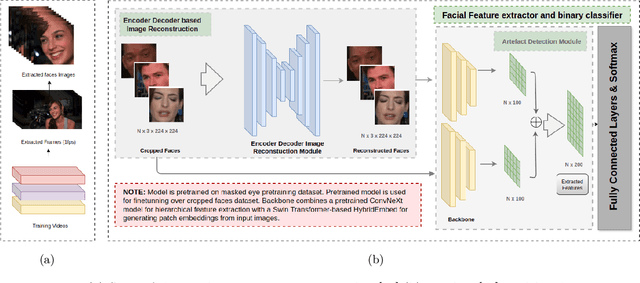
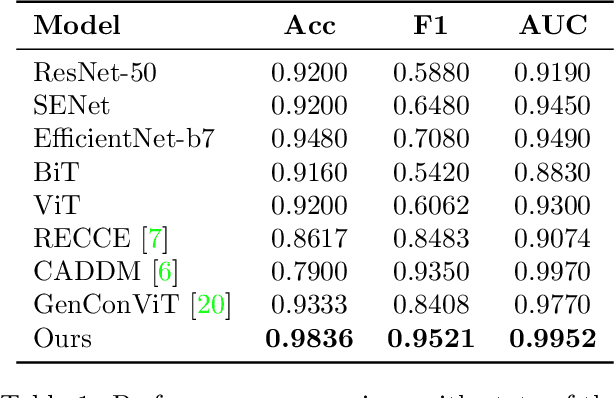
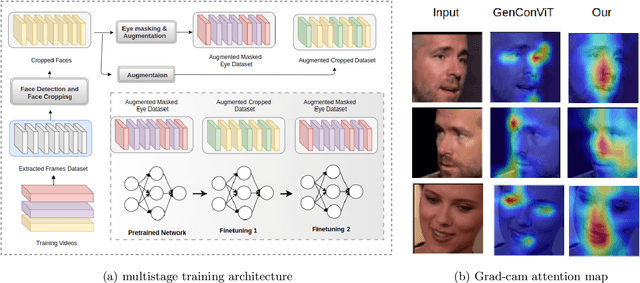
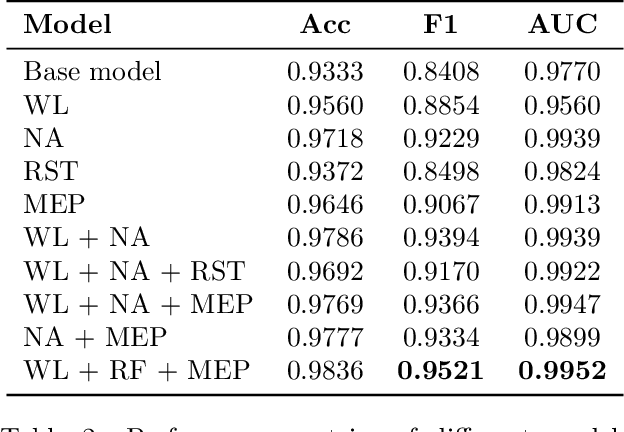
The rapid increase in deepfake technology has raised significant concerns about digital media integrity. Detecting deepfakes is crucial for safeguarding digital media. However, most standard image classifiers fail to distinguish between fake and real faces. Our analysis reveals that this failure is due to the model's inability to explicitly focus on the artefacts typically in deepfakes. We propose an enhanced architecture based on the GenConViT model, which incorporates weighted loss and update augmentation techniques and includes masked eye pretraining. This proposed model improves the F1 score by 1.71% and the accuracy by 4.34% on the Celeb-DF v2 dataset. The source code for our model is available at https://github.com/Monu-Khicher-1/multi-stage-learning