 Add to Chrome
 Add to Firefox
 Add to Edge
QSMP: finding representative time series subsequences through Quick Shift+Matrix Profile
Aug 16, 2026
Finding representative waveforms in long time series has scientific and practical value in many domains, as it enables summarization and visualization of large time series datasets, and downstream tasks like classification and forecasting. We present here QSMP, a method to find representative waveforms in long time series through a density-guided clustering of time series subsequences. Our method makes a novel connection between Quick Shift, a mode-seeking algorithm, and the Matrix Profile, a time series similarity-search data structure, to adapt Quick Shift to the clustering of subsequences in long time series, with a space complexity that is superior to the state-of-the-art method. Our experiments on synthetic and real datasets show that QSMP can be a valuable tool to summarize and visualize long time series by finding representative waveforms.

Multidataset Independent Subspace Analysis with Application to Multimodal Fusion
Nov 11, 2019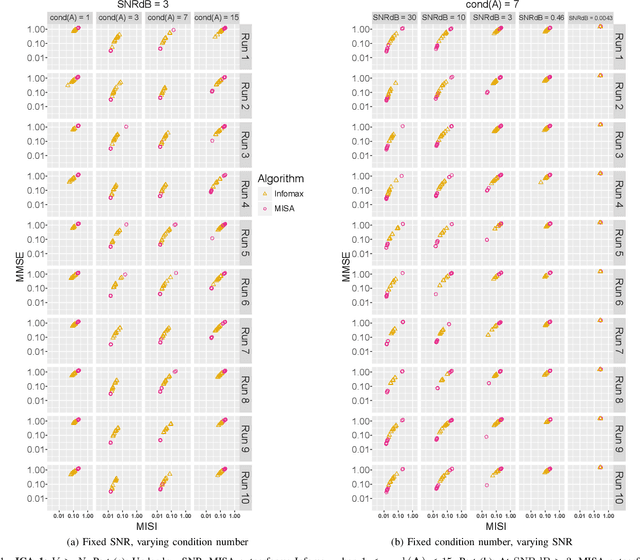
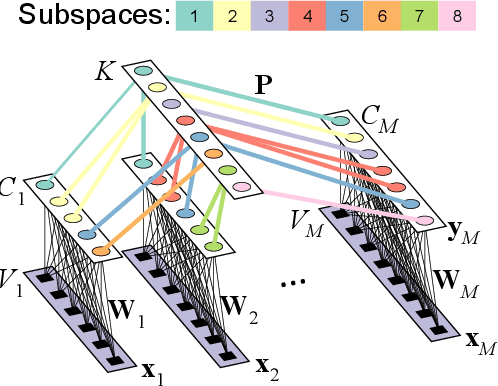
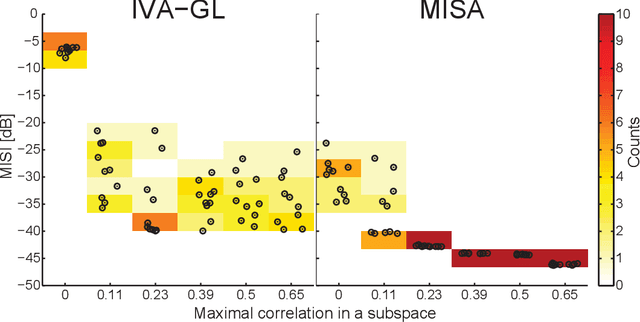
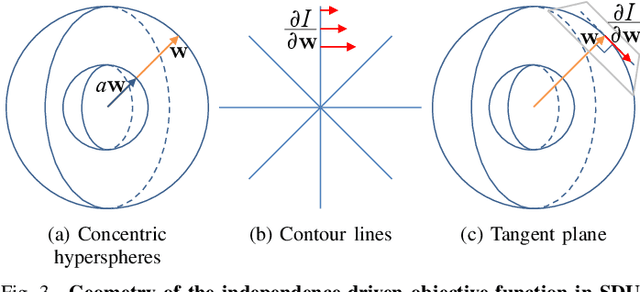
In the last two decades, unsupervised latent variable models---blind source separation (BSS) especially---have enjoyed a strong reputation for the interpretable features they produce. Seldom do these models combine the rich diversity of information available in multiple datasets. Multidatasets, on the other hand, yield joint solutions otherwise unavailable in isolation, with a potential for pivotal insights into complex systems. To take advantage of the complex multidimensional subspace structures that capture underlying modes of shared and unique variability across and within datasets, we present a direct, principled approach to multidataset combination. We design a new method called multidataset independent subspace analysis (MISA) that leverages joint information from multiple heterogeneous datasets in a flexible and synergistic fashion. Methodological innovations exploiting the Kotz distribution for subspace modeling in conjunction with a novel combinatorial optimization for evasion of local minima enable MISA to produce a robust generalization of independent component analysis (ICA), independent vector analysis (IVA), and independent subspace analysis (ISA) in a single unified model. We highlight the utility of MISA for multimodal information fusion, including sample-poor regimes and low signal-to-noise ratio scenarios, promoting novel applications in both unimodal and multimodal brain imaging data.