 Add to Chrome
 Add to Firefox
 Add to Edge
RadAnnotate: Large Language Models for Efficient and Reliable Radiology Report Annotation
Mar 16, 2026
Radiology report annotation is essential for clinical NLP, yet manual labeling is slow and costly. We present RadAnnotate, an LLM-based framework that studies retrieval-augmented synthetic reports and confidence-based selective automation to reduce expert effort for labeling in RadGraph. We study RadGraph-style entity labeling (graph nodes) and leave relation extraction (edges) to future work. First, we train entity-specific classifiers on gold-standard reports and characterize their strengths and failure modes across anatomy and observation categories, with uncertain observations hardest to learn. Second, we generate RAG-guided synthetic reports and show that synthetic-only models remain within 1-2 F1 points of gold-trained models, and that synthetic augmentation is especially helpful for uncertain observations in a low-resource setting, improving F1 from 0.61 to 0.70. Finally, by learning entity-specific confidence thresholds, RadAnnotate can automatically annotate 55-90% of reports at 0.86-0.92 entity match score while routing low-confidence cases for expert review.

Intelligent Documentation in Medical Education: Can AI Replace Manual Case Logging?
Jan 19, 2026Procedural case logs are a core requirement in radiology training, yet they are time-consuming to complete and prone to inconsistency when authored manually. This study investigates whether large language models (LLMs) can automate procedural case log documentation directly from free-text radiology reports. We evaluate multiple local and commercial LLMs under instruction-based and chain-of-thought prompting to extract structured procedural information from 414 curated interventional radiology reports authored by nine residents between 2018 and 2024. Model performance is assessed using sensitivity, specificity, and F1-score, alongside inference latency and token efficiency to estimate operational cost. Results show that both local and commercial models achieve strong extraction performance, with best F1-scores approaching 0.87, while exhibiting different trade-offs between speed and cost. Automation using LLMs has the potential to substantially reduce clerical burden for trainees and improve consistency in case logging. These findings demonstrate the feasibility of AI-assisted documentation in medical education and highlight the need for further validation across institutions and clinical workflows.
Intelligent Word Embeddings of Free-Text Radiology Reports
Nov 19, 2017
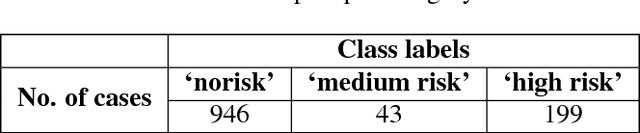
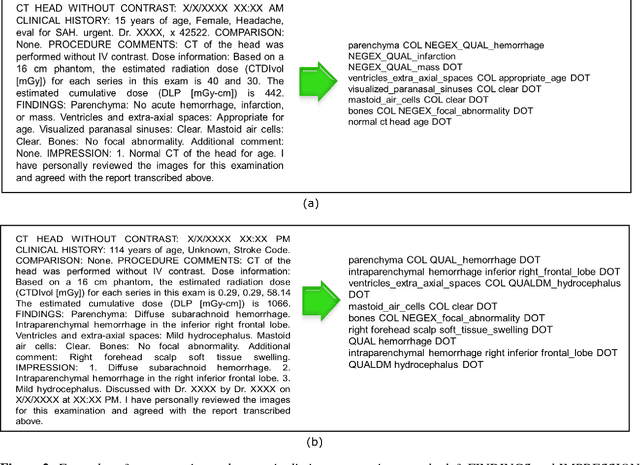
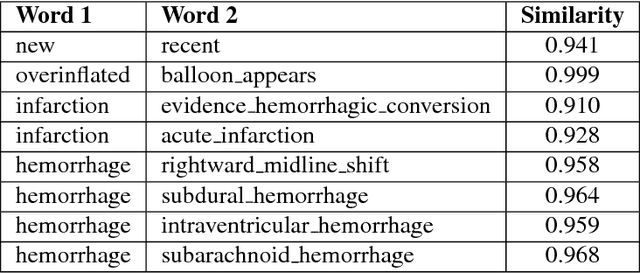
Radiology reports are a rich resource for advancing deep learning applications in medicine by leveraging the large volume of data continuously being updated, integrated, and shared. However, there are significant challenges as well, largely due to the ambiguity and subtlety of natural language. We propose a hybrid strategy that combines semantic-dictionary mapping and word2vec modeling for creating dense vector embeddings of free-text radiology reports. Our method leverages the benefits of both semantic-dictionary mapping as well as unsupervised learning. Using the vector representation, we automatically classify the radiology reports into three classes denoting confidence in the diagnosis of intracranial hemorrhage by the interpreting radiologist. We performed experiments with varying hyperparameter settings of the word embeddings and a range of different classifiers. Best performance achieved was a weighted precision of 88% and weighted recall of 90%. Our work offers the potential to leverage unstructured electronic health record data by allowing direct analysis of narrative clinical notes.