 Add to Chrome
 Add to Firefox
 Add to Edge
Learning to Think from Multiple Thinkers
Apr 27, 2026
We study learning with Chain-of-Thought (CoT) supervision from multiple thinkers, all of whom provide correct but possibly systematically different solutions, e.g., step-by-step solutions to math problems written by different thinkers, or step-by-step execution traces of different programs solving the same problem. We consider classes that are computationally easy to learn using CoT supervision from a single thinker, but hard to learn with only end-result supervision, i.e., without CoT (Joshi et al. 2025). We establish that, under cryptographic assumptions, learning can be hard from CoT supervision provided by two or a few different thinkers, in passive data-collection settings. On the other hand, we provide a generic computationally efficient active learning algorithm that learns with a small amount of CoT data per thinker that is completely independent of the target accuracy $\varepsilon$, a moderate number of thinkers that scales as $\log \frac{1}{\varepsilon}\log \log \frac{1}{\varepsilon}$, and sufficient passive end-result data that scales as $\frac{1}{\varepsilon}\cdot poly\log\frac{1}{\varepsilon}$.

Benign Overfitting in Single-Head Attention
Oct 10, 2024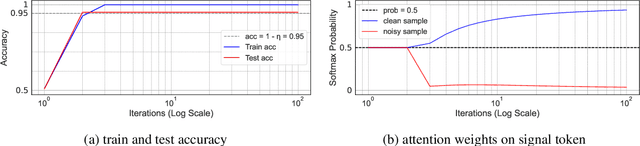
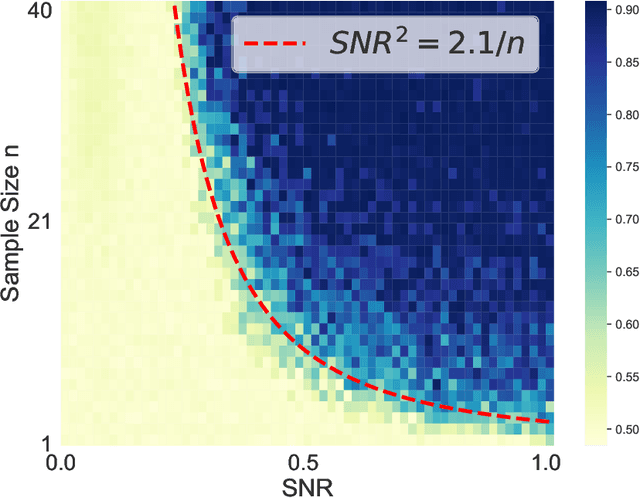
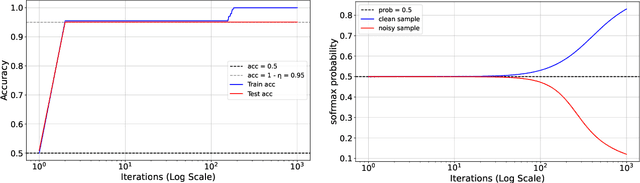
The phenomenon of benign overfitting, where a trained neural network perfectly fits noisy training data but still achieves near-optimal test performance, has been extensively studied in recent years for linear models and fully-connected/convolutional networks. In this work, we study benign overfitting in a single-head softmax attention model, which is the fundamental building block of Transformers. We prove that under appropriate conditions, the model exhibits benign overfitting in a classification setting already after two steps of gradient descent. Moreover, we show conditions where a minimum-norm/maximum-margin interpolator exhibits benign overfitting. We study how the overfitting behavior depends on the signal-to-noise ratio (SNR) of the data distribution, namely, the ratio between norms of signal and noise tokens, and prove that a sufficiently large SNR is both necessary and sufficient for benign overfitting.
Initialization-Dependent Sample Complexity of Linear Predictors and Neural Networks
May 25, 2023We provide several new results on the sample complexity of vector-valued linear predictors (parameterized by a matrix), and more generally neural networks. Focusing on size-independent bounds, where only the Frobenius norm distance of the parameters from some fixed reference matrix $W_0$ is controlled, we show that the sample complexity behavior can be surprisingly different than what we may expect considering the well-studied setting of scalar-valued linear predictors. This also leads to new sample complexity bounds for feed-forward neural networks, tackling some open questions in the literature, and establishing a new convex linear prediction problem that is provably learnable without uniform convergence.