 Add to Chrome
 Add to Firefox
 Add to Edge
Misinformation Span Detection in Videos via Audio Transcripts
Apr 23, 2026
Online misinformation is one of the most challenging issues lately, yielding severe consequences, including political polarization, attacks on democracy, and public health risks. Misinformation manifests in any platform with a large user base, including online social networks and messaging apps. It permeates all media and content forms, including images, text, audio, and video. Distinctly, video-based misinformation represents a multifaceted challenge for fact-checkers, given the ease with which individuals can record and upload videos on various video-sharing platforms. Previous research efforts investigated detecting video-based misinformation, focusing on whether a video shares misinformation or not on a video level. While this approach is useful, it only provides a limited and non-easily interpretable view of the problem given that it does not provide an additional context of when misinformation occurs within videos and what content (i.e., claims) are responsible for the video's misinformation nature. In this work, we attempt to bridge this research gap by creating two novel datasets that allow us to explore misinformation detection on videos via audio transcripts, focusing on identifying the span of videos that are responsible for the video's misinformation claim (misinformation span detection). We present two new datasets for this task. We transcribe each video's audio to text, identifying the video segment in which the misinformation claims appears, resulting in two datasets of more than 500 videos with over 2,400 segments containing annotated fact-checked claims. Then, we employ classifiers built with state-of-the-art language models, and our results show that we can identify in which part of a video there is misinformation with an F1 score of 0.68. We make publicly available our annotated datasets. We also release all transcripts, audio and videos.

On the Reliability of Sampling Strategies in Offline Recommender Evaluation
Aug 07, 2025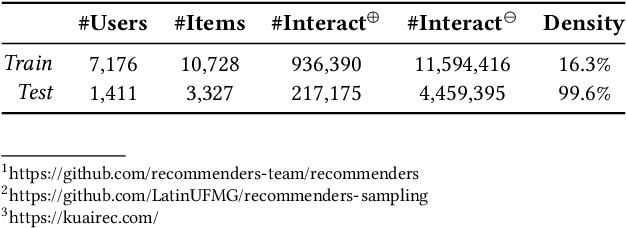
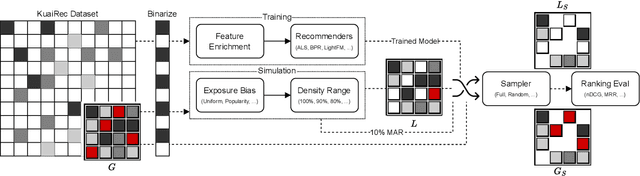
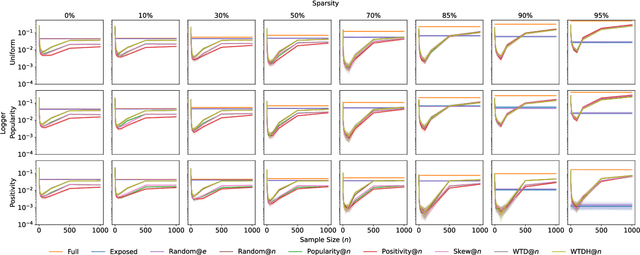
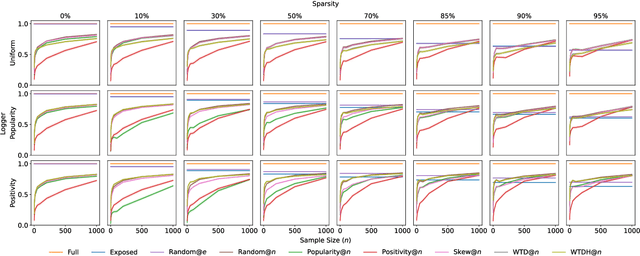
Offline evaluation plays a central role in benchmarking recommender systems when online testing is impractical or risky. However, it is susceptible to two key sources of bias: exposure bias, where users only interact with items they are shown, and sampling bias, introduced when evaluation is performed on a subset of logged items rather than the full catalog. While prior work has proposed methods to mitigate sampling bias, these are typically assessed on fixed logged datasets rather than for their ability to support reliable model comparisons under varying exposure conditions or relative to true user preferences. In this paper, we investigate how different combinations of logging and sampling choices affect the reliability of offline evaluation. Using a fully observed dataset as ground truth, we systematically simulate diverse exposure biases and assess the reliability of common sampling strategies along four dimensions: sampling resolution (recommender model separability), fidelity (agreement with full evaluation), robustness (stability under exposure bias), and predictive power (alignment with ground truth). Our findings highlight when and how sampling distorts evaluation outcomes and offer practical guidance for selecting strategies that yield faithful and robust offline comparisons.