 Add to Chrome
 Add to Firefox
 Add to Edge
Lightweight Neural Networks for Affordance Segmentation: Enhancement of the Decoder Module
Jul 31, 2026
The deployment of deep neural networks for visual affordance segmentation on wearable robots poses may prove critical, due to some conflicting aspects of the problem. On one hand, affordance segmentation requires high-level abstraction capabilities, that typically involve large-size models. On the other hand, computing resources hosted on wearable robots prevent to run large-size models in real-time. The paper presents an analysis of the role of the segmentation head in the trade-off between generalization performance and compute cost. The obtained models outperform modern baseline solutions in well-known, real-world datasets while meeting low computing requirements.

Filling the Pareto-Optimal Front for Affordance Segmentation on Embedded Devices Using RGB-D Cameras
Jul 30, 2026While depth sensors have the potential to complement RGB data for affordance segmentation in wearable robots, their usage seems to remain underexplored. The paper proposes two approaches: a reformulated version of hardware-aware neural architecture search, endowed with a newly designed search space to integrate depth (D) information into small-sized deep networks, and a dedicated fine-tuning approach, including a preprocessing layer to merge depth information with RGB data and make it compatible with conventional architectures. In both cases, those methods aim to generate solutions that benefit from modern (portable) hardware accelerators and overcome existing tiny-like approaches, which often fail to tackle critical scenarios due to the severe constraints set by the supporting hardware. Extensive experiments on a pair of real-world datasets demonstrate the effectiveness of the proposed method as compared with existing solutions. The approach presented in the paper generates, in most cases, solutions that identify the Pareto optimal front to balance generalization performance and hardware requirements. The paper also describes the supporting prototype, including a Jetson Nano board and a RealSense RGB-D camera. When considering the energy profile of the device, the overall system can attain real-time performances within an energy budget that is compatible with standard batteries, such as those used in smartphones.
Energy-Efficient Deep Learning for Traffic Classification on Microcontrollers
Jun 12, 2025In this paper, we present a practical deep learning (DL) approach for energy-efficient traffic classification (TC) on resource-limited microcontrollers, which are widely used in IoT-based smart systems and communication networks. Our objective is to balance accuracy, computational efficiency, and real-world deployability. To that end, we develop a lightweight 1D-CNN, optimized via hardware-aware neural architecture search (HW-NAS), which achieves 96.59% accuracy on the ISCX VPN-NonVPN dataset with only 88.26K parameters, a 20.12K maximum tensor size, and 10.08M floating-point operations (FLOPs). Moreover, it generalizes across various TC tasks, with accuracies ranging from 94% to 99%. To enable deployment, the model is quantized to INT8, suffering only a marginal 1-2% accuracy drop relative to its Float32 counterpart. We evaluate real-world inference performance on two microcontrollers: the high-performance STM32F746G-DISCO and the cost-sensitive Nucleo-F401RE. The deployed model achieves inference latencies of 31.43ms and 115.40ms, with energy consumption of 7.86 mJ and 29.10 mJ per inference, respectively. These results demonstrate the feasibility of on-device encrypted traffic analysis, paving the way for scalable, low-power IoT security solutions.
Efficient Traffic Classification using HW-NAS: Advanced Analysis and Optimization for Cybersecurity on Resource-Constrained Devices
Jun 12, 2025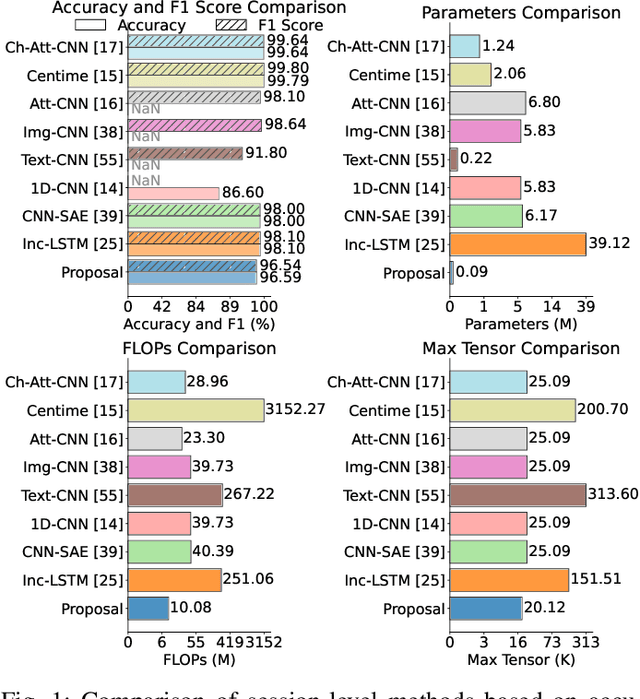
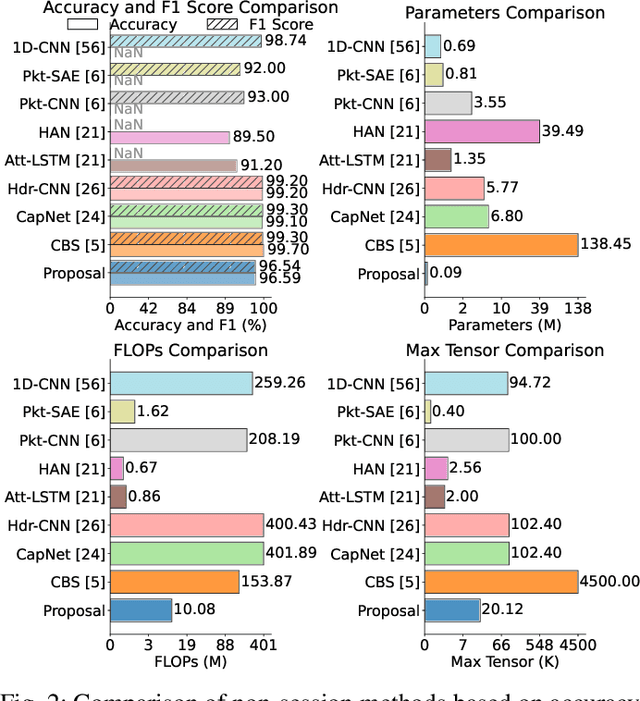
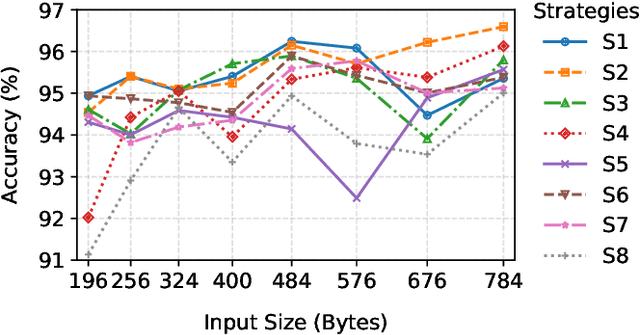
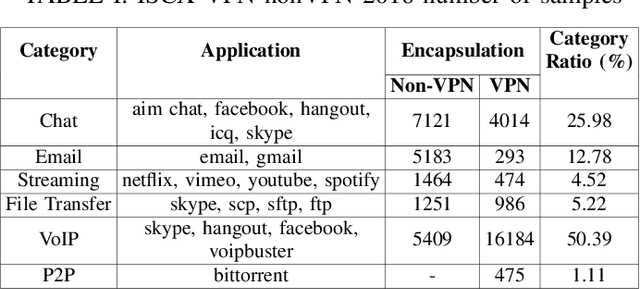
This paper presents a hardware-efficient deep neural network (DNN), optimized through hardware-aware neural architecture search (HW-NAS); the DNN supports the classification of session-level encrypted traffic on resource-constrained Internet of Things (IoT) and edge devices. Thanks to HW-NAS, a 1D convolutional neural network (CNN) is tailored on the ISCX VPN-nonVPN dataset to meet strict memory and computational limits while achieving robust performance. The optimized model attains an accuracy of 96.59% with just 88.26K parameters, 10.08M FLOPs, and a maximum tensor size of 20.12K. Compared to state-of-the-art models, it achieves reductions of up to 444-fold, 312-fold, and 15.6-fold in these metrics, respectively, significantly minimizing memory footprint and runtime requirements. The model also demonstrates versatility in classification tasks, achieving accuracies of up to 99.64% in VPN differentiation, VPN-type classification, broader traffic categories, and application identification. In addition, an in-depth approach to header-level preprocessing strategies confirms that the optimized model can provide notable performances across a wide range of configurations, even in scenarios with stricter privacy considerations. Likewise, a reduction in the length of sessions of up to 75% yields significant improvements in efficiency, while maintaining high accuracy with only a negligible drop of 1-2%. However, the importance of careful preprocessing and session length selection in the classification of raw traffic data is still present, as improper settings or aggressive reductions can bring about a 7% reduction in overall accuracy. Those results highlight the method's effectiveness in enforcing cybersecurity for IoT networks, by providing scalable, efficient solutions for the real-time analysis of encrypted traffic within strict hardware limitations.