 Add to Chrome
 Add to Firefox
 Add to Edge
Formulating Reinforcement Learning for Human-Robot Collaboration through Off-Policy Evaluation
Jan 27, 2026
Reinforcement learning (RL) has the potential to transform real-world decision-making systems by enabling autonomous agents to learn from experience. Deploying RL in real-world settings, especially in the context of human-robot interaction, requires defining state representations and reward functions, which are critical for learning efficiency and policy performance. Traditional RL approaches often rely on domain expertise and trial-and-error, necessitating extensive human involvement as well as direct interaction with the environment, which can be costly and impractical, especially in complex and safety-critical applications. This work proposes a novel RL framework that leverages off-policy evaluation (OPE) for state space and reward function selection, using only logged interaction data. This approach eliminates the need for real-time access to the environment or human-in-the-loop feedback, greatly reducing the dependency on costly real-time interactions. The proposed approach systematically evaluates multiple candidate state representations and reward functions by training offline RL agents and applying OPE to estimate policy performance. The optimal state space and reward function are selected based on their ability to produce high-performing policies under OPE metrics. Our method is validated on two environments: the Lunar Lander environment by OpenAI Gym, which provides a controlled setting for assessing state space and reward function selection, and a NASA-MATB-II human subjects study environment, which evaluates the approach's real-world applicability to human-robot teaming scenarios. This work enhances the feasibility and scalability of offline RL for real-world environments by automating critical RL design decisions through a data-driven OPE-based evaluation, enabling more reliable, effective, and sustainable RL formulation for complex human-robot interaction settings.

Avoiding Death through Fear Intrinsic Conditioning
Jun 05, 2025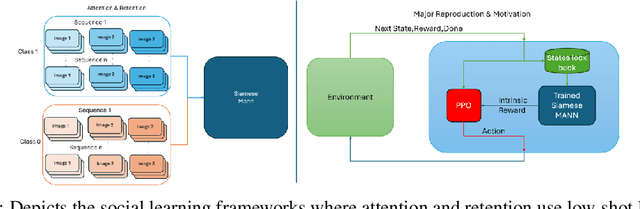
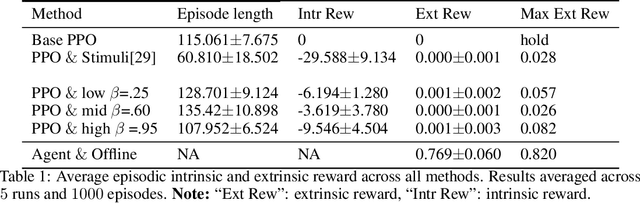
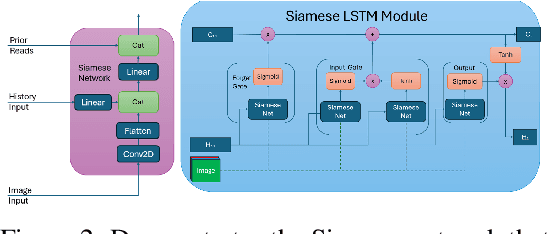
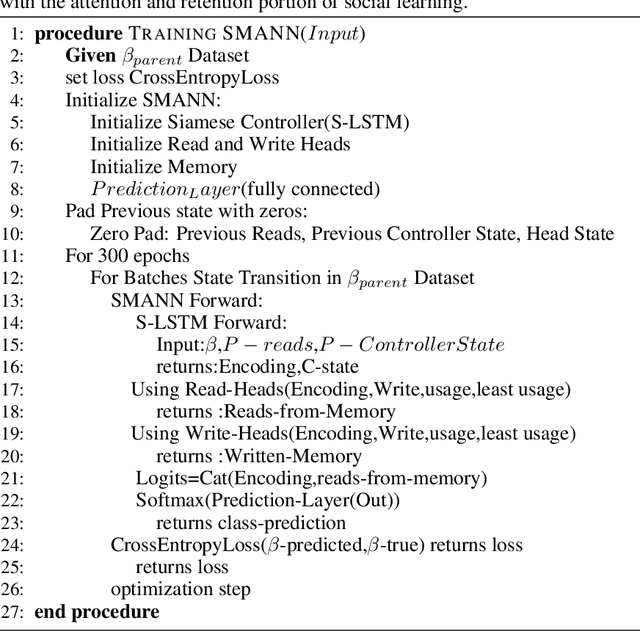
Biological and psychological concepts have inspired reinforcement learning algorithms to create new complex behaviors that expand agents' capacity. These behaviors can be seen in the rise of techniques like goal decomposition, curriculum, and intrinsic rewards, which have paved the way for these complex behaviors. One limitation in evaluating these methods is the requirement for engineered extrinsic for realistic environments. A central challenge in engineering the necessary reward function(s) comes from these environments containing states that carry high negative rewards, but provide no feedback to the agent. Death is one such stimuli that fails to provide direct feedback to the agent. In this work, we introduce an intrinsic reward function inspired by early amygdala development and produce this intrinsic reward through a novel memory-augmented neural network (MANN) architecture. We show how this intrinsic motivation serves to deter exploration of terminal states and results in avoidance behavior similar to fear conditioning observed in animals. Furthermore, we demonstrate how modifying a threshold where the fear response is active produces a range of behaviors that are described under the paradigm of general anxiety disorders (GADs). We demonstrate this behavior in the Miniworld Sidewalk environment, which provides a partially observable Markov decision process (POMDP) and a sparse reward with a non-descriptive terminal condition, i.e., death. In effect, this study results in a biologically-inspired neural architecture and framework for fear conditioning paradigms; we empirically demonstrate avoidance behavior in a constructed agent that is able to solve environments with non-descriptive terminal conditions.