 Add to Chrome
 Add to Firefox
 Add to Edge
Digital Twin-Assisted Measurement Design and Channel Statistics Prediction
Mar 24, 2026
Prediction of wireless channels and their statistics is a fundamental procedure for ensuring performance guarantees in wireless systems. Statistical radio maps powered by Gaussian processes (GPs) offer flexible, non-parametric frameworks, but their performance depends critically on the choice of mean and covariance functions. These are typically learned from dense measurements without exploiting environmental geometry. Digital twins (DTs) of wireless environments leverage computational power to incorporate geometric information; however, they require costly calibration to accurately capture material and propagation characteristics. This work introduces a hybrid channel prediction framework that leverages uncalibrated DTs derived from open-source maps to extract geometry-induced prior information for GP prediction. These structural priors are fused with a small number of channel measurements, enabling data-efficient prediction of channel statistics across the entire environment. By exploiting the uncertainty quantification inherent to GPs, the framework supports principled measurement selection by identifying informative probing locations under resource constraints. Through this integration of imperfect DTs with statistical learning, the proposed method reduces measurement overhead, improves prediction accuracy, and establishes a practical approach for resource-efficient wireless channel prediction.

On Models with Power Conservation in Reflective Intelligent Surfaces and their Design Implications
Dec 06, 2024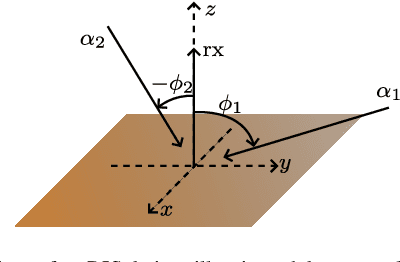
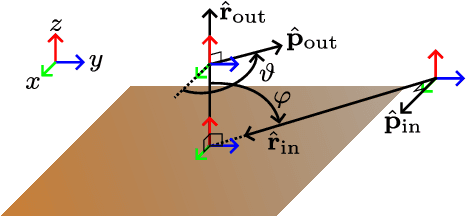
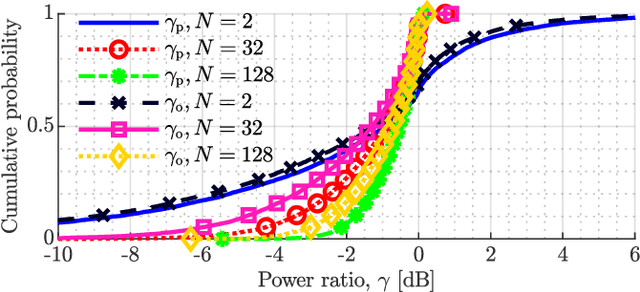
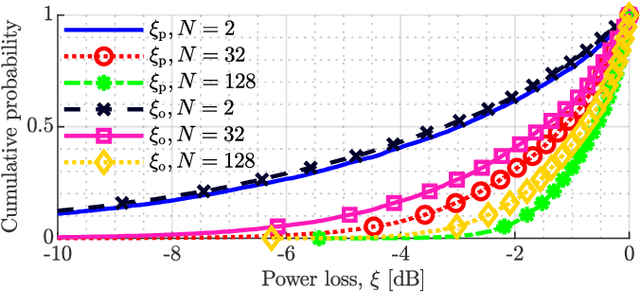
Reconfigurable intelligent surfaces (RISs) are potential enablers of future wireless communications and sensing applications and use-cases. The RIS is envisioned as a dynamically controllable surface that is capable of transforming impinging electromagnetic waves in terms of angles and polarization. Many models has been proposed to predict the wave-transformation capabilities of potential RISs, where power conservation is ensured by enforcing that the scattered power equals the power impinging upon the aperture of the RIS, without considering whether the scattered field adds coherently of destructively with the source field. In effect, this means that power is not conserved, as elaborated in this paper. With the goal of investigating the implications of global and local power conservation in RISs, work considers a single-layer metasurface based RIS. A complete end-to-end communications channel is given through polarizability modeling and conditions for power conservation and channel reciprocity are derived. The implications of the power conservation conditions upon the end-to-end communications channel is analyzed.
Geometry-informed Channel Statistics Prediction Based upon Uncalibrated Digital Twins
Nov 20, 2024Digital twins (DTs) of wireless environments can be utilized to predict the propagation channel and reduce the overhead of required to estimate the channel statistics. However, direct channel prediction requires data-intensive calibration of the DT to capture the environment properties relevant for propagation of electromagnetic signals. We introduce a framework that starts from a satellite image of the environment to produce an uncalibrated DT, which has no or imprecise information about the materials and their electromagnetic properties. The key idea is to use the uncalibrated DT to implicitly provide a geometric prior for the environment. This is utilized to inform a Gaussian process (GP), which permits the use of few channel measurements to attain an accurate prediction of the channel statistics. Additionally, the framework is able to quantify the uncertainty in channel statistics prediction and select rate in ultra-reliable low-latency communication (URLLC) that complies with statistical guarantees. The efficacy of the proposed geometry-informed GP is validated using experimental data obtained through a measurement campaign. Furthermore, the proposed prediction framework is shown to provide significant improvements compared to the benchmarks where i) direct channel statistics prediction is obtained using an uncalibrated DT and (ii) the GP predicts channel statistics using information about the location.