 Add to Chrome
 Add to Firefox
 Add to Edge
Prediction of Critical Heat Flux in Rod Bundles Using Tube-Based Hybrid Machine Learning Models in CTF
Feb 03, 2026
The prediction of critical heat flux (CHF) using machine learning (ML) approaches has become a highly active research activity in recent years, the goal of which is to build models more accurate than current conventional approaches such as empirical correlations or lookup tables (LUTs). Previous work developed and deployed tube-based pure and hybrid ML models in the CTF subchannel code, however, full-scale reactor core simulations require the use of rod bundle geometries. Unlike isolated subchannels, rod bundles experience complex thermal hydraulic phenomena such as channel crossflow, spacer grid losses, and effects from unheated conductors. This study investigates the generalization of ML-based CHF prediction models in rod bundles after being trained on tube-based CHF data. A purely data-driven DNN and two hybrid bias-correction models were implemented in the CTF subchannel code and used to predict CHF location and magnitude in the Combustion Engineering 5-by-5 bundle CHF test series. The W-3 correlation, Bowring correlation, and Groeneveld LUT were used as baseline comparators. On average, all three ML-based approaches produced magnitude and location predictions more accurate than the baseline models, with the hybrid LUT model exhibiting the most favorable performance metrics.

A Three-Stage Bayesian Transfer Learning Framework to Improve Predictions in Data-Scarce Domains
Oct 30, 2025The use of ML in engineering has grown steadily to support a wide array of applications. Among these methods, deep neural networks have been widely adopted due to their performance and accessibility, but they require large, high-quality datasets. Experimental data are often sparse, noisy, or insufficient to build resilient data-driven models. Transfer learning, which leverages relevant data-abundant source domains to assist learning in data-scarce target domains, has shown efficacy. Parameter transfer, where pretrained weights are reused, is common but degrades under large domain shifts. Domain-adversarial neural networks (DANNs) help address this issue by learning domain-invariant representations, thereby improving transfer under greater domain shifts in a semi-supervised setting. However, DANNs can be unstable during training and lack a native means for uncertainty quantification. This study introduces a fully-supervised three-stage framework, the staged Bayesian domain-adversarial neural network (staged B-DANN), that combines parameter transfer and shared latent space adaptation. In Stage 1, a deterministic feature extractor is trained on the source domain. This feature extractor is then adversarially refined using a DANN in Stage 2. In Stage 3, a Bayesian neural network is built on the adapted feature extractor for fine-tuning on the target domain to handle conditional shifts and yield calibrated uncertainty estimates. This staged B-DANN approach was first validated on a synthetic benchmark, where it was shown to significantly outperform standard transfer techniques. It was then applied to the task of predicting critical heat flux in rectangular channels, leveraging data from tube experiments as the source domain. The results of this study show that the staged B-DANN method can improve predictive accuracy and generalization, potentially assisting other domains in nuclear engineering.
Physics-Based Hybrid Machine Learning for Critical Heat Flux Prediction with Uncertainty Quantification
Feb 26, 2025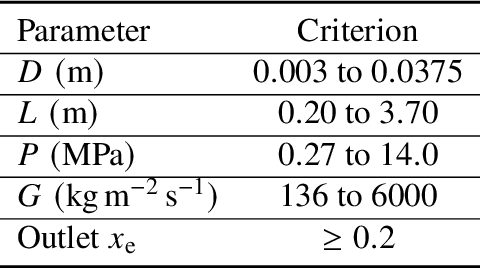
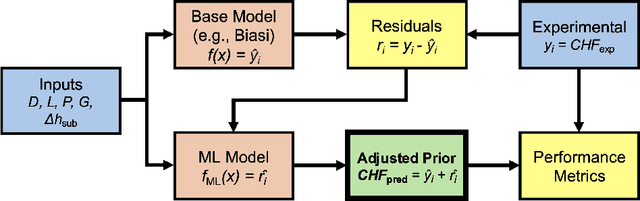
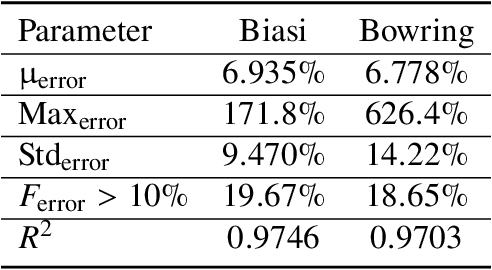
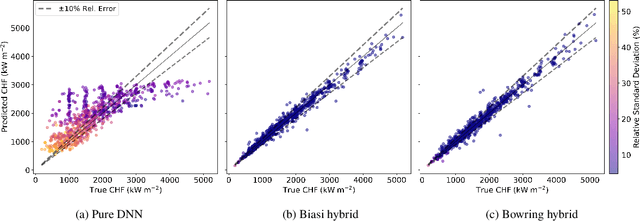
Critical heat flux is a key quantity in boiling system modeling due to its impact on heat transfer and component temperature and performance. This study investigates the development and validation of an uncertainty-aware hybrid modeling approach that combines machine learning with physics-based models in the prediction of critical heat flux in nuclear reactors for cases of dryout. Two empirical correlations, Biasi and Bowring, were employed with three machine learning uncertainty quantification techniques: deep neural network ensembles, Bayesian neural networks, and deep Gaussian processes. A pure machine learning model without a base model served as a baseline for comparison. This study examines the performance and uncertainty of the models under both plentiful and limited training data scenarios using parity plots, uncertainty distributions, and calibration curves. The results indicate that the Biasi hybrid deep neural network ensemble achieved the most favorable performance (with a mean absolute relative error of 1.846% and stable uncertainty estimates), particularly in the plentiful data scenario. The Bayesian neural network models showed slightly higher error and uncertainty but superior calibration. By contrast, deep Gaussian process models underperformed by most metrics. All hybrid models outperformed pure machine learning configurations, demonstrating resistance against data scarcity.