 Add to Chrome
 Add to Firefox
 Add to Edge
Hijacking Text Heritage: Hiding the Human Signature through Homoglyphic Substitution
Apr 11, 2026
In what way could a data breach involving government-issued IDs such as passports, driver's licenses, etc., rival a random voluntary disclosure on a nondescript social-media platform? At first glance, the former appears more significant, and that is a valid assessment. The disclosed data could contain an individual's date of birth and address; for all intents and purposes, a leak of that data would be disastrous. Given the threat, the latter scenario involving an innocuous online post seems comparatively harmless--or does it? From that post and others like it, a forensic linguist could stylometrically uncover equivalent pieces of information, estimating an age range for the author (adolescent or adult) and narrowing down their geographical location (specific country). While not an exact science--the determinations are statistical--stylometry can reveal comparable, though noticeably diluted, information about an individual. To prevent an ID from being breached, simply sharing it as little as possible suffices. Preventing the leakage of personal information from written text requires a more complex solution: adversarial stylometry. In this paper, we explore how performing homoglyph substitution--the replacement of characters with visually similar alternatives (e.g., "h" $\texttt{[U+0068]}$ $\rightarrow$ "h" $\texttt{[U+04BB]}$)--on text can degrade stylometric systems.

StegoStylo: Squelching Stylometric Scrutiny through Steganographic Stitching
Jan 14, 2026Stylometry--the identification of an author through analysis of a text's style (i.e., authorship attribution)--serves many constructive purposes: it supports copyright and plagiarism investigations, aids detection of harmful content, offers exploratory cues for certain medical conditions (e.g., early signs of dementia or depression), provides historical context for literary works, and helps uncover misinformation and disinformation. In contrast, when stylometry is employed as a tool for authorship verification--confirming whether a text truly originates from a claimed author--it can also be weaponized for malicious purposes. Techniques such as de-anonymization, re-identification, tracking, profiling, and downstream effects like censorship illustrate the privacy threats that stylometric analysis can enable. Building on these concerns, this paper further explores how adversarial stylometry combined with steganography can counteract stylometric analysis. We first present enhancements to our adversarial attack, $\textit{TraceTarnish}$, providing stronger evidence of its capacity to confound stylometric systems and reduce their attribution and verification accuracy. Next, we examine how steganographic embedding can be fine-tuned to mask an author's stylistic fingerprint, quantifying the level of authorship obfuscation achievable as a function of the proportion of words altered with zero-width Unicode characters. Based on our findings, steganographic coverage of 33% or higher seemingly ensures authorship obfuscation. Finally, we reflect on the ways stylometry can be used to undermine privacy and argue for the necessity of defensive tools like $\textit{TraceTarnish}$.
Applications of Positive Unlabeled (PU) and Negative Unlabeled (NU) Learning in Cybersecurity
Dec 09, 2024This paper explores the relatively underexplored application of Positive Unlabeled (PU) Learning and Negative Unlabeled (NU) Learning in the cybersecurity domain. While these semi-supervised learning methods have been applied successfully in fields like medicine and marketing, their potential in cybersecurity remains largely untapped. The paper identifies key areas of cybersecurity--such as intrusion detection, vulnerability management, malware detection, and threat intelligence--where PU/NU learning can offer significant improvements, particularly in scenarios with imbalanced or limited labeled data. We provide a detailed problem formulation for each subfield, supported by mathematical reasoning, and highlight the specific challenges and research gaps in scaling these methods to real-time systems, addressing class imbalance, and adapting to evolving threats. Finally, we propose future directions to advance the integration of PU/NU learning in cybersecurity, offering solutions that can better detect, manage, and mitigate emerging cyber threats.
Harnessing PU Learning for Enhanced Cloud-based DDoS Detection: A Comparative Analysis
Oct 24, 2024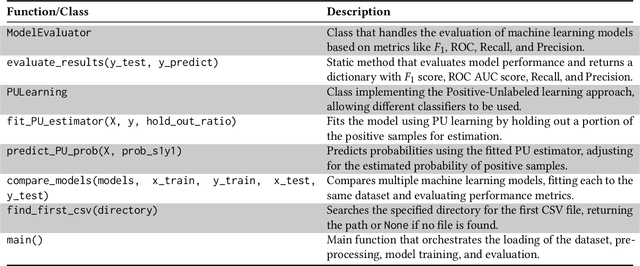
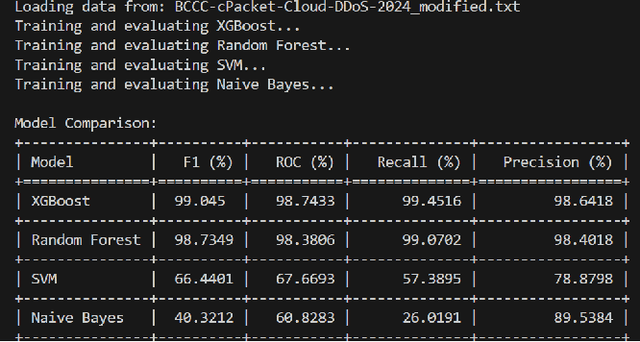
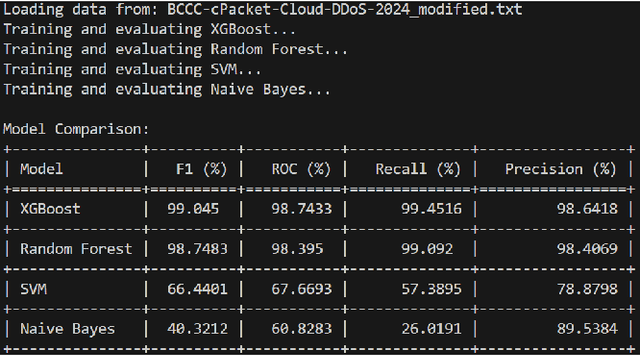
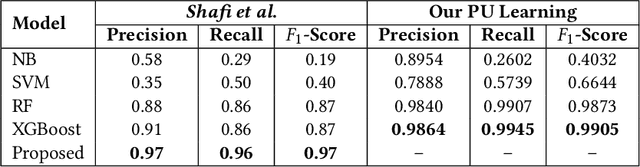
This paper explores the application of Positive-Unlabeled (PU) learning for enhanced Distributed Denial-of-Service (DDoS) detection in cloud environments. Utilizing the $\texttt{BCCC-cPacket-Cloud-DDoS-2024}$ dataset, we implement PU learning with four machine learning algorithms: XGBoost, Random Forest, Support Vector Machine, and Na\"{i}ve Bayes. Our results demonstrate the superior performance of ensemble methods, with XGBoost and Random Forest achieving $F_{1}$ scores exceeding 98%. We quantify the efficacy of each approach using metrics including $F_{1}$ score, ROC AUC, Recall, and Precision. This study bridges the gap between PU learning and cloud-based anomaly detection, providing a foundation for addressing Context-Aware DDoS Detection in multi-cloud environments. Our findings highlight the potential of PU learning in scenarios with limited labeled data, offering valuable insights for developing more robust and adaptive cloud security mechanisms.