 Add to Chrome
 Add to Firefox
 Add to Edge
Robustness and Imperceptibility Analysis of Hybrid Spatial-Frequency Domain Image Watermarking
Nov 13, 2025
The proliferation of digital media necessitates robust methods for copyright protection and content authentication. This paper presents a comprehensive comparative study of digital image watermarking techniques implemented using the spatial domain (Least Significant Bit - LSB), the frequency domain (Discrete Fourier Transform - DFT), and a novel hybrid (LSB+DFT) approach. The core objective is to evaluate the trade-offs between imperceptibility (measured by Peak Signal-to-Noise Ratio - PSNR) and robustness (measured by Normalized Correlation - NC and Bit Error Rate - BER). We implemented these three techniques within a unified MATLAB-based experimental framework. The watermarked images were subjected to a battery of common image processing attacks, including JPEG compression, Gaussian noise, and salt-and-pepper noise, at varying intensities. Experimental results generated from standard image datasets (USC-SIPI) demonstrate that while LSB provides superior imperceptibility, it is extremely fragile. The DFT method offers significant robustness at the cost of visual quality. The proposed hybrid LSB+DFT technique, which leverages redundant embedding and a fallback extraction mechanism, is shown to provide the optimal balance, maintaining high visual fidelity while exhibiting superior resilience to all tested attacks.

Evaluating Gemini LLM in Food Image-Based Recipe and Nutrition Description with EfficientNet-B4 Visual Backbone
Nov 11, 2025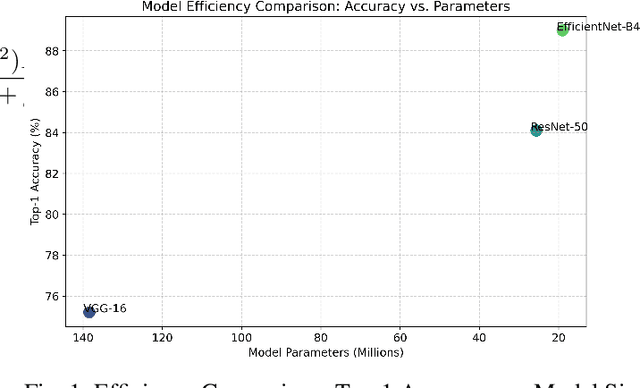
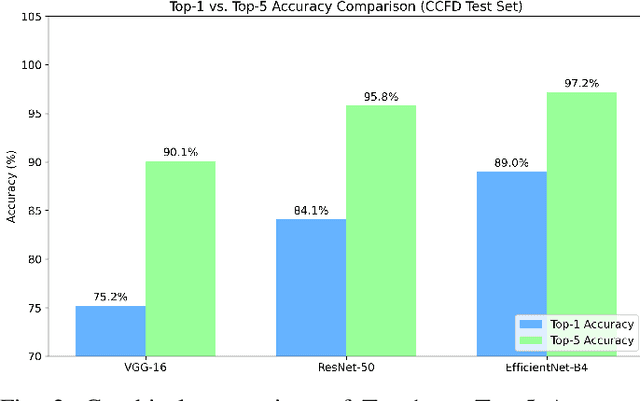
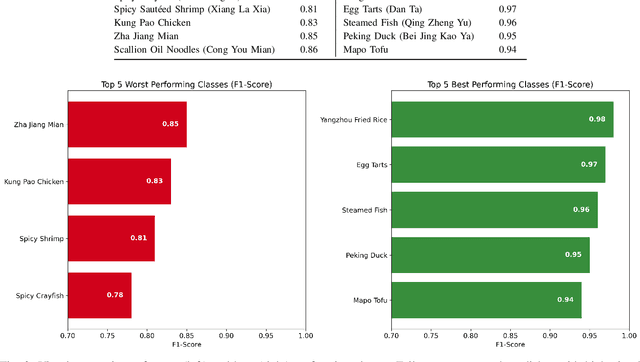
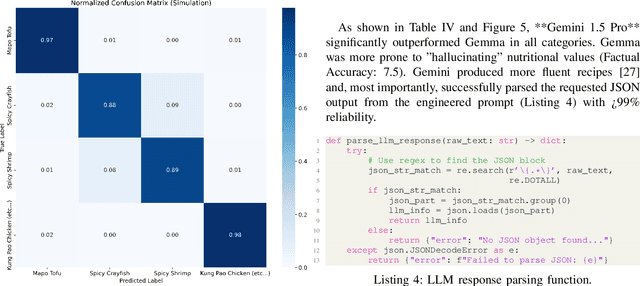
The proliferation of digital food applications necessitates robust methods for automated nutritional analysis and culinary guidance. This paper presents a comprehensive comparative evaluation of a decoupled, multimodal pipeline for food recognition. We evaluate a system integrating a specialized visual backbone (EfficientNet-B4) with a powerful generative large language model (Google's Gemini LLM). The core objective is to evaluate the trade-offs between visual classification accuracy, model efficiency, and the quality of generative output (nutritional data and recipes). We benchmark this pipeline against alternative vision backbones (VGG-16, ResNet-50, YOLOv8) and a lightweight LLM (Gemma). We introduce a formalization for "Semantic Error Propagation" (SEP) to analyze how classification inaccuracies from the visual module cascade into the generative output. Our analysis is grounded in a new Custom Chinese Food Dataset (CCFD) developed to address cultural bias in public datasets. Experimental results demonstrate that while EfficientNet-B4 (89.0\% Top-1 Acc.) provides the best balance of accuracy and efficiency, and Gemini (9.2/10 Factual Accuracy) provides superior generative quality, the system's overall utility is fundamentally bottlenecked by the visual front-end's perceptive accuracy. We conduct a detailed per-class analysis, identifying high semantic similarity as the most critical failure mode.