 Add to Chrome
 Add to Firefox
 Add to Edge
An Inverse Scattering Inspired Fourier Neural Operator for Time-Dependent PDE Learning
Dec 22, 2025
Learning accurate and stable time-advancement operators for nonlinear partial differential equations (PDEs) remains challenging, particularly for chaotic, stiff, and long-horizon dynamical systems. While neural operator methods such as the Fourier Neural Operator (FNO) and Koopman-inspired extensions achieve good short-term accuracy, their long-term stability is often limited by unconstrained latent representations and cumulative rollout errors. In this work, we introduce an inverse scattering inspired Fourier Neural Operator(IS-FNO), motivated by the reversibility and spectral evolution structure underlying the classical inverse scattering transform. The proposed architecture enforces a near-reversible pairing between lifting and projection maps through an explicitly invertible neural transformation, and models latent temporal evolution using exponential Fourier layers that naturally encode linear and nonlinear spectral dynamics. We systematically evaluate IS-FNO against baseline FNO and Koopman-based models on a range of benchmark PDEs, including the Michelson-Sivashinsky and Kuramoto-Sivashinsky equations (in one and two dimensions), as well as the integrable Korteweg-de Vries and Kadomtsev-Petviashvili equations. The results demonstrate that IS-FNO achieves lower short-term errors and substantially improved long-horizon stability in non-stiff regimes. For integrable systems, reduced IS-FNO variants that embed analytical scattering structure retain competitive long-term accuracy despite limited model capacity. Overall, this work shows that incorporating physical structure -- particularly reversibility and spectral evolution -- into neural operator design significantly enhances robustness and long-term predictive fidelity for nonlinear PDE dynamics.

Koopman Theory-Inspired Method for Learning Time Advancement Operators in Unstable Flame Front Evolution
Dec 11, 2024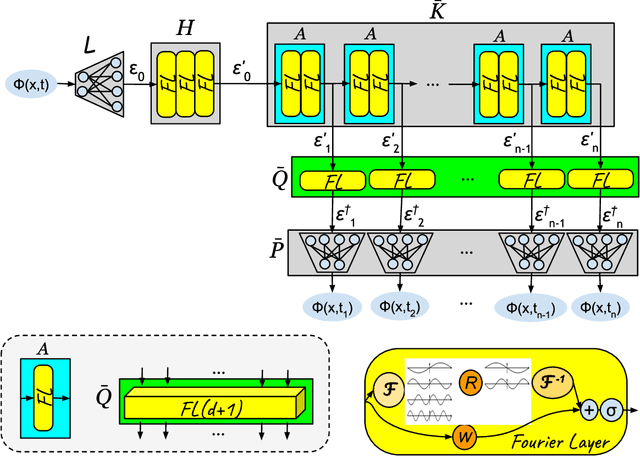
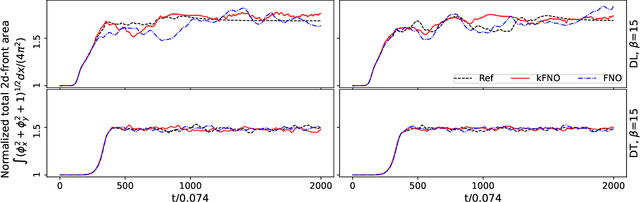
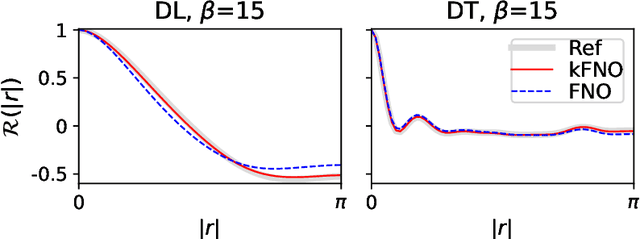
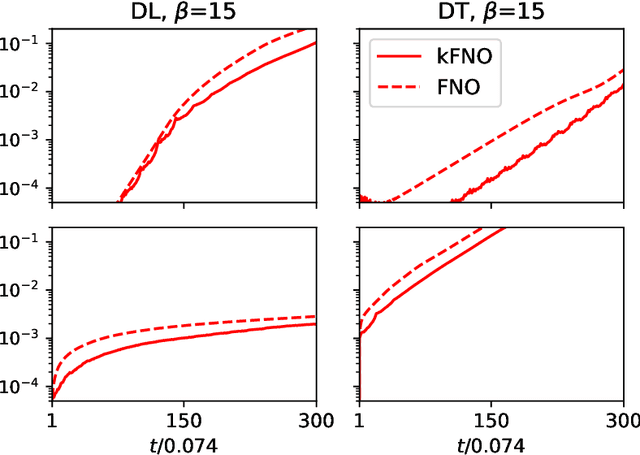
Predicting the evolution of complex systems governed by partial differential equations (PDEs) remains challenging, especially for nonlinear, chaotic behaviors. This study introduces Koopman-inspired Fourier Neural Operators (kFNO) and Convolutional Neural Networks (kCNN) to learn solution advancement operators for flame front instabilities. By transforming data into a high-dimensional latent space, these models achieve more accurate multi-step predictions compared to traditional methods. Benchmarking across one- and two-dimensional flame front scenarios demonstrates the proposed approaches' superior performance in short-term accuracy and long-term statistical reproduction, offering a promising framework for modeling complex dynamical systems.
Learning Flame Evolution Operator under Hybrid Darrieus Landau and Diffusive Thermal Instability
May 11, 2024Recent advancements in the integration of artificial intelligence (AI) and machine learning (ML) with physical sciences have led to significant progress in addressing complex phenomena governed by nonlinear partial differential equations (PDE). This paper explores the application of novel operator learning methodologies to unravel the intricate dynamics of flame instability, particularly focusing on hybrid instabilities arising from the coexistence of Darrieus-Landau (DL) and Diffusive-Thermal (DT) mechanisms. Training datasets encompass a wide range of parameter configurations, enabling the learning of parametric solution advancement operators using techniques such as parametric Fourier Neural Operator (pFNO), and parametric convolutional neural networks (pCNN). Results demonstrate the efficacy of these methods in accurately predicting short-term and long-term flame evolution across diverse parameter regimes, capturing the characteristic behaviors of pure and blended instabilities. Comparative analyses reveal pFNO as the most accurate model for learning short-term solutions, while all models exhibit robust performance in capturing the nuanced dynamics of flame evolution. This research contributes to the development of robust modeling frameworks for understanding and controlling complex physical processes governed by nonlinear PDE.
Parametric Learning of Time-Advancement Operators for Unstable Flame Evolution
Feb 14, 2024This study investigates the application of machine learning, specifically Fourier Neural Operator (FNO) and Convolutional Neural Network (CNN), to learn time-advancement operators for parametric partial differential equations (PDEs). Our focus is on extending existing operator learning methods to handle additional inputs representing PDE parameters. The goal is to create a unified learning approach that accurately predicts short-term solutions and provides robust long-term statistics under diverse parameter conditions, facilitating computational cost savings and accelerating development in engineering simulations. We develop and compare parametric learning methods based on FNO and CNN, evaluating their effectiveness in learning parametric-dependent solution time-advancement operators for one-dimensional PDEs and realistic flame front evolution data obtained from direct numerical simulations of the Navier-Stokes equations.