 Add to Chrome
 Add to Firefox
 Add to Edge
RankT2I: A Submodular Framework for Discovering Interpretable and Diverse Semantics in Text-to-Image Models
Aug 14, 2026
Recent advances in text-to-image (T2I) models have revolutionized the field of image generation and editing. However, identifying semantics that a T2I model can successfully edit in an image continues to be a challenging task. Most existing approaches require users to manually specify semantics to modify a particular image, a time-consuming process that often involves extensive trial and error. In this paper, we present RankT2I, a novel, training-free, and model-agnostic framework that automates the discovery of editable semantics in diffusion and FLUX-based models. Given a visual domain, we first utilize a multimodal vision-language model to gather a broad set of candidate semantics. We then frame semantic discovery as a set selection problem and use a submodular objective to identify semantics that are relevant, editable, and diverse. Our method helps users efficiently identify a wide range of semantics for text-to-image editing models across several domains while outperforming existing methods.

Explaining in Diffusion: Explaining a Classifier Through Hierarchical Semantics with Text-to-Image Diffusion Models
Dec 24, 2024
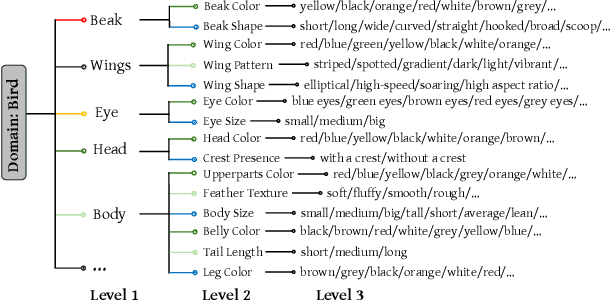

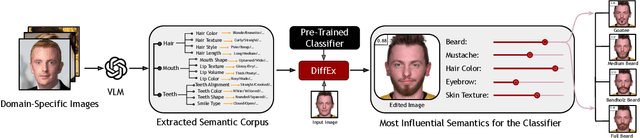
Classifiers are important components in many computer vision tasks, serving as the foundational backbone of a wide variety of models employed across diverse applications. However, understanding the decision-making process of classifiers remains a significant challenge. We propose DiffEx, a novel method that leverages the capabilities of text-to-image diffusion models to explain classifier decisions. Unlike traditional GAN-based explainability models, which are limited to simple, single-concept analyses and typically require training a new model for each classifier, our approach can explain classifiers that focus on single concepts (such as faces or animals) as well as those that handle complex scenes involving multiple concepts. DiffEx employs vision-language models to create a hierarchical list of semantics, allowing users to identify not only the overarching semantic influences on classifiers (e.g., the 'beard' semantic in a facial classifier) but also their sub-types, such as 'goatee' or 'Balbo' beard. Our experiments demonstrate that DiffEx is able to cover a significantly broader spectrum of semantics compared to its GAN counterparts, providing a hierarchical tool that delivers a more detailed and fine-grained understanding of classifier decisions.