 Add to Chrome
 Add to Firefox
 Add to Edge
Generative Brownian Bridge Diffusion In Motion Space For Enhanced Myocardial Strain Analysis
Aug 03, 2026
Myocardial strain analysis of cardiac magnetic resonance (CMR) images provides an important tool for evaluating cardiac function. However, current techniques require either human-adjusted post-processing with suboptimal regional accuracy, or specialized and costly imaging acquisitions. In this paper, we propose to leverage the power of generative models to synthesize high-quality motion-derived strain values from routinely acquired CMR sequences. Specifically, we develop a novel Brownian bridge diffusion model in motion space to learn the probabilistic mapping between standard CMR motion estimated from widely adopted registration methods and highly accurate motion provided by advanced strain imaging techniques. To promote the fidelity of anatomical structure in the generation process, our model is conditioned on the corresponding CMR images. We validate our method on large-scale multi-center CMR datasets including subjects of paired standard cine CMR and advanced strain imaging acquisitions. Experimental results demonstrate that our framework significantly improves the accuracy of motion prediction and strain analysis from standard CMRs compared to existing learning-based approaches. Our research represents a new paradigm for potentially developing cost-effective, clinically deployable AI tools for cardiac function assessment with enhanced strain accuracy in busy clinical workflows. Our code is publicly available at anonymous.4open.science/r/Brownian-Bridge-strain-analysis-1140.

Automated Program Repair Based on Code Review: How do Pre-trained Transformer Models Perform?
Apr 16, 2023
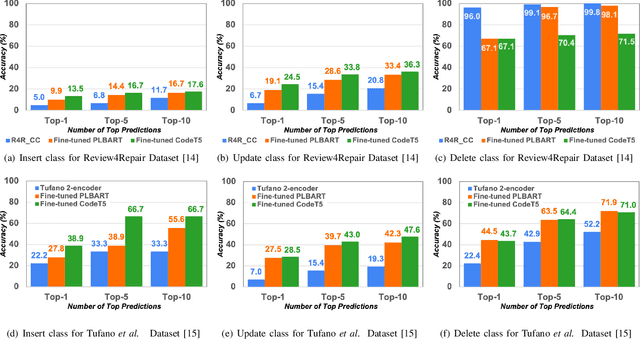
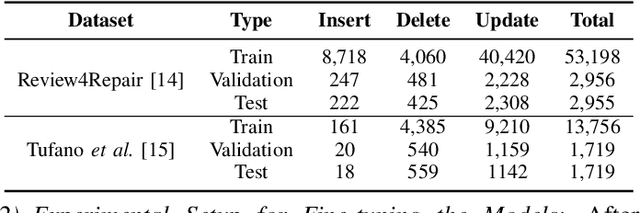

Sequence-to-sequence models have been used to transform erroneous programs into correct ones when trained with a large enough dataset. Some recent studies also demonstrated strong empirical evidence that code review (natural language instruction about suggestive changes in code) can improve the program repair further. Large language models, trained with Natural Language (NL) and computer program corpora, have the capacity to contain inherent knowledge of both. In this study, we investigate if this inherent knowledge of code and NL can be utilized to improve automated program repair. We applied PLBART and CodeT5, two state-of-the-art language models that are pre-trained with both Programming Language (PL) and Natural Language (NL), on two such natural language-based program repair datasets and found that the pre-trained language models fine-tuned with datasets containing both code review and subsequent code changes notably outperform each of the previous models. We observed that the pre-trained models improve the previously best-reported results by 9.91% on the Review4Repair dataset and by 24.72% on the dataset by Tufano et al. This suggests that a pre-trained sequential model has a better understanding of natural language and can utilize it much better. We performed an ablation study to assess the contribution of the pre-training mechanism and the model architecture. We found that pre-training was significantly more important in the performance gain than the model architecture. The practical application of using pre-trained transformer models in the context of automated program repair is still a long way off. However, our study demonstrates the substantial value of employing pre-trained models, paving the path for future studies to use more of these.