 Add to Chrome
 Add to Firefox
 Add to Edge
Chow-Liu Ordering for Long-Context Reasoning in Chain-of-Agents
Mar 10, 2026
Sequential multi-agent reasoning frameworks such as Chain-of-Agents (CoA) handle long-context queries by decomposing inputs into chunks and processing them sequentially using LLM-based worker agents that read from and update a bounded shared memory. From a probabilistic perspective, CoA aims to approximate the conditional distribution corresponding to a model capable of jointly reasoning over the entire long context. CoA achieves this through a latent-state factorization in which only bounded summaries of previously processed evidence are passed between agents. The resulting bounded-memory approximation introduces a lossy information bottleneck, making the final evidence state inherently dependent on the order in which chunks are processed. In this work, we study the problem of chunk ordering for long-context reasoning. We use the well-known Chow-Liu trees to learn a dependency structure that prioritizes strongly related chunks. Empirically, we show that a breadth-first traversal of the resulting tree yields chunk orderings that reduce information loss across agents and consistently outperform both default document-chunk ordering and semantic score-based ordering in answer relevance and exact-match accuracy across three long-context benchmarks.

COSMIR: Chain Orchestrated Structured Memory for Iterative Reasoning over Long Context
Oct 06, 2025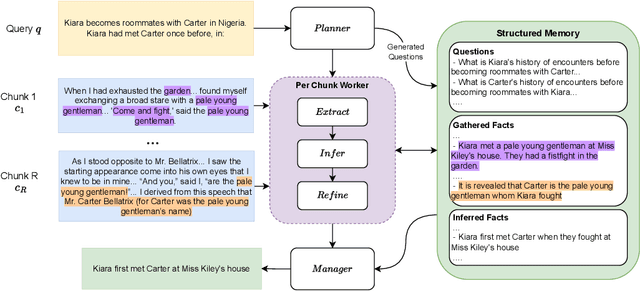
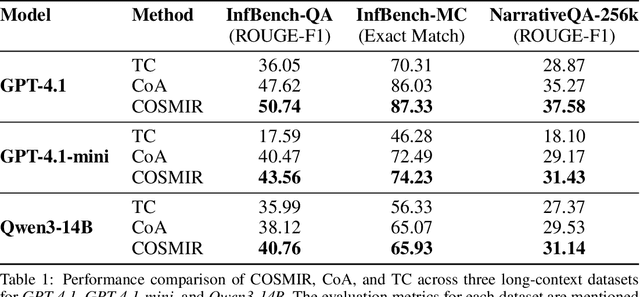
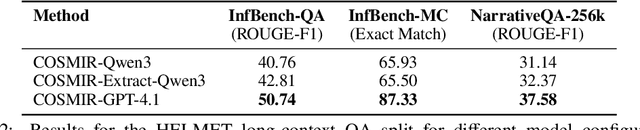
Reasoning over very long inputs remains difficult for large language models (LLMs). Common workarounds either shrink the input via retrieval (risking missed evidence), enlarge the context window (straining selectivity), or stage multiple agents to read in pieces. In staged pipelines (e.g., Chain of Agents, CoA), free-form summaries passed between agents can discard crucial details and amplify early mistakes. We introduce COSMIR (Chain Orchestrated Structured Memory for Iterative Reasoning), a chain-style framework that replaces ad hoc messages with a structured memory. A Planner agent first turns a user query into concrete, checkable sub-questions. worker agents process chunks via a fixed micro-cycle: Extract, Infer, Refine, writing all updates to the shared memory. A Manager agent then Synthesizes the final answer directly from the memory. This preserves step-wise read-then-reason benefits while changing both the communication medium (structured memory) and the worker procedure (fixed micro-cycle), yielding higher faithfulness, better long-range aggregation, and auditability. On long-context QA from the HELMET suite, COSMIR reduces propagation-stage information loss and improves accuracy over a CoA baseline.