 Add to Chrome
 Add to Firefox
 Add to Edge
Do Language Models Dream of Binding Molecules? Benchmarking LLMs under Spatial Constraints
Jul 20, 2026
Structure-based drug design (SBDD) leverages the 3D structure of protein targets, often complemented by other spatial constraints, to generate candidate binding molecules. While diffusion models have dominated as a leading paradigm for high-quality 3D molecule generation, LLM-based methods are rapidly emerging in molecular design and have shown competitive performance in pocket-conditioned molecular generation. However, their ability to reason about physics and 3D spatial environments is largely underexplored. In this work, we systematically analyze whether current general-purpose LLMs are capable of navigating complex 3D constraints compared to established baselines such as specialized diffusion models. We consider 3D ligand generation conditioned on protein pockets together with ligand- and interaction-derived spatial constraints, including anchor fragments, pharmacophore points, and mandatory pocket-ligand interactions. To enable this evaluation, we introduce 3D-Fit - a token-efficient benchmarking strategy for assessing LLM performance on multi-conditioned spatial molecule generation. Our findings reveal a clear pattern in LLM spatial capabilities: while they still lag behind state-of-the-art approaches, they are promising and can handle multiple spatial constraints simultaneously, enabling scaling to heterogeneous setups.

URSA: Chemistry-Aware Benchmark for Utilitarian Retrosynthesis Assessment
Jul 06, 2026Synthesis planning aiming to find pathways of reactions for a target molecule is one of the most important and challenging tasks in drug discovery. Recent progress has produced both specialized deep-learning retrosynthesis systems and general-purpose large language models, but objective comparison remains difficult due to the lack of flexible, chemically interpretable benchmarking protocols. In the current study, we are introducing the URSA (Utilitarian RetroSynthesis Assessment) evaluation framework that provides the opportunity to benchmark the synthetic routes not only from a formal perspective, such as convergence to commercially available starting materials, but also from a chemical plausibility perspective, mimicking the way expert chemists evaluate the reactions and routes. The study covers a comprehensive evaluation of both conventional end-to-end retrosynthesis solutions and LLMs for the synthesis planning task on a set of novel, diverse target molecules with undisclosed synthetic routes, which represent realistic tasks in the daily drug design routine. We find that while LLMs can support high-level strategic planning, they currently underperform specialized retrosynthesis models in reliably solving synthesis planning tasks.
MMAI Gym for Science: Training Liquid Foundation Models for Drug Discovery
Mar 03, 2026General-purpose large language models (LLMs) that rely on in-context learning do not reliably deliver the scientific understanding and performance required for drug discovery tasks. Simply increasing model size or introducing reasoning tokens does not yield significant performance gains. To address this gap, we introduce the MMAI Gym for Science, a one-stop shop molecular data formats and modalities as well as task-specific reasoning, training, and benchmarking recipes designed to teach foundation models the 'language of molecules' in order to solve practical drug discovery problems. We use MMAI Gym to train an efficient Liquid Foundation Model (LFM) for these applications, demonstrating that smaller, purpose-trained foundation models can outperform substantially larger general-purpose or specialist models on molecular benchmarks. Across essential drug discovery tasks - including molecular optimization, ADMET property prediction, retrosynthesis, drug-target activity prediction, and functional group reasoning - the resulting model achieves near specialist-level performance and, in the majority of settings, surpasses larger models, while remaining more efficient and broadly applicable in the domain.
When Single Answer Is Not Enough: Rethinking Single-Step Retrosynthesis Benchmarks for LLMs
Feb 03, 2026Recent progress has expanded the use of large language models (LLMs) in drug discovery, including synthesis planning. However, objective evaluation of retrosynthesis performance remains limited. Existing benchmarks and metrics typically rely on published synthetic procedures and Top-K accuracy based on single ground-truth, which does not capture the open-ended nature of real-world synthesis planning. We propose a new benchmarking framework for single-step retrosynthesis that evaluates both general-purpose and chemistry-specialized LLMs using ChemCensor, a novel metric for chemical plausibility. By emphasizing plausibility over exact match, this approach better aligns with human synthesis planning practices. We also introduce CREED, a novel dataset comprising millions of ChemCensor-validated reaction records for LLM training, and use it to train a model that improves over the LLM baselines under this benchmark.
nach0-pc: Multi-task Language Model with Molecular Point Cloud Encoder
Oct 11, 2024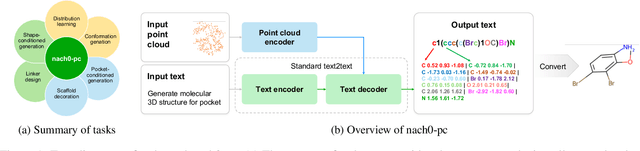
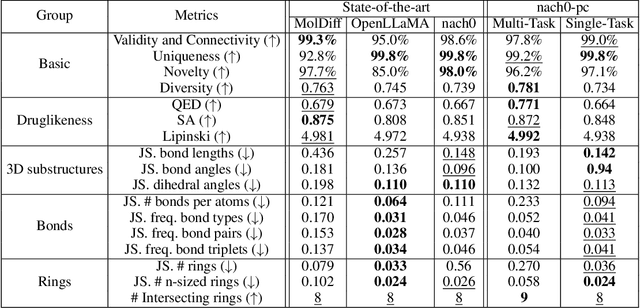
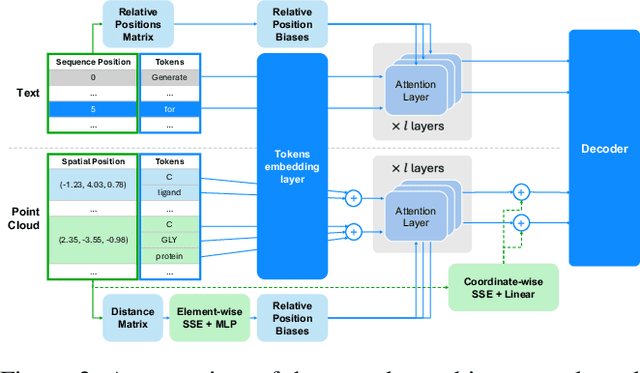
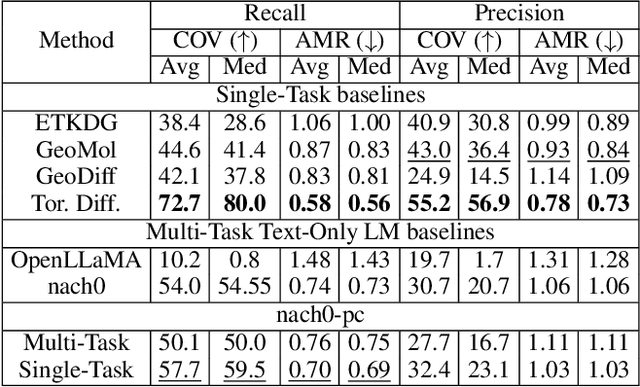
Recent advancements have integrated Language Models (LMs) into a drug discovery pipeline. However, existing models mostly work with SMILES and SELFIES chemical string representations, which lack spatial features vital for drug discovery. Additionally, attempts to translate chemical 3D structures into text format encounter issues such as excessive length and insufficient atom connectivity information. To address these issues, we introduce nach0-pc, a model combining domain-specific encoder and textual representation to handle spatial arrangement of atoms effectively. Our approach utilizes a molecular point cloud encoder for concise and order-invariant structure representation. We introduce a novel pre-training scheme for molecular point clouds to distillate the knowledge from spatial molecular structures datasets. After fine-tuning within both single-task and multi-task frameworks, nach0-pc demonstrates performance comparable with other diffusion models in terms of generated samples quality across several established spatial molecular generation tasks. Notably, our model is a multi-task approach, in contrast to diffusion models being limited to single tasks. Additionally, it is capable of processing point cloud-related data, which language models are not capable of handling due to memory limitations. These lead to our model having reduced training and inference time while maintaining on par performance.
BindGPT: A Scalable Framework for 3D Molecular Design via Language Modeling and Reinforcement Learning
Jun 06, 2024
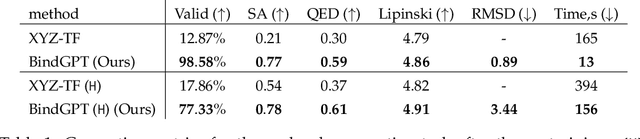

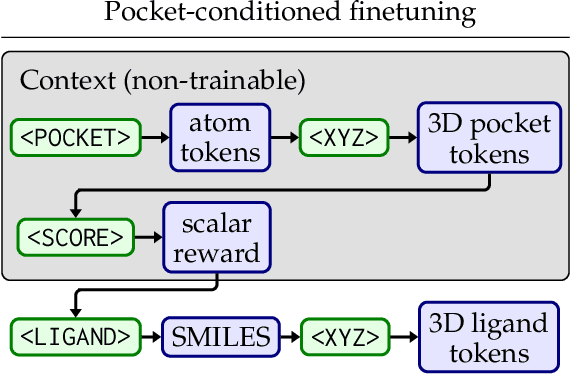
Generating novel active molecules for a given protein is an extremely challenging task for generative models that requires an understanding of the complex physical interactions between the molecule and its environment. In this paper, we present a novel generative model, BindGPT which uses a conceptually simple but powerful approach to create 3D molecules within the protein's binding site. Our model produces molecular graphs and conformations jointly, eliminating the need for an extra graph reconstruction step. We pretrain BindGPT on a large-scale dataset and fine-tune it with reinforcement learning using scores from external simulation software. We demonstrate how a single pretrained language model can serve at the same time as a 3D molecular generative model, conformer generator conditioned on the molecular graph, and a pocket-conditioned 3D molecule generator. Notably, the model does not make any representational equivariance assumptions about the domain of generation. We show how such simple conceptual approach combined with pretraining and scaling can perform on par or better than the current best specialized diffusion models, language models, and graph neural networks while being two orders of magnitude cheaper to sample.