 Add to Chrome
 Add to Firefox
 Add to Edge
Self-Organized Learning in Oscillatory Neural Networks with Memristive Signed Couplings
Jul 01, 2026
Oscillatory neural networks (ONNs) have emerged as a promising neuromorphic architecture, leveraging coupled dynamical systems to perform computation and represent information through phase relationships. Their interactions can be designed to support intrinsic energy-minimizing dynamics, enabling tasks such as associative memory and optimization, and positioning them as a candidate architecture for continuous learning and inference. We present a neuromorphic primitive implemented using memristive edges with inhibitory couplings as a potential design for autonomous learning, and provide circuit simulation validation that the system is capable of denoising noisy inputs on an auto-associative task. While numerical Hopfield/Ising models routinely assume signed weights, neuromorphic implementations of ONNs often fail to realize negative weights due to device and circuit constraints. A practically implementable route to inhibitory (negative) weights is particularly valuable: it expands the class of attractor structures accessible to oscillator networks beyond purely synchronous couplings, and supports phase-coded memories where anti-phase constraints are not merely transiently enforced during training but can persist autonomously after release. We provide circuit simulations and theoretical analyses demonstrating that signed effective weights are necessary for anti-phase attractors to persist autonomously.

Autonomous Learning of Attractors for Neuromorphic Computing with Wien Bridge Oscillator Networks
Dec 16, 2025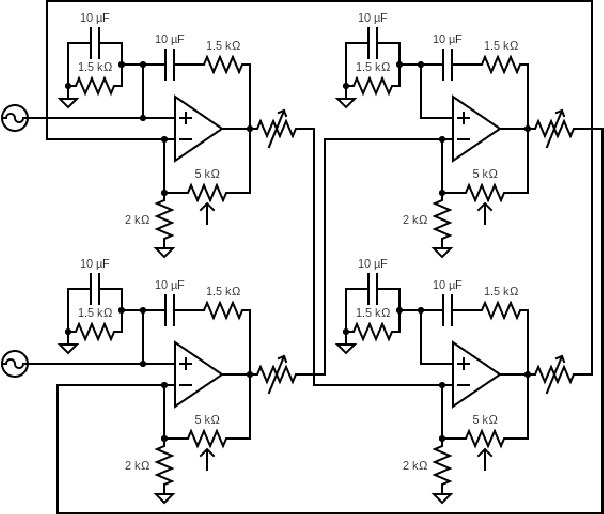
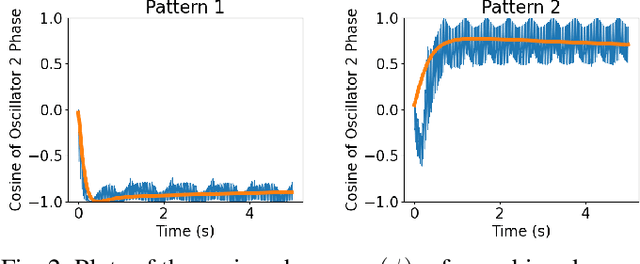
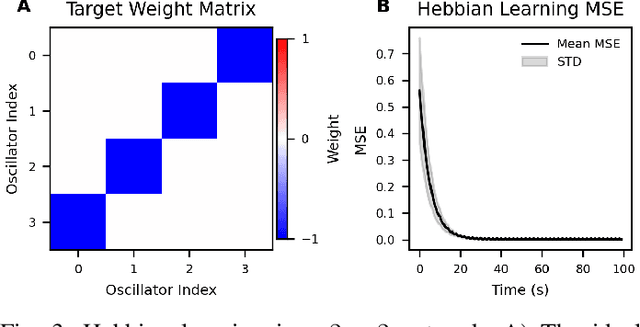
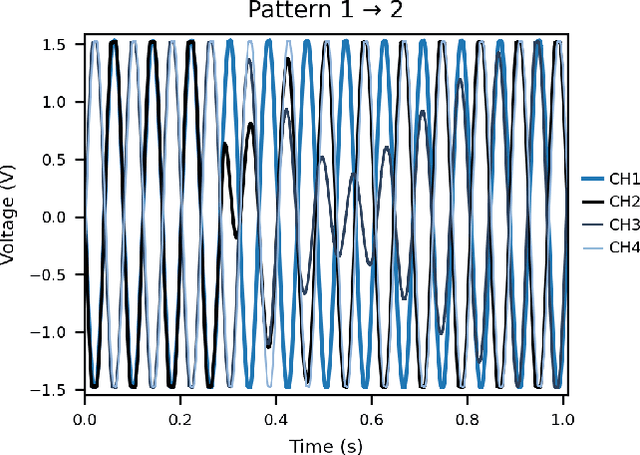
We present an oscillatory neuromorphic primitive implemented with networks of coupled Wien bridge oscillators and tunable resistive couplings. Phase relationships between oscillators encode patterns, and a local Hebbian learning rule continuously adapts the couplings, allowing learning and recall to emerge from the same ongoing analog dynamics rather than from separate training and inference phases. Using a Kuramoto-style phase model with an effective energy function, we show that learned phase patterns form attractor states and validate this behavior in simulation and hardware. We further realize a 2-4-2 architecture with a hidden layer of oscillators, whose bipartite visible-hidden coupling allows multiple internal configurations to produce the same visible phase states. When inputs are switched, transient spikes in energy followed by relaxation indicate how the network can reduce surprise by reshaping its energy landscape. These results support coupled oscillator circuits as a hardware platform for energy-based neuromorphic computing with autonomous, continuous learning.