 Add to Chrome
 Add to Firefox
 Add to Edge
Flexible Cutoff Learning: Optimizing Machine Learning Potentials After Training
Mar 10, 2026
We introduce Flexible Cutoff Learning (FCL), a method for training machine learning interatomic potentials (MLIPs) whose cutoff radii can be adjusted after training. Unlike conventional MLIPs that fix the cutoff radius during training, FCL models are trained by randomly sampling cutoff radii independently for each atom. The resulting model can then be deployed with different per-atom cutoff radii depending on the application, enabling application-specific optimization of the accuracy-cost tradeoff. Using a differentiable cost model, these per-atom cutoffs can be optimized for specific target systems after training. We demonstrate FCL with a modified MACE architecture trained on the MAD dataset. For a subset featuring molecular crystals, optimized per-atom cutoffs reduce computational cost by more than 60% while increasing force errors by less than 1%. These results show that FCL enables training of a single general-purpose MLIP that can be adapted to diverse applications through post-training cutoff optimization, eliminating the need for retraining.

On the Interplay of Subset Selection and Informed Graph Neural Networks
Jun 15, 2023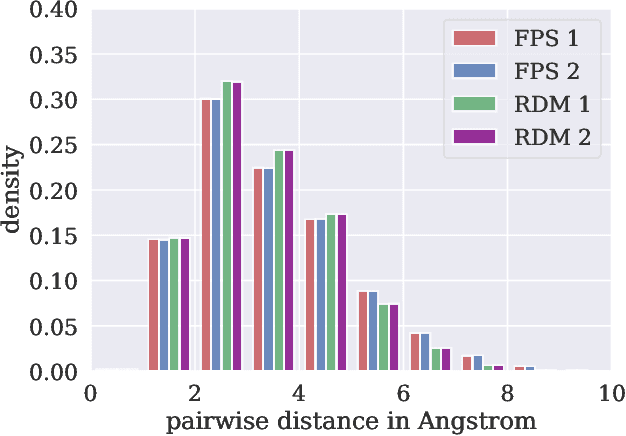
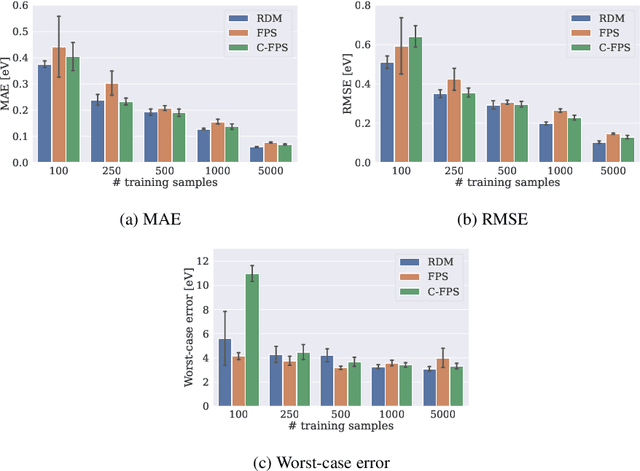


Machine learning techniques paired with the availability of massive datasets dramatically enhance our ability to explore the chemical compound space by providing fast and accurate predictions of molecular properties. However, learning on large datasets is strongly limited by the availability of computational resources and can be infeasible in some scenarios. Moreover, the instances in the datasets may not yet be labelled and generating the labels can be costly, as in the case of quantum chemistry computations. Thus, there is a need to select small training subsets from large pools of unlabelled data points and to develop reliable ML methods that can effectively learn from small training sets. This work focuses on predicting the molecules atomization energy in the QM9 dataset. We investigate the advantages of employing domain knowledge-based data sampling methods for an efficient training set selection combined with informed ML techniques. In particular, we show how maximizing molecular diversity in the training set selection process increases the robustness of linear and nonlinear regression techniques such as kernel methods and graph neural networks. We also check the reliability of the predictions made by the graph neural network with a model-agnostic explainer based on the rate distortion explanation framework.