 Add to Chrome
 Add to Firefox
 Add to Edge
PACUTE: Phonology-, Affix-, and Character-level Understanding of Tokens for Filipino
Jun 13, 2026
Large language models (LLMs) process text as sequences of subword tokens, which can obscure the character-level and morphological structure that underlies word formation. This limitation is most acute for languages with non-concatenative morphology, where standard tokenizers systematically misalign token boundaries with morpheme boundaries. We introduce PACUTE, a diagnostic benchmark of 4,600 tasks designed to evaluate morphological understanding in Filipino, a language characterized by productive infixation, reduplication, and diacritic-driven lexical distinctions that are typically absent from written text. PACUTE includes a hierarchical diagnostic framework of six compositional levels that localizes where morphological understanding breaks down. Evaluating open-weight LLMs and frontier commercial models, we find that open-weight models perform near chance on morpheme decomposition regardless of scale. Frontier models perform much better, often recovering individual affixes under contains-match scoring, but remain far below their character-level ceilings on compositional tasks of morpheme transformations and syllabification. These results identify productive morphological composition, rather than character access alone, as the persistent bottleneck for Filipino word-structure understanding.

Batayan: A Filipino NLP benchmark for evaluating Large Language Models
Feb 19, 2025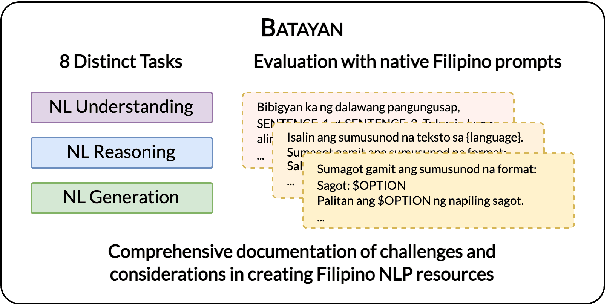
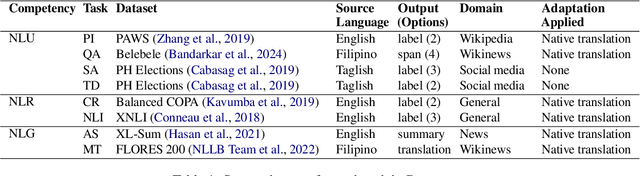
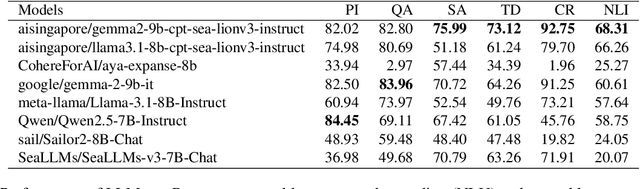
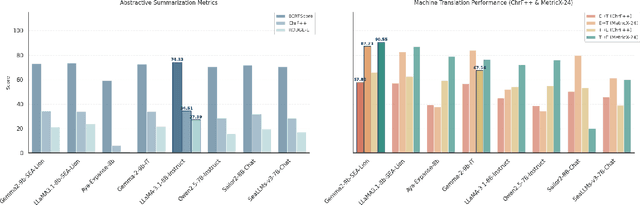
Recent advances in large language models (LLMs) have demonstrated remarkable capabilities on widely benchmarked high-resource languages; however, linguistic nuances of under-resourced languages remain unexplored. We introduce Batayan, a holistic Filipino benchmark designed to systematically evaluate LLMs across three key natural language processing (NLP) competencies: understanding, reasoning, and generation. Batayan consolidates eight tasks, covering both Tagalog and code-switched Taglish utterances. Our rigorous, native-speaker-driven annotation process ensures fluency and authenticity to the complex morphological and syntactic structures of Filipino, alleviating a pervasive translationese bias in existing Filipino corpora. We report empirical results on a variety of multilingual LLMs, highlighting significant performance gaps that signal the under-representation of Filipino in pretraining corpora, the unique hurdles in modeling Filipino's rich morphology and construction, and the importance of explicit Filipino language support and instruction tuning. Moreover, we discuss the practical challenges encountered in dataset construction and propose principled solutions for building culturally and linguistically-faithful resources in under-represented languages. We also provide a public benchmark and leaderboard as a clear foundation for iterative, community-driven progress in Filipino NLP.