 Add to Chrome
 Add to Firefox
 Add to Edge
Neurosim: A Fast Simulator for Neuromorphic Robot Perception
Feb 16, 2026
Neurosim is a fast, real-time, high-performance library for simulating sensors such as dynamic vision sensors, RGB cameras, depth sensors, and inertial sensors. It can also simulate agile dynamics of multi-rotor vehicles in complex and dynamic environments. Neurosim can achieve frame rates as high as ~2700 FPS on a desktop GPU. Neurosim integrates with a ZeroMQ-based communication library called Cortex to facilitate seamless integration with machine learning and robotics workflows. Cortex provides a high-throughput, low-latency message-passing system for Python and C++ applications, with native support for NumPy arrays and PyTorch tensors. This paper discusses the design philosophy behind Neurosim and Cortex. It demonstrates how they can be used to (i) train neuromorphic perception and control algorithms, e.g., using self-supervised learning on time-synchronized multi-modal data, and (ii) test real-time implementations of these algorithms in closed-loop. Neurosim and Cortex are available at https://github.com/grasp-lyrl/neurosim .

Fairer and More Accurate Tabular Models Through NAS
Oct 18, 2023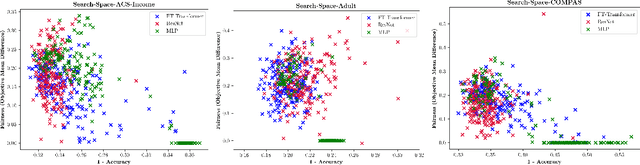
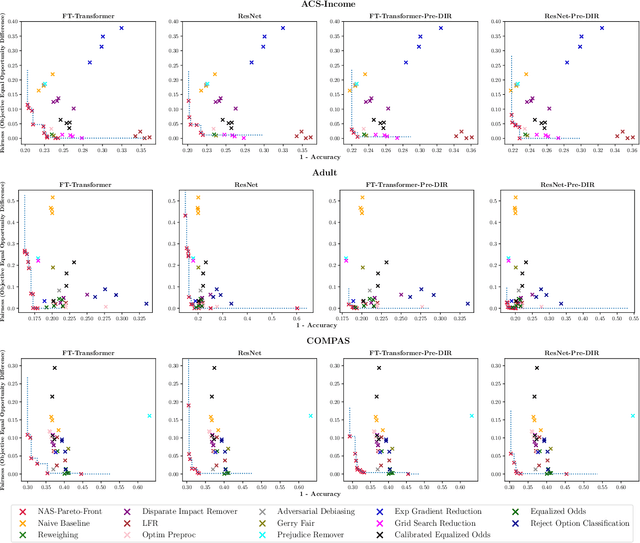
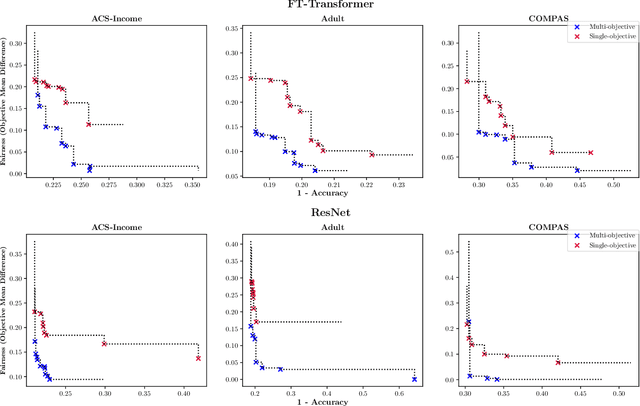
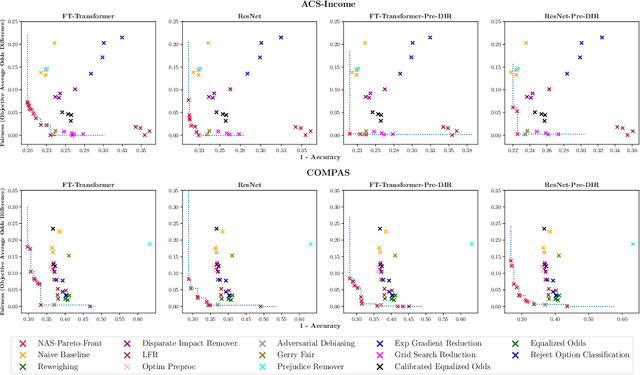
Making models algorithmically fairer in tabular data has been long studied, with techniques typically oriented towards fixes which usually take a neural model with an undesirable outcome and make changes to how the data are ingested, what the model weights are, or how outputs are processed. We employ an emergent and different strategy where we consider updating the model's architecture and training hyperparameters to find an entirely new model with better outcomes from the beginning of the debiasing procedure. In this work, we propose using multi-objective Neural Architecture Search (NAS) and Hyperparameter Optimization (HPO) in the first application to the very challenging domain of tabular data. We conduct extensive exploration of architectural and hyperparameter spaces (MLP, ResNet, and FT-Transformer) across diverse datasets, demonstrating the dependence of accuracy and fairness metrics of model predictions on hyperparameter combinations. We show that models optimized solely for accuracy with NAS often fail to inherently address fairness concerns. We propose a novel approach that jointly optimizes architectural and training hyperparameters in a multi-objective constraint of both accuracy and fairness. We produce architectures that consistently Pareto dominate state-of-the-art bias mitigation methods either in fairness, accuracy or both, all of this while being Pareto-optimal over hyperparameters achieved through single-objective (accuracy) optimization runs. This research underscores the promise of automating fairness and accuracy optimization in deep learning models.