 Add to Chrome
 Add to Firefox
 Add to Edge
Systematic Analysis of Penalty-Optimised Illumination Design for Tomographic Volumetric Additive Manufacturing via the Extendable Framework TVAM AID Using the Core Imaging Library
Feb 12, 2026
Tomographic Volumetric Additive Manufacturing(TVAM) is a novel manufacturing method that allows for the fast creation of objects of complex geometry in layerless fashion. The process is based on the solidification of photopolymer that occurs when a sufficient threshold dose of light-energy is absorbed. In order to create complex shapes, an illumination plan must be designed to force solidification in some desired areas while leaving other regions liquid. Determining an illumination plan can be considered as an optimisation problem where a variety of objective functionals (penalties) can be used. This work considers a selection of penalty functions and their impact on selected printing metrics; linking the shape of penalty functions to ranges of light-energy dose levels in in-part regions that should be printed and out-of-part regions that should remain liquid. Further, the threshold parameters that are typically used to demarcate minimum light-energy for in-part regions and maximum light-energy for out-of-part regions are investigated systematically as design parameters on both existing and new methods. This enables the characterisation of their effects on some selected printing metrics as well as informed selection for default values. This work is underpinned by a reproducible and extensible framework, TVAM Adaptive Illumination Design(TVAM AID), which makes use of the open-source Core Imaging Library(CIL) that is designed for tomographic imaging with an emphasis on reconstruction. The foundation of TVAM AID which is presented here can hence be easily enhanced by existing functionality in CIL thus lowering the barrier to entry and encouraging use of strategies that already exist for reconstruction optimisation.

Data-driven Evolutions of Critical Points
Nov 01, 2019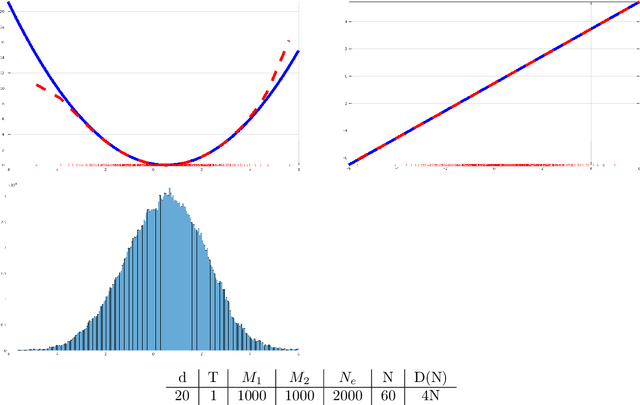
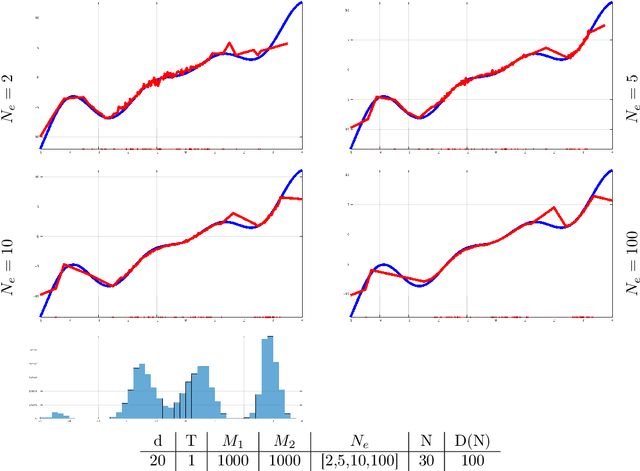
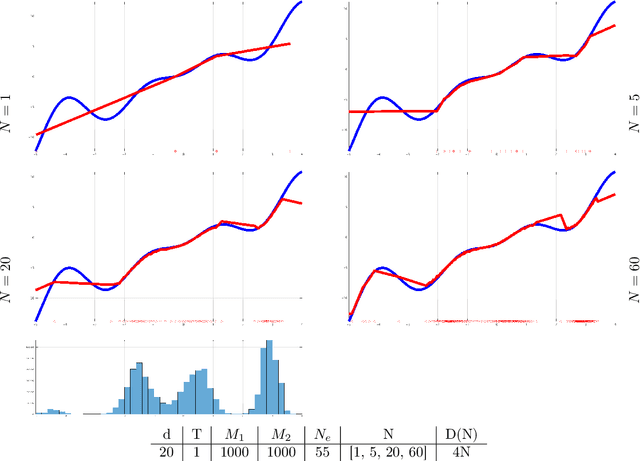
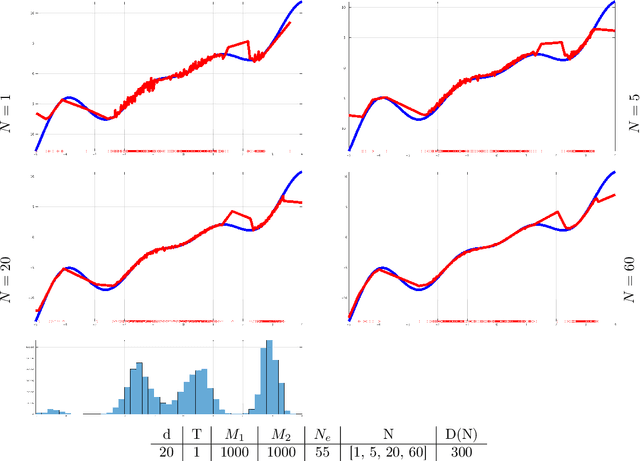
In this paper we are concerned with the learnability of energies from data obtained by observing time evolutions of their critical points starting at random initial equilibria. As a byproduct of our theoretical framework we introduce the novel concept of mean-field limit of critical point evolutions and of their energy balance as a new form of transport. We formulate the energy learning as a variational problem, minimizing the discrepancy of energy competitors from fulfilling the equilibrium condition along any trajectory of critical points originated at random initial equilibria. By Gamma-convergence arguments we prove the convergence of minimal solutions obtained from finite number of observations to the exact energy in a suitable sense. The abstract framework is actually fully constructive and numerically implementable. Hence, the approximation of the energy from a finite number of observations of past evolutions allows to simulate further evolutions, which are fully data-driven. As we aim at a precise quantitative analysis, and to provide concrete examples of tractable solutions, we present analytic and numerical results on the reconstruction of an elastic energy for a one-dimensional model of thin nonlinear-elastic rod.
Use of semantic technologies for the development of a dynamic trajectories generator in a Semantic Chemistry eLearning platform
Dec 07, 2010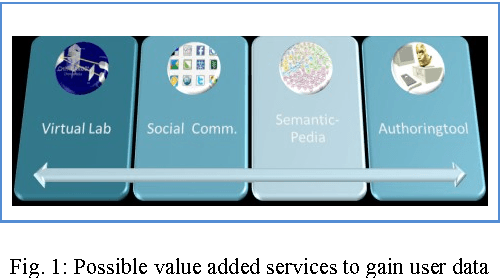

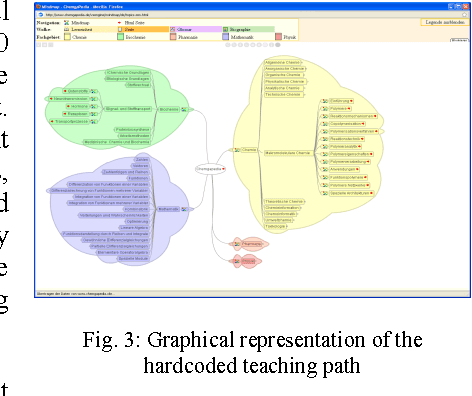
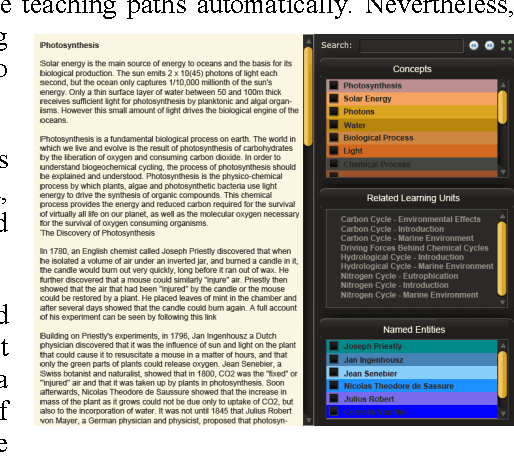
ChemgaPedia is a multimedia, webbased eLearning service platform that currently contains about 18.000 pages organized in 1.700 chapters covering the complete bachelor studies in chemistry and related topics of chemistry, pharmacy, and life sciences. The eLearning encyclopedia contains some 25.000 media objects and the eLearning platform provides services such as virtual and remote labs for experiments. With up to 350.000 users per month the platform is the most frequently used scientific educational service in the German spoken Internet. In this demo we show the benefit of mapping the static eLearning contents of ChemgaPedia to a Linked Data representation for Semantic Chemistry which allows for generating dynamic eLearning paths tailored to the semantic profiles of the users.