 Add to Chrome
 Add to Firefox
 Add to Edge
Natural Quantization of Neural Networks
Mar 19, 2025
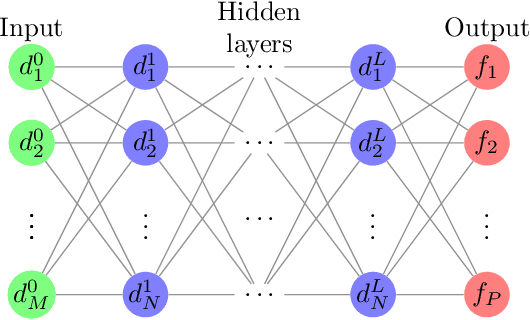
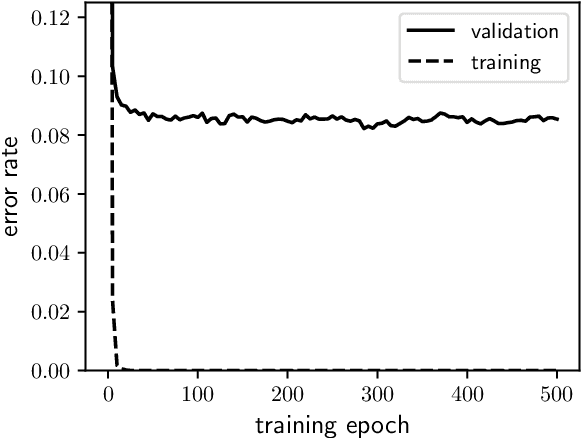
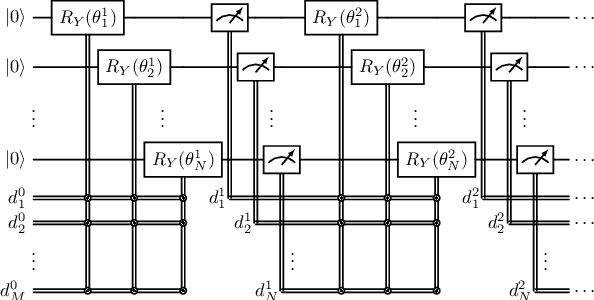
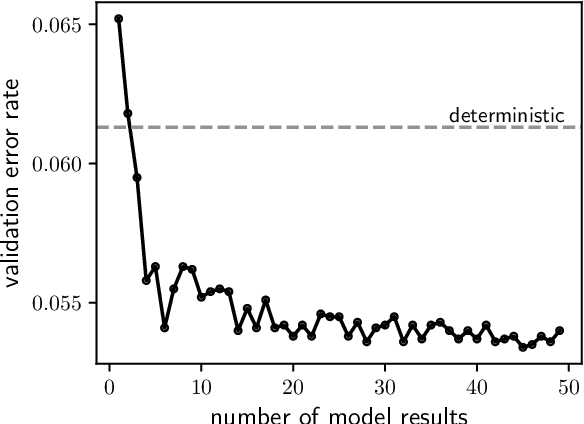
We propose a natural quantization of a standard neural network, where the neurons correspond to qubits and the activation functions are implemented via quantum gates and measurements. The simplest quantized neural network corresponds to applying single-qubit rotations, with the rotation angles being dependent on the weights and measurement outcomes of the previous layer. This realization has the advantage of being smoothly tunable from the purely classical limit with no quantum uncertainty (thereby reproducing the classical neural network exactly) to a quantum case, where superpositions introduce an intrinsic uncertainty in the network. We benchmark this architecture on a subset of the standard MNIST dataset and find a regime of "quantum advantage," where the validation error rate in the quantum realization is smaller than that in the classical model. We also consider another approach where quantumness is introduced via weak measurements of ancilla qubits entangled with the neuron qubits. This quantum neural network also allows for smooth tuning of the degree of quantumness by controlling an entanglement angle, $g$, with $g=\frac\pi 2$ replicating the classical regime. We find that validation error is also minimized within the quantum regime in this approach. We also observe a quantum transition, with sharp loss of the quantum network's ability to learn at a critical point $g_c$. The proposed quantum neural networks are readily realizable in present-day quantum computers on commercial datasets.

Neural Networks as Spin Models: From Glass to Hidden Order Through Training
Aug 12, 2024We explore a one-to-one correspondence between a neural network (NN) and a statistical mechanical spin model where neurons are mapped to Ising spins and weights to spin-spin couplings. The process of training an NN produces a family of spin Hamiltonians parameterized by training time. We study the magnetic phases and the melting transition temperature as training progresses. First, we prove analytically that the common initial state before training--an NN with independent random weights--maps to a layered version of the classical Sherrington-Kirkpatrick spin glass exhibiting a replica symmetry breaking. The spin-glass-to-paramagnet transition temperature is calculated. Further, we use the Thouless-Anderson-Palmer (TAP) equations--a theoretical technique to analyze the landscape of energy minima of random systems--to determine the evolution of the magnetic phases on two types of NNs (one with continuous and one with binarized activations) trained on the MNIST dataset. The two NN types give rise to similar results, showing a quick destruction of the spin glass and the appearance of a phase with a hidden order, whose melting transition temperature $T_c$ grows as a power law in training time. We also discuss the properties of the spectrum of the spin system's bond matrix in the context of rich vs. lazy learning. We suggest that this statistical mechanical view of NNs provides a useful unifying perspective on the training process, which can be viewed as selecting and strengthening a symmetry-broken state associated with the training task.