 Add to Chrome
 Add to Firefox
 Add to Edge
Nonlinear System Identification Nano-drone Benchmark
Dec 16, 2025
We introduce a benchmark for system identification based on 75k real-world samples from the Crazyflie 2.1 Brushless nano-quadrotor, a sub-50g aerial vehicle widely adopted in robotics research. The platform presents a challenging testbed due to its multi-input, multi-output nature, open-loop instability, and nonlinear dynamics under agile maneuvers. The dataset comprises four aggressive trajectories with synchronized 4-dimensional motor inputs and 13-dimensional output measurements. To enable fair comparison of identification methods, the benchmark includes a suite of multi-horizon prediction metrics for evaluating both one-step and multi-step error propagation. In addition to the data, we provide a detailed description of the platform and experimental setup, as well as baseline models highlighting the challenge of accurate prediction under real-world noise and actuation nonlinearities. All data, scripts, and reference implementations are released as open-source at https://github.com/idsia-robotics/nanodrone-sysid-benchmark to facilitate transparent comparison of algorithms and support research on agile, miniaturized aerial robotics.

Learning Low-Dimensional Embeddings for Black-Box Optimization
May 02, 2025When gradient-based methods are impractical, black-box optimization (BBO) provides a valuable alternative. However, BBO often struggles with high-dimensional problems and limited trial budgets. In this work, we propose a novel approach based on meta-learning to pre-compute a reduced-dimensional manifold where optimal points lie for a specific class of optimization problems. When optimizing a new problem instance sampled from the class, black-box optimization is carried out in the reduced-dimensional space, effectively reducing the effort required for finding near-optimal solutions.
In-Context Learning for Zero-Shot Speed Estimation of BLDC motors
Apr 01, 2025Accurate speed estimation in sensorless brushless DC motors is essential for high-performance control and monitoring, yet conventional model-based approaches struggle with system nonlinearities and parameter uncertainties. In this work, we propose an in-context learning framework leveraging transformer-based models to perform zero-shot speed estimation using only electrical measurements. By training the filter offline on simulated motor trajectories, we enable real-time inference on unseen real motors without retraining, eliminating the need for explicit system identification while retaining adaptability to varying operating conditions. Experimental results demonstrate that our method outperforms traditional Kalman filter-based estimators, especially in low-speed regimes that are crucial during motor startup.
Hawkes-based cryptocurrency forecasting via Limit Order Book data
Dec 21, 2023Accurately forecasting the direction of financial returns poses a formidable challenge, given the inherent unpredictability of financial time series. The task becomes even more arduous when applied to cryptocurrency returns, given the chaotic and intricately complex nature of crypto markets. In this study, we present a novel prediction algorithm using limit order book (LOB) data rooted in the Hawkes model, a category of point processes. Coupled with a continuous output error (COE) model, our approach offers a precise forecast of return signs by leveraging predictions of future financial interactions. Capitalizing on the non-uniformly sampled structure of the original time series, our strategy surpasses benchmark models in both prediction accuracy and cumulative profit when implemented in a trading environment. The efficacy of our approach is validated through Monte Carlo simulations across 50 scenarios. The research draws on LOB measurements from a centralized cryptocurrency exchange where the stablecoin Tether is exchanged against the U.S. dollar.
META-SMGO-$Δ$: similarity as a prior in black-box optimization
Apr 30, 2023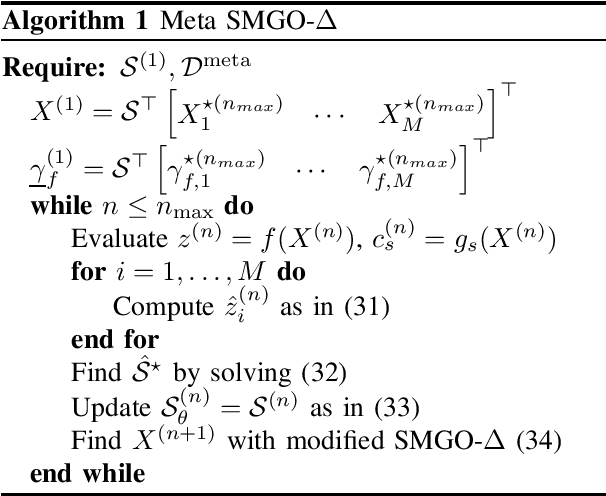
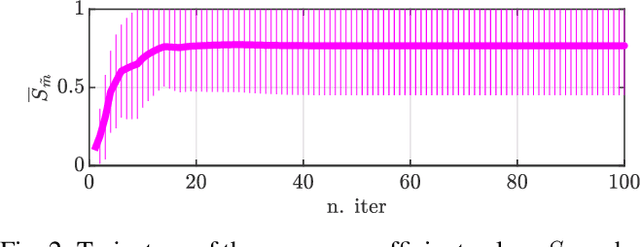
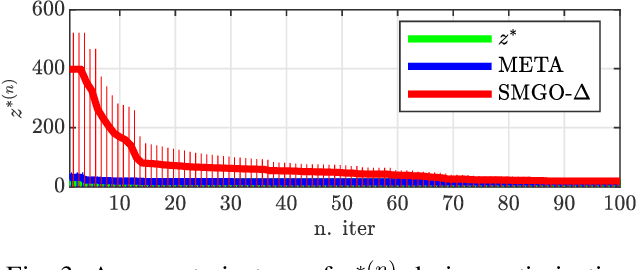
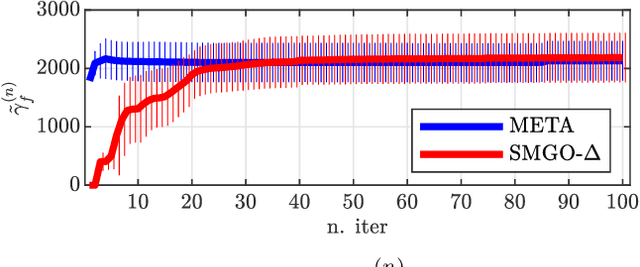
When solving global optimization problems in practice, one often ends up repeatedly solving problems that are similar to each others. By providing a rigorous definition of similarity, in this work we propose to incorporate the META-learning rationale into SMGO-$\Delta$, a global optimization approach recently proposed in the literature, to exploit priors obtained from similar past experience to efficiently solve new (similar) problems. Through a benchmark numerical example we show the practical benefits of our META-extension of the baseline algorithm, while providing theoretical bounds on its performance.