 Add to Chrome
 Add to Firefox
 Add to Edge
Imbalanced Classification under Capacity Constraints
May 05, 2026
In many classification settings, the class of primary interest is underrepresented, leading to imbalanced data problems that arise in applications such as rare disease detection and fraud identification. In these contexts, identifying a potential positive instance typically triggers costly follow-up actions, such as medical imaging or detailed transaction inspection, which are subject to limited operational capacity. Motivated by this setting, we consider classification problems where data may arrive sequentially and decisions must be made under constraints on the number of instances that can be selected for further analysis. We propose a classification framework that explicitly controls the rate of positive predictions, enforcing a user-defined bound on the proportion of observations classified as belonging to the minority class while maximizing detection performance. The approach can be implemented using standard learning methods and naturally extends to online settings, where decisions are taken in real time. We show that incorporating capacity constraints leads to substantial improvements over classical approaches, including resampling techniques such as SMOTE, which do not directly control the selection rate.

Semi-supervised learning
Dec 15, 2017


Semi-supervised learning deals with the problem of how, if possible, to take advantage of a huge amount of not classified data, to perform classification, in situations when, typically, the labelled data are few. Even though this is not always possible (it depends on how useful is to know the distribution of the unlabelled data in the inference of the labels), several algorithm have been proposed recently. A new algorithm is proposed, that under almost neccesary conditions, attains asymptotically the performance of the best theoretical rule, when the size of unlabeled data tends to infinity. The set of necessary assumptions, although reasonables, show that semi-parametric classification only works for very well conditioned problems.
A nonlinear aggregation type classifier
Sep 09, 2015


We introduce a nonlinear aggregation type classifier for functional data defined on a separable and complete metric space. The new rule is built up from a collection of $M$ arbitrary training classifiers. If the classifiers are consistent, then so is the aggregation rule. Moreover, asymptotically the aggregation rule behaves as well as the best of the $M$ classifiers. The results of a small simulation are reported both, for high dimensional and functional data, and a real data example is analyzed.
Clustering using Unsupervised Binary Trees: CUBT
Oct 27, 2011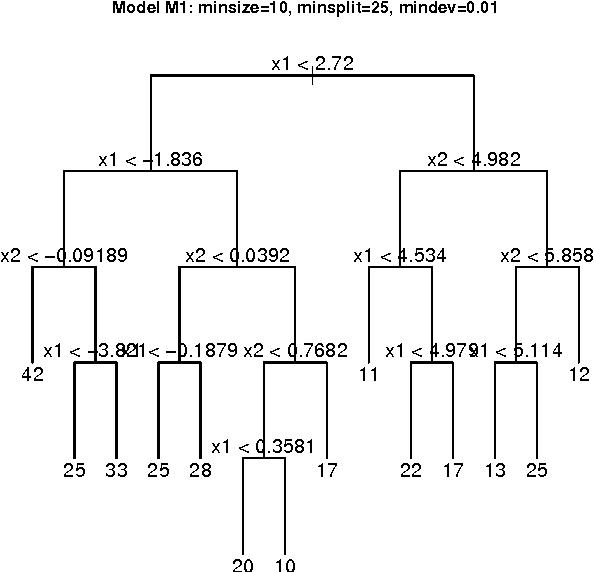
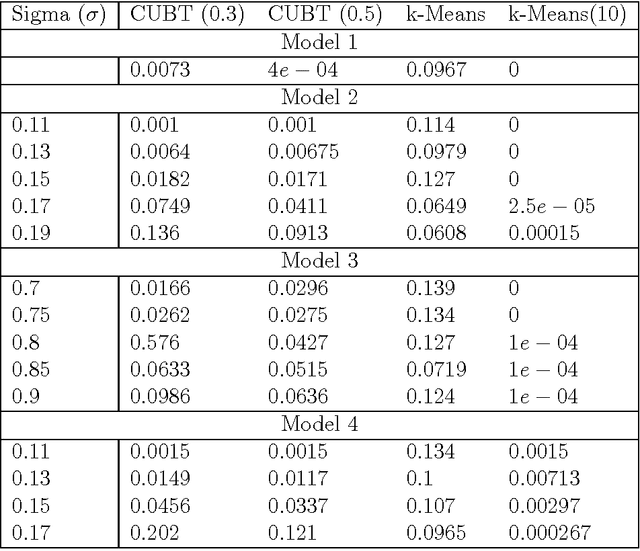
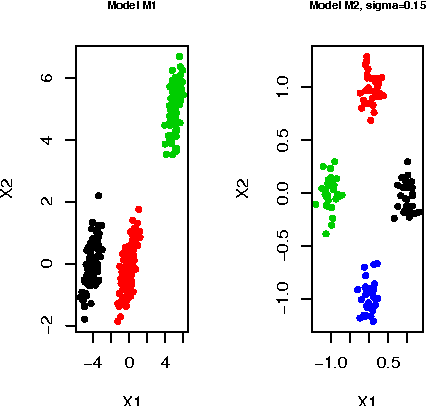
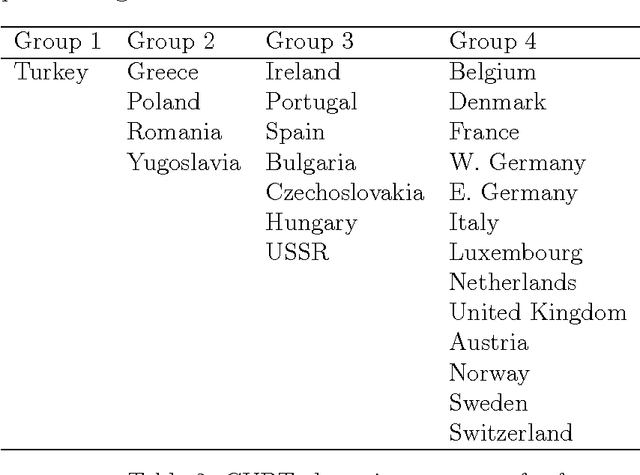
We herein introduce a new method of interpretable clustering that uses unsupervised binary trees. It is a three-stage procedure, the first stage of which entails a series of recursive binary splits to reduce the heterogeneity of the data within the new subsamples. During the second stage (pruning), consideration is given to whether adjacent nodes can be aggregated. Finally, during the third stage (joining), similar clusters are joined together, even if they do not share the same parent originally. Consistency results are obtained, and the procedure is used on simulated and real data sets.