 Add to Chrome
 Add to Firefox
 Add to Edge
LLM-Driven Evolutionary Generation of Multi-Objective Bayesian Optimization Algorithms
Jul 06, 2026
Designing effective multi-objective Bayesian optimization (MOBO) algorithms requires balancing many interdependent design choices whose optimal configuration is problem-dependent and typically demands deep expertise. We extend the LLaMEA framework to MOBO, using large language models as mutation and crossover operators within evolutionary strategies to generate complete algorithm implementations, with SMAC hyperparameter optimization integrated into the evolutionary loop. Across nine evolutionary runs we generated approximately 900 algorithms and benchmarked them on twelve synthetic problems (ZDT, DTLZ, WFG) and three real-world engineering problems (RE), using a BoFire qParEGO implementation as a state-of-the-art Bayesian-optimization baseline. On the synthetic suite the strongest generated algorithm attains the highest mean normalized hypervolume (0.971, vs. 0.869 for qParEGO) while requiring roughly 60x less wall-clock time; a Friedman test with post-hoc analysis places the two in a single top-performing group, and per-problem tests find the generated algorithm significantly better than qParEGO on 7 of the 12 problems and never worse, matching state-of-the-art accuracy at an order-of-magnitude lower cost. On the three unseen real-world engineering problems a generated algorithm attains the best mean normalized hypervolume (0.985, vs. 0.971 for qParEGO)--significantly better than qParEGO on two of the three problems--at roughly 3.4x lower wall-clock cost, confirming that the gains transfer beyond the synthetic regime. LLM-driven evolutionary search can thus discover algorithm designs that achieve Pareto-efficient trade-offs difficult to reach through manual design.

Sometimes You Want to Go Where Everybody Knows your Name
Jan 30, 2018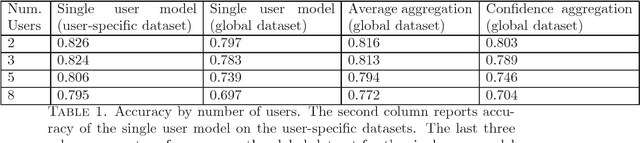
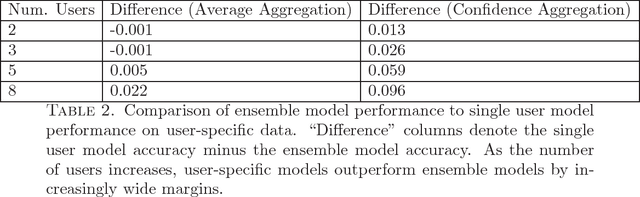
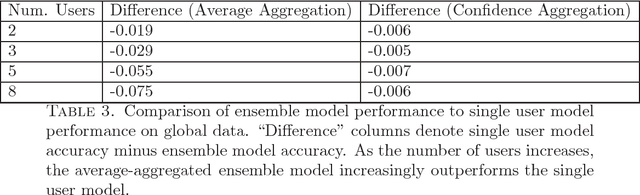
We introduce a new metric for measuring how well a model personalizes to a user's specific preferences. We define personalization as a weighting between performance on user specific data and performance on a more general global dataset that represents many different users. This global term serves as a form of regularization that forces us to not overfit to individual users who have small amounts of data. In order to protect user privacy, we add the constraint that we may not centralize or share user data. We also contribute a simple experiment in which we simulate classifying sentiment for users with very distinct vocabularies. This experiment functions as an example of the tension between doing well globally on all users, and doing well on any specific individual user. It also provides a concrete example of how to employ our new metric to help reason about and resolve this tension. We hope this work can help frame and ground future work into personalization.