 Add to Chrome
 Add to Firefox
 Add to Edge
Towards Load-Aware Prefill Deflection for Disaggregated LLM Serving
Jul 02, 2026
Disaggregated LLM serving runs prefill and decode on separate GPU pools to keep the two phases from interfering. In practice, this creates a new asymmetry: under bursty, heavy-tailed workloads prefill nodes saturate while decode nodes have compute underutilized, and on a production-style A100 cluster with 2 prefill and 2 decode nodes (2P2D), we find that prefill execution accounts for only 2-23% of P95 Time-to-First-Token (TTFT). Queuing and inter-node GPU-GPU KV-cache transfer account for the rest. We present a proactive prefill-deflecting scheduler that lets decode nodes serve prefill phase of requests as chunked-prefill steps interleaved with their in-flight decode batches. For each queued request, we estimate the TTFT it would see on the prefill node, and on every decode node, search for the largest chunk schedule that keeps in-flight decodes within their Time-Between-Tokens (TBT) SLO and deflect when the decode path helps tail latency. Because the prefill phase of deflected requests runs in place on the decode node, the inter-node KV transfer is eliminated. Implemented on vLLM and evaluated on production-style traces with DeepSeek-V2-Lite, our approach reduces P95 TTFT by upto 81% and raises SLO attainment by upto 79% over state-of-the-art disaggregated schedulers, at sub-millisecond per-request routing cost.

Lean Attention: Hardware-Aware Scalable Attention Mechanism for the Decode-Phase of Transformers
May 17, 2024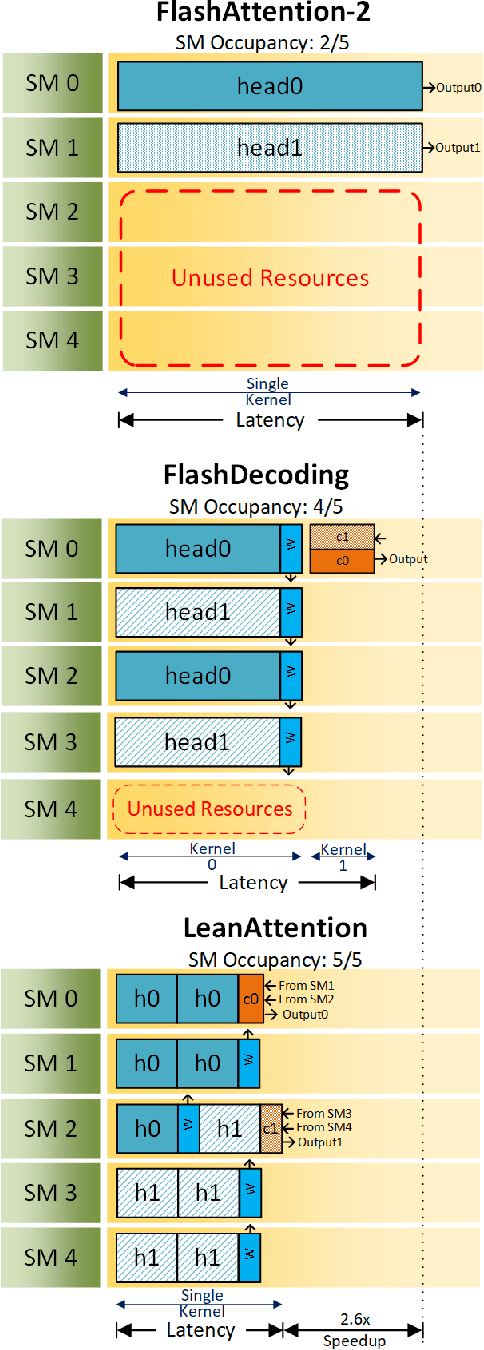
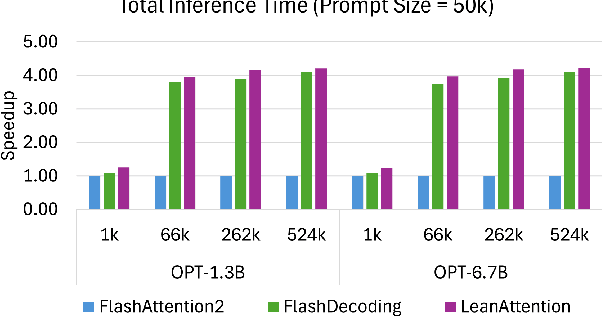
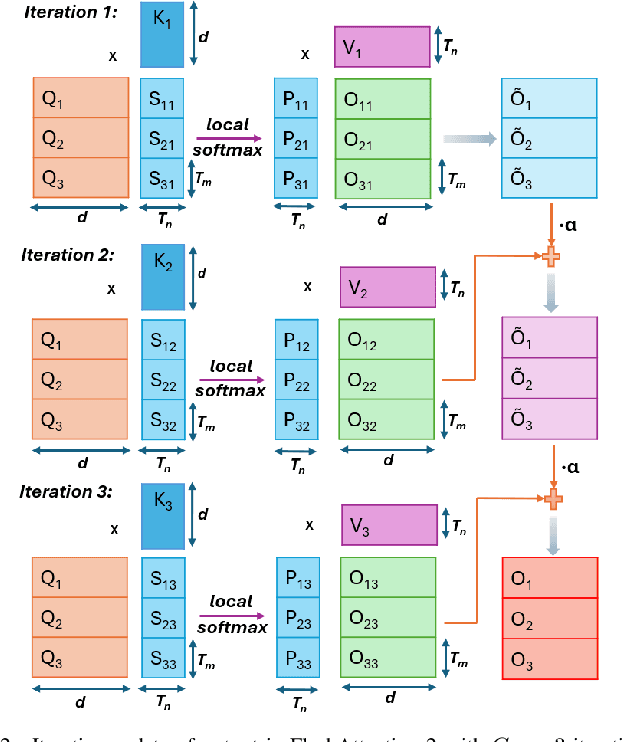
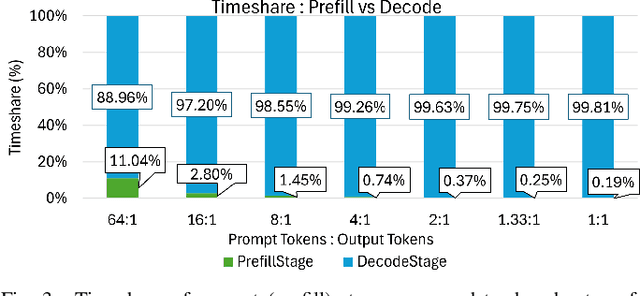
Transformer-based models have emerged as one of the most widely used architectures for natural language processing, natural language generation, and image generation. The size of the state-of-the-art models has increased steadily reaching billions of parameters. These huge models are memory hungry and incur significant inference latency even on cutting edge AI-accelerators, such as GPUs. Specifically, the time and memory complexity of the attention operation is quadratic in terms of the total context length, i.e., prompt and output tokens. Thus, several optimizations such as key-value tensor caching and FlashAttention computation have been proposed to deliver the low latency demands of applications relying on such large models. However, these techniques do not cater to the computationally distinct nature of different phases during inference. To that end, we propose LeanAttention, a scalable technique of computing self-attention for the token-generation phase (decode-phase) of decoder-only transformer models. LeanAttention enables scaling the attention mechanism implementation for the challenging case of long context lengths by re-designing the execution flow for the decode-phase. We identify that the associative property of online softmax can be treated as a reduction operation thus allowing us to parallelize the attention computation over these large context lengths. We extend the "stream-K" style reduction of tiled calculation to self-attention to enable parallel computation resulting in an average of 2.6x attention execution speedup over FlashAttention-2 and up to 8.33x speedup for 512k context lengths.