 Add to Chrome
 Add to Firefox
 Add to Edge
Diversed Model Discovery via Structured Table Discovery
May 21, 2026
Model cards describe model behavior through a mixture of textual descriptions and structured artifacts, including performance, configuration, and dataset tables. Existing model search systems rely predominantly on semantic similarity over text, which can produce homogeneous result sets and limit exploration of alternatives. We argue that model search is inherently comparative: users want models that are task-aligned yet differentiated in measurable ways. We hypothesize that this balance requires retrieval over condensed, high-quality evidence rather than verbose descriptions, and much of that evidence is concentrated in structured tables. We present StructuredSemanticSearch, a table-driven model search framework built on the ModelTables benchmark. Given a query, StructuredSemanticSearch combines a semantic baseline for task alignment with a structure-aware pipeline that discovers query-related model-card tables using table discovery operators such as unionability, joinability, and keyword search. Retrieved tables are mapped back to model cards under a controlled top-k budget, enabling fair comparison between text-based and table-based retrieval. Beyond retrieval, StructuredSemanticSearch adapts table integration to the model-table domain through orientation-aware integration, producing compact integrated views of tables from partially overlapping and sometimes transposed evidence tables. For evaluation, we introduce a nugget-based, auditable protocol that extracts compact evidence items from model cards, matches queries to condition- or intent-specific nuggets, and measures evidence coverage and diversity over retrieved model-card candidate sets. This protocol also provides a scalable path toward approximate, evidence-based labeling in dynamic model lakes. Experiments on 597 model-recommendation queries show improved nugget coverage for the structure-aware pipeline than semantic baseline

ModelTables: A Corpus of Tables about Models
Dec 18, 2025We present ModelTables, a benchmark of tables in Model Lakes that captures the structured semantics of performance and configuration tables often overlooked by text only retrieval. The corpus is built from Hugging Face model cards, GitHub READMEs, and referenced papers, linking each table to its surrounding model and publication context. Compared with open data lake tables, model tables are smaller yet exhibit denser inter table relationships, reflecting tightly coupled model and benchmark evolution. The current release covers over 60K models and 90K tables. To evaluate model and table relatedness, we construct a multi source ground truth using three complementary signals: (1) paper citation links, (2) explicit model card links and inheritance, and (3) shared training datasets. We present one extensive empirical use case for the benchmark which is table search. We compare canonical Data Lake search operators (unionable, joinable, keyword) and Information Retrieval baselines (dense, sparse, hybrid retrieval) on this benchmark. Union based semantic table retrieval attains 54.8 % P@1 overall (54.6 % on citation, 31.3 % on inheritance, 30.6 % on shared dataset signals); table based dense retrieval reaches 66.5 % P@1, and metadata hybrid retrieval achieves 54.1 %. This evaluation indicates clear room for developing better table search methods. By releasing ModelTables and its creation protocol, we provide the first large scale benchmark of structured data describing AI model. Our use case of table discovery in Model Lakes, provides intuition and evidence for developing more accurate semantic retrieval, structured comparison, and principled organization of structured model knowledge. Source code, data, and other artifacts have been made available at https://github.com/RJMillerLab/ModelTables.
Fuzzy Integration of Data Lake Tables
Jan 16, 2025Data integration is an important step in any data science pipeline where the objective is to unify the information available in different datasets for comprehensive analysis. Full Disjunction, which is an associative extension of the outer join operator, has been shown to be an effective operator for integrating datasets. It fully preserves and combines the available information. Existing Full Disjunction algorithms only consider the equi-join scenario where only tuples having the same value on joining columns are integrated. This, however, does not realistically represent an open data scenario, where datasets come from diverse sources with inconsistent values (e.g., synonyms, abbreviations, etc.) and with limited metadata. So, joining just on equal values severely limits the ability of Full Disjunction to fully combine datasets. Thus, in this work, we propose an extension of Full Disjunction to also account for "fuzzy" matches among tuples. We present a novel data-driven approach to enable the joining of approximate or fuzzy matches within Full Disjunction. Experimentally, we show that fuzzy Full Disjunction does not add significant time overhead over a state-of-the-art Full Disjunction implementation and also that it enhances the integration effectiveness.
Model Lakes
Mar 04, 2024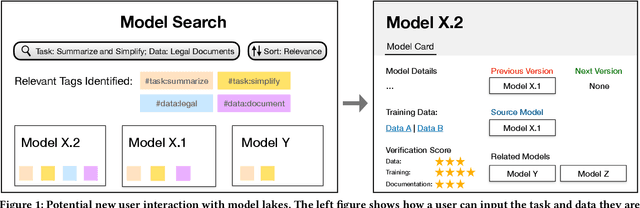
Given a set of deep learning models, it can be hard to find models appropriate to a task, understand the models, and characterize how models are different one from another. Currently, practitioners rely on manually-written documentation to understand and choose models. However, not all models have complete and reliable documentation. As the number of machine learning models increases, this issue of finding, differentiating, and understanding models is becoming more crucial. Inspired from research on data lakes, we introduce and define the concept of model lakes. We discuss fundamental research challenges in the management of large models. And we discuss what principled data management techniques can be brought to bear on the study of large model management.
Generative Benchmark Creation for Table Union Search
Aug 07, 2023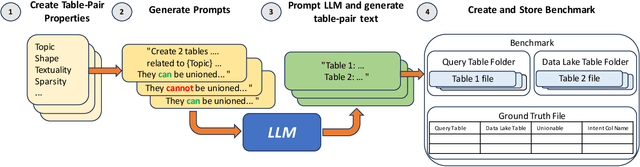
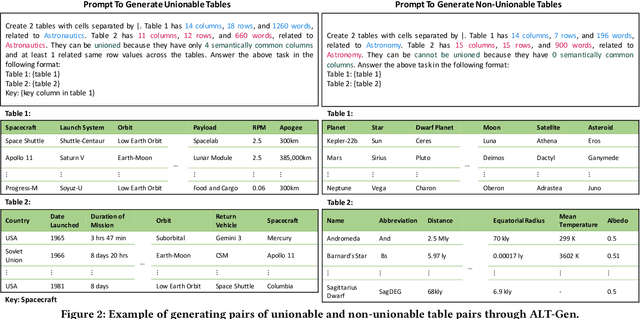
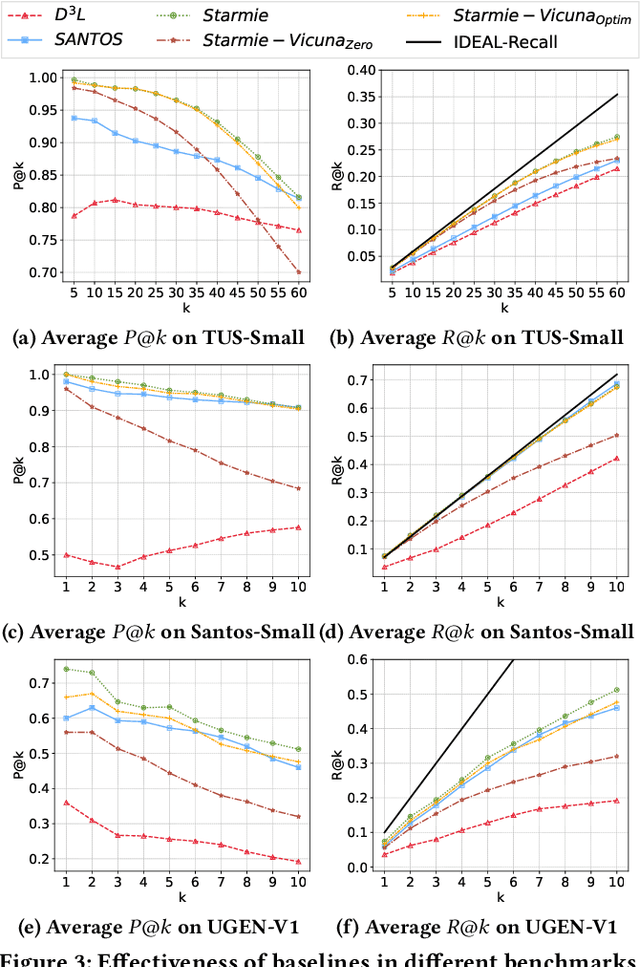
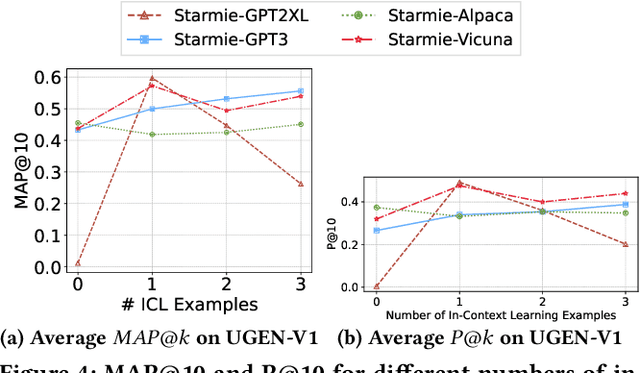
Data management has traditionally relied on synthetic data generators to generate structured benchmarks, like the TPC suite, where we can control important parameters like data size and its distribution precisely. These benchmarks were central to the success and adoption of database management systems. But more and more, data management problems are of a semantic nature. An important example is finding tables that can be unioned. While any two tables with the same cardinality can be unioned, table union search is the problem of finding tables whose union is semantically coherent. Semantic problems cannot be benchmarked using synthetic data. Our current methods for creating benchmarks involve the manual curation and labeling of real data. These methods are not robust or scalable and perhaps more importantly, it is not clear how robust the created benchmarks are. We propose to use generative AI models to create structured data benchmarks for table union search. We present a novel method for using generative models to create tables with specified properties. Using this method, we create a new benchmark containing pairs of tables that are both unionable and non-unionable but related. We thoroughly evaluate recent existing table union search methods over existing benchmarks and our new benchmark. We also present and evaluate a new table search methods based on recent large language models over all benchmarks. We show that the new benchmark is more challenging for all methods than hand-curated benchmarks, specifically, the top-performing method achieves a Mean Average Precision of around 60%, over 30% less than its performance on existing manually created benchmarks. We examine why this is the case and show that the new benchmark permits more detailed analysis of methods, including a study of both false positives and false negatives that were not possible with existing benchmarks.