 Add to Chrome
 Add to Firefox
 Add to Edge
Enabling 6G Wireless Communications: UWB Characterization of Corridors within the H-Band
Mar 19, 2026
Future sixth-generation of wireless system is expected to provide data-rates in the order of 1 Tbps and latencies below 1 ms. Among others, one of the most promising strategies to meet these requirements is to operate at higher frequencies than millimeter wave bands: the THz bands. Nevertheless, because of the higher losses and the detriment of classical propagation mechanisms, deploying systems operating at these frequencies becomes a real challenge. Consequently, short-range scenarios are of special interest since these effects of THz bands can be managed. This work conducts an extensive campaign within corridors at frequencies within the H-band in the range from 250 GHz to 330 GHz. For the first time in literature, an ultra wideband of 80 GHz is studied simultaneously. Large scale effects are assessed by estimating and modeling path gain. The path gain exponent varies between -2.1 and -1.6, which is explained by a guiding effect also observed at millimeter wave bands. Small scale effects are also evaluated in terms of parameters such as rice $K$-factor, root mean squared delay spread and coherence bandwidth. Additionally, an analytical approximation based on the classical N-rays model is proposed obtaining an accurate representation of the wireless channel which is coherent with the empirical analysis. The full analysis reveals the suitability of these THz bands for deploying point-to-point links due to the predominance of the line-of-sight contribution respect to the reflected components.

Site-Specific Radio Channel Representation -- Current State and Future Applications
Jun 18, 2024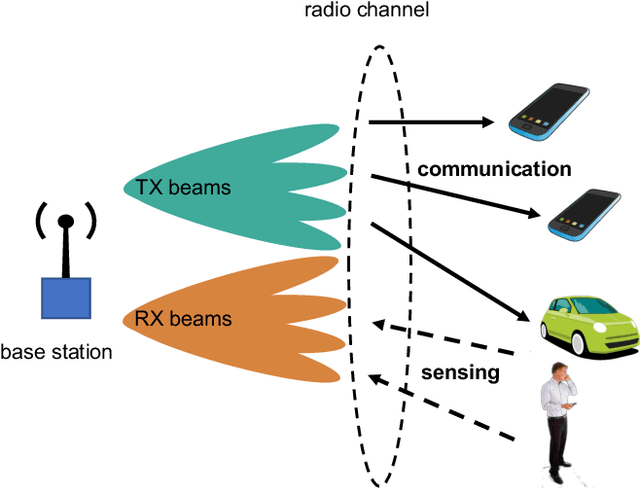
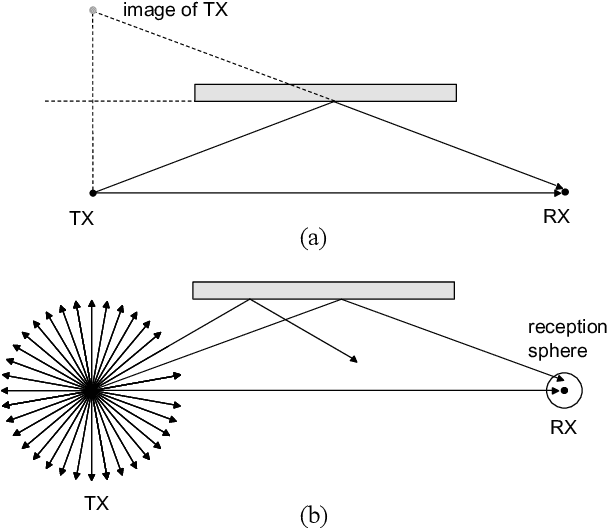
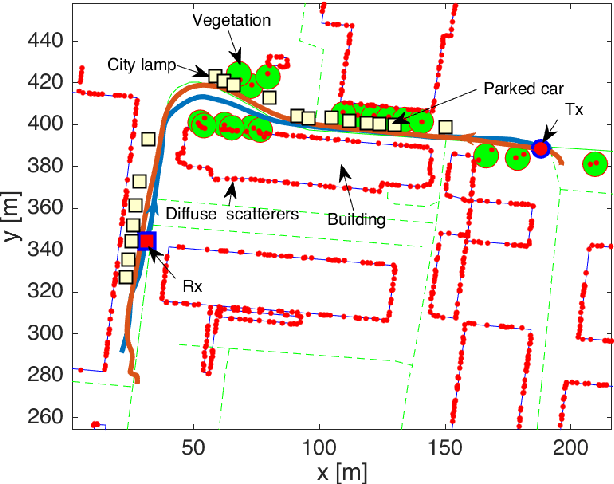
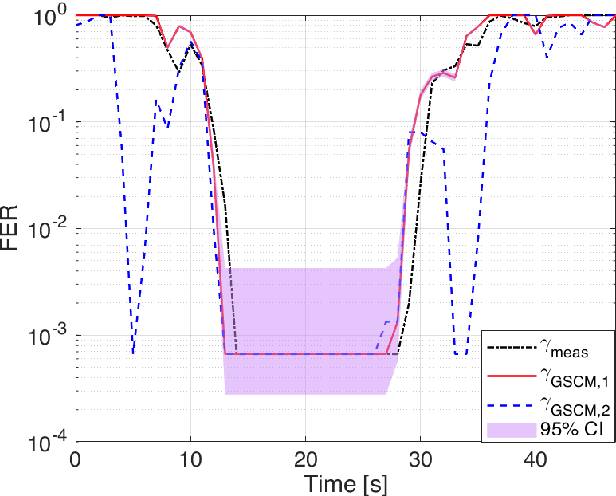
A site-specific radio channel representation considers the surroundings of the communication system through the environment geometry, such as buildings, vegetation, and mobile objects including their material and surface properties. In this article, we focus on communication technologies for 5G and beyond that are increasingly able to exploit the specific environment geometry for both communication and sensing. We present methods for a site-specific radio channel representation that is spatially consistent, such that mobile transmitter and receveiver cause a correlated time-varying channel impulse response. When modelled as random, this channel impulse response has non-stationary statistical properties, i.e., a time-variant Doppler spectrum, power delay profile, K-factor and spatial correlation. A site-specific radio channel representation will enable research into emerging 5G and beyond technologies such as distributed multiple-input multiple-output systems, reconfigurable intelligent surfaces, multi-band communication, and joint communication and sensing. These 5G and beyond technologies will be deployed for a wide range of environments, from dense urban areas to railways, road transportation, industrial automation, and unmanned aerial vehicles.