 Add to Chrome
 Add to Firefox
 Add to Edge
PPI is the Difference Estimator: Recognizing the Survey Sampling Roots of Prediction-Powered Inference
Mar 19, 2026
Prediction-powered inference (PPI) is a rapidly growing framework for combining machine learning predictions with a small set of gold-standard labels to conduct valid statistical inference. In this article, I argue that the core estimators underlying PPI are equivalent to well-established estimators from the survey sampling literature dating back to the 1970s. Specifically, the PPI estimator for a population mean is algebraically equivalent to the difference estimator of Cassel et al. (1976), and PPI plus corresponds to the generalized regression (GREG) estimator of Sarndal et al. (2003). Recognizing this equivalence, I consider what part of PPI is inherited from a long-standing literature in statistics, what part is genuinely new, and where inferential claims require care. After introducing the two frameworks and establishing their equivalence, I break down where PPI diverges from model-assisted estimation, including differences in the mode of inference, the role of the unlabeled data pool, and the consequences of differential prediction error for subgroup estimands such as the average treatment effect. I then identify what each framework offers the other: PPI researchers can draw on the survey sampling literature's well-developed theory of calibration, optimal allocation, and design-based diagnostics, while survey sampling researchers can benefit from PPI's extensions to non-standard estimands and its accessible software ecosystem. The article closes with a call for integration between these two communities, motivated by the growing use of large language models as measurement instruments in applied research.

Matching with Text Data: An Experimental Evaluation of Methods for Matching Documents and of Measuring Match Quality
Oct 03, 2018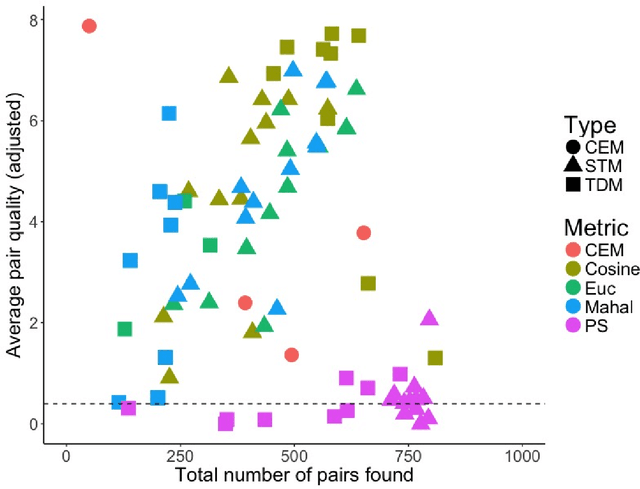
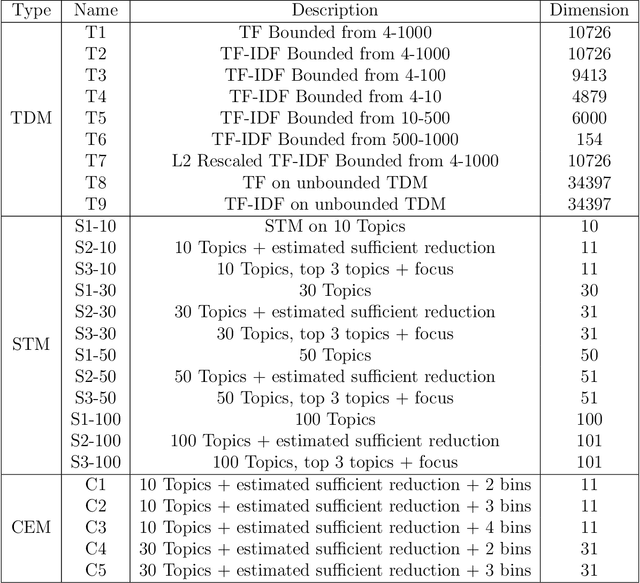
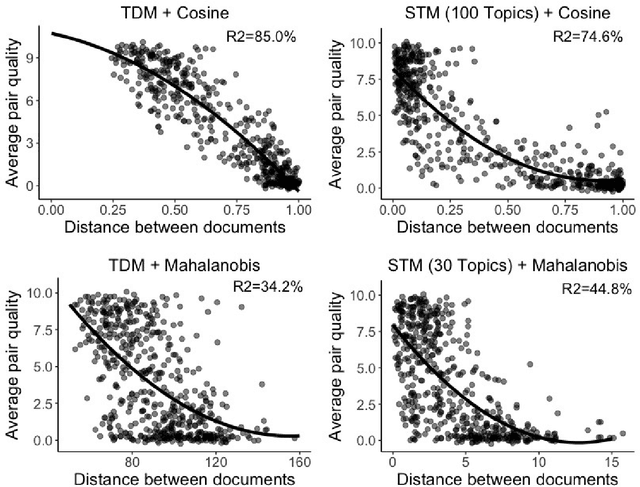
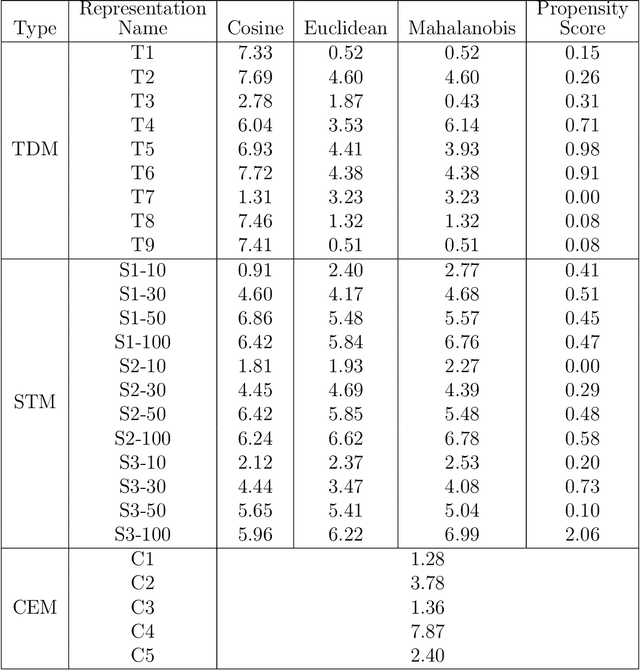
Matching for causal inference is a well-studied problem, but standard methods fail when the units to match are text documents: the high-dimensional and rich nature of the data renders exact matching infeasible, causes propensity scores to produce incomparable matches, and makes assessing match quality difficult. In this paper, we characterize a framework for matching text documents that decomposes existing methods into: (1) the choice of text representation, and (2) the choice of distance metric. We investigate how different choices within this framework affect both the quantity and quality of matches identified through a systematic multifactor evaluation experiment using human subjects. Altogether we evaluate over 100 unique text matching methods along with 5 comparison methods taken from the literature. Our experimental results identify methods that generate matches with higher subjective match quality than current state-of-the-art techniques. We enhance the precision of these results by developing a predictive model to estimate the match quality of pairs of text documents as a function of our various distance scores. This model, which we find successfully mimics human judgment, also allows for approximate and unsupervised evaluation of new procedures. We then employ the identified best method to illustrate the utility of text matching in two applications. First, we engage with a substantive debate in the study of media bias by using text matching to control for topic selection when comparing news articles from thirteen news sources. We then show how conditioning on text data leads to more precise causal inferences in an observational study examining the effects of a medical intervention.