 Add to Chrome
 Add to Firefox
 Add to Edge
Zadoff-Chu Sequences for Chirp-Domain Communication: Diversity-Complexity Tradeoffs in Doubly Dispersive Channels
Aug 04, 2026
Orthogonal frequency-division multiplexing (OFDM) combats multipath-induced time dispersion by dividing the channel into narrowband sub-channels. However, when the channel also exhibits frequency dispersion due to mobility (Doppler effect), these sub-channels lose orthogonality and cause inter-carrier interference that degrades the reliability performance of the communication system. We investigate Zadoff-Chu (ZC) sequences for chirp-domain communication to improve reliability in time-frequency dispersive channels. We show that ZC sequences are the only constant-amplitude zero-autocorrelation (CAZAC) sequences that transform a doubly dispersive channel into a singly dispersive channel that is either pure time or frequency dispersion. This transformation is controlled by the ZC root, which provides a geometric projection from the delay-Doppler domain onto a one-dimensional chirp-domain axis with a closed-form design rule. Because the transformed channel is singly dispersive, the receiver equalizes a one-dimensional convolutional channel rather than a two-dimensional delay-Doppler channel and can reuse trellis-based detectors that generate the soft information that coded systems require. Then, we present ZC-based modulations, derive the effective channel after transformation, and analyze diversity, which reveals an underlying trade-off between diversity and receiver complexity. When evaluated at a vehicle speed of 540 km/h and a carrier frequency of 4 GHz, ZC-based modulations demonstrate performance comparable to affine frequency division multiplexing (AFDM) and orthogonal time-frequency space (OTFS), with gains of about 5 dB over orthogonal chirp division multiplexing (OCDM) and 10 dB over OFDM.

Equitable 6G Access Service via Cloud-Enabled HAPS for Optimizing Hybrid Air-Ground Networks
Dec 05, 2022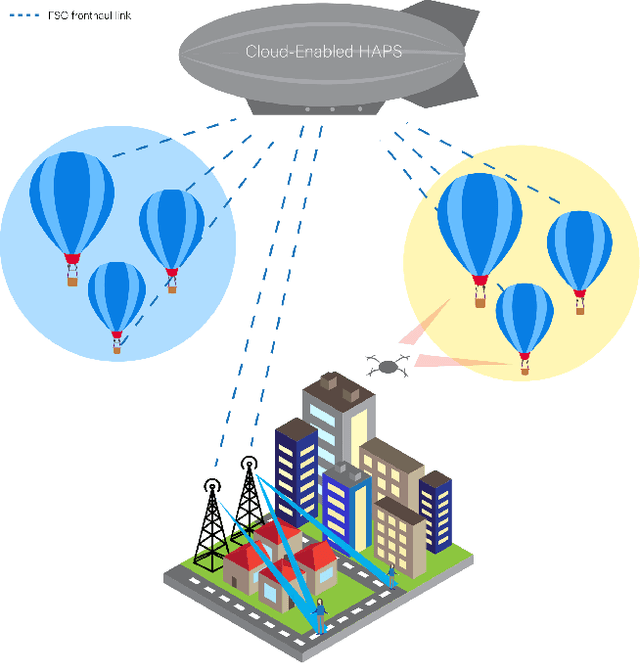
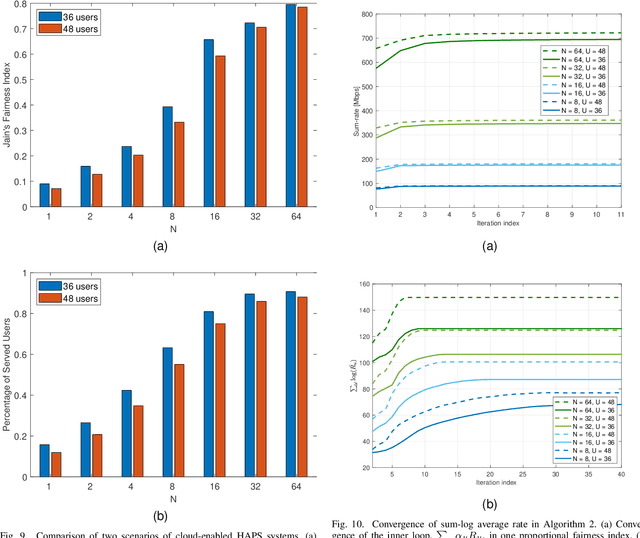
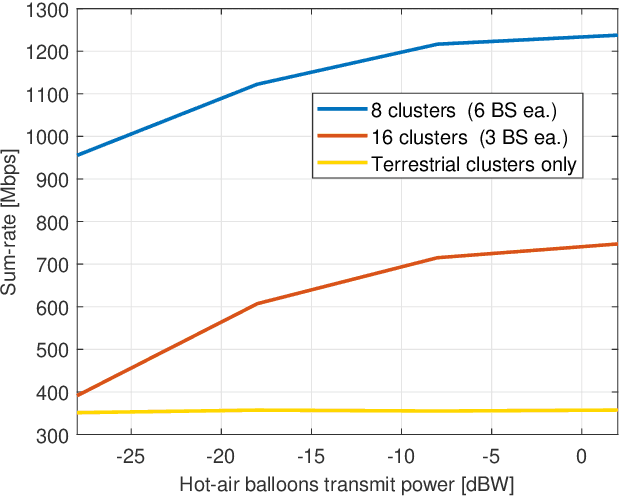
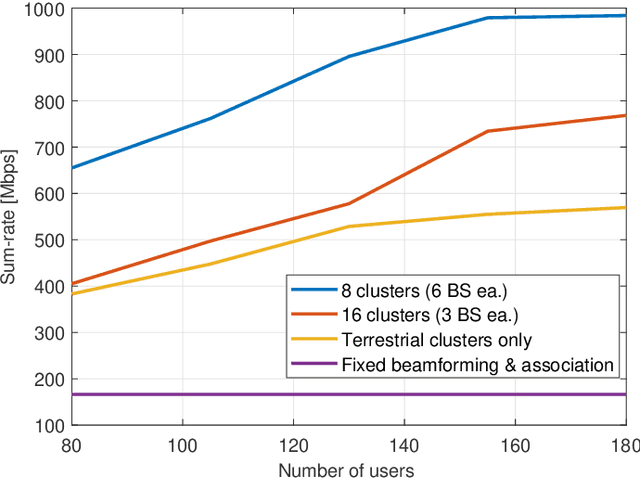
The evolvement of wireless communication services concurs with significant growth in data traffic, thereby inflicting stringent requirements on terrestrial networks. This work invigorates a novel connectivity solution that integrates aerial and terrestrial communications with a cloud-enabled high-altitude platform station (HAPS) to promote an equitable connectivity landscape. Consider a cloud-enabled HAPS connected to both terrestrial base-stations and hot-air balloons via a data-sharing fronthauling strategy. The paper then assumes that both the terrestrial base-stations and the hot-air balloons are grouped into disjoint clusters to serve the aerial and terrestrial users in a coordinated fashion. The work then focuses on finding the user-to-transmitter scheduling and the associated beamforming policies in the downlink direction of cloud-enabled HAPS systems by maximizing two different objectives, namely, the sum-rate and sum-of-log of the long-term average rate, both subject to limited transmit power and finite fronthaul capacity. The paper proposes solving the two non-convex discrete and continuous optimization problems using numerical iterative optimization algorithms. The proposed algorithms rely on well-chosen convexification and approximation steps, namely, fractional programming and sparse beamforming via re-weighted $\ell_0$-norm approximation. The numerical results outline the yielded gain illustrated through equitable access service in crowded and unserved areas, and showcase the numerical benefits stemming from the proposed cloud-enabled HAPS coordination of hot-air balloons and terrestrial base-stations for democratizing connectivity and empowering the digital inclusion framework.