 Add to Chrome
 Add to Firefox
 Add to Edge
Speeding up the annotation process in semantic segmentation industrial applications
Jun 18, 2026
Current machine learning models commonly require large and well-annotated datasets. However, the annotation process often becomes a bottleneck, with increased complexity leading to higher chances of human errors. Within this context, our goal in this paper is to leverage unsupervised algorithms to improve data annotation efficiency for complex semantic segmentation problems in industrial materials science. Previous research has quantified labeling time and others explored unsupervised methods. However, to the best of our knowledge, this is the first study to quantify how much unsupervised algorithms accelerate the labeling process. We aim to validate the extent to which this laborious process can be accelerated, focusing on semantic segmentation tasks that involve annotating each pixel of high-resolution images, such as the microstructure characterization challenge in materials science. Specifically, we demonstrate that by using unsupervised computer vision algorithms, the time required for the labeling process can be reduced from 170 hours to 37 hours, achieving an approximate reduction of 78\%. The dataset we work with includes large images of dimensions 1280x959 and 960x703, which further increases the complexity of the annotation task. Despite these challenges, we create and share the largest public steel microstructure segmentation dataset to date, available under MIT License with permanent DOI, contributing a fully annotated, high-resolution dataset to the field. Additionally, this is the first work to compare the labeling time from scratch (a common approach in previous studies) to the labeling time when using these unsupervised algorithms as a pre-annotation step. Furthermore, we provide a Deep Learning model trained on this dataset, validated by field experts, and deployed in an industrial setting, serving as an initial benchmark for this public dataset.

Evaluating Hierarchies through A Partially Observable Markov Decision Processes Methodology
Aug 27, 2019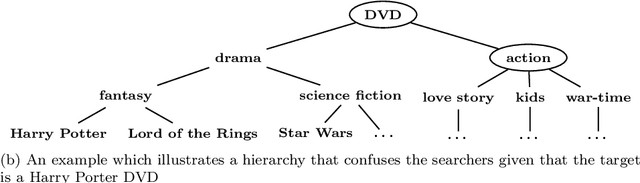
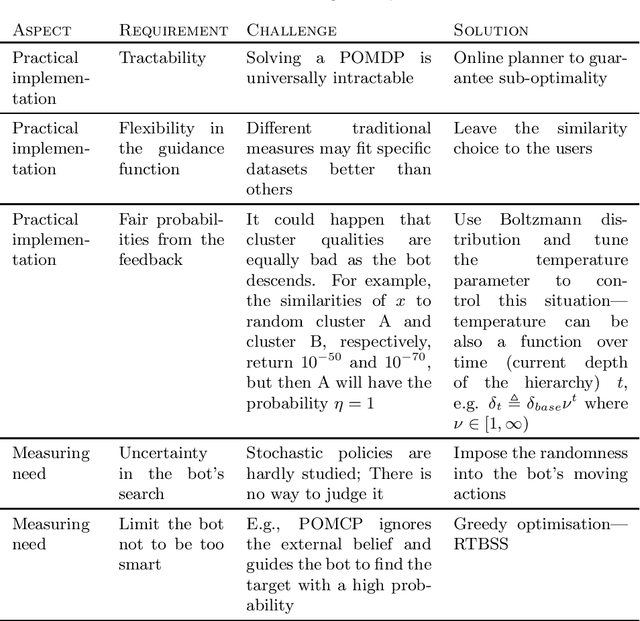
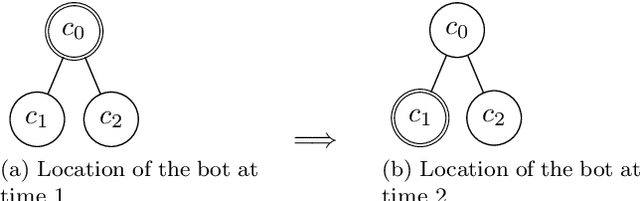

Hierarchical clustering has been shown to be valuable in many scenarios, e.g. catalogues, biology research, image processing, and so on. Despite its usefulness to many situations, there is no agreed methodology on how to properly evaluate the hierarchies produced from different techniques, particularly in the case where ground-truth labels are unavailable. This motivates us to propose a framework for assessing the quality of hierarchical clustering allocations which covers the case of no ground-truth information. Such a quality measurement is useful, for example, to assess the hierarchical structures used by online retailer websites to display their product catalogues. Differently to all the previous measures and metrics, our framework tackles the evaluation from a decision theoretic perspective. We model the process as a bot searching stochastically for items in the hierarchy and establish a measure representing the degree to which the hierarchy supports this search. We employ the concept of Partially Observable Markov Decision Processes (POMDP) to model the uncertainty, the decision making, and the cognitive return for searchers in such a scenario. In this paper, we fully discuss the modeling details and demonstrate its application on some datasets.