 Add to Chrome
 Add to Firefox
 Add to Edge
Building Trust in Autonomous Commerce: A Verifiable Global Event Timeline and AI-Ready Fraud Intelligence Layer
Jul 21, 2026
Agentic commerce protocols such as AP2 and ACP define mechanisms for secure agent-initiated transactions but do not provide interoperable, tamper-evident auditability or verifiable temporal ordering of events across heterogeneous domains. This paper addresses these gaps by proposing a verifiable global event timeline for agentic commerce, constructed from four core components: canonical event schemas that enforce deterministic serialization, deterministic batch formation ensuring reproducible ordering without reliance on synchronized clocks, Merkle-based append-only commitments providing logarithmic-cost inclusion proofs, and blockchain anchoring establishing a tamper-evident temporal backbone. Building on this infrastructure, we introduce a cryptographically signed fraud marker that binds risk labels to anchored evidence through an unforgeable provenance chain, and a dataset lineage model enabling reproducible, tamper-evident AI training pipelines. Empirical results from a prototype implementation demonstrate: Merkle tree construction processes 50,000 events in 47 milliseconds; end-to-end verification completes in under 0.013 milliseconds regardless of batch size; inclusion proof sizes grow logarithmically from 320 bytes at 1,000 events to 512 bytes at 50,000 events; and Merkle-based verification outperforms linear scan by 14.4x at 50,000 events.

A comparative study of various Deep Learning techniques for spatio-temporal Super-Resolution reconstruction of Forced Isotropic Turbulent flows
Jul 07, 2021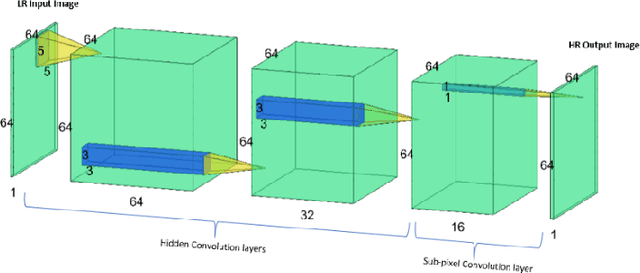
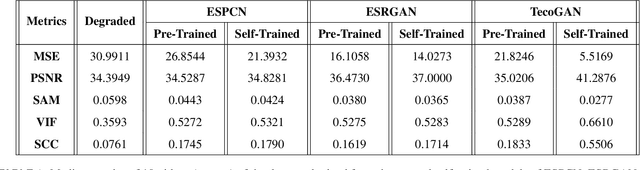
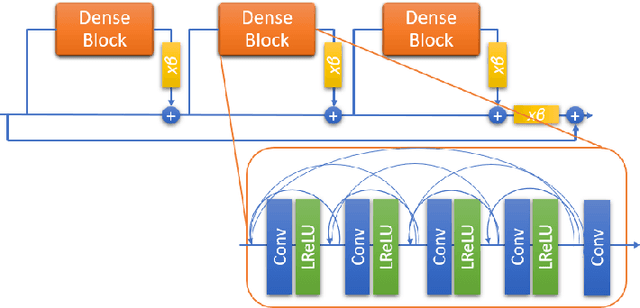
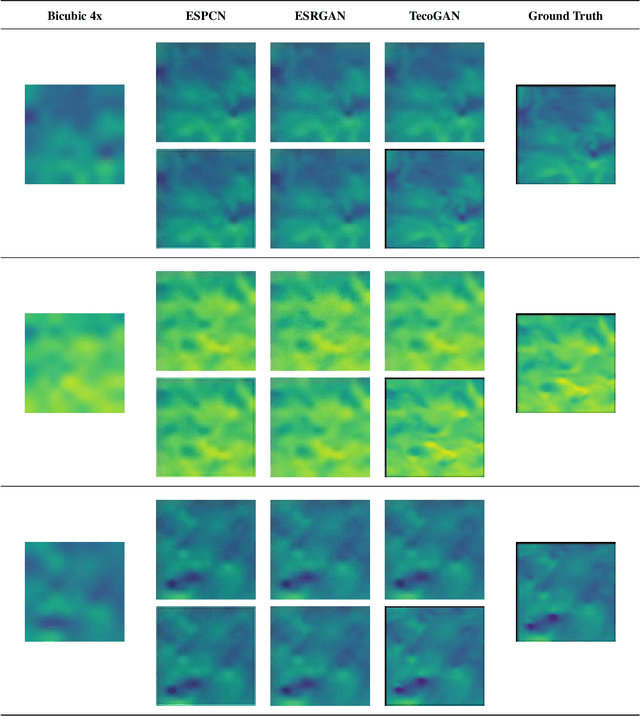
Super-resolution is an innovative technique that upscales the resolution of an image or a video and thus enables us to reconstruct high-fidelity images from low-resolution data. This study performs super-resolution analysis on turbulent flow fields spatially and temporally using various state-of-the-art machine learning techniques like ESPCN, ESRGAN and TecoGAN to reconstruct high-resolution flow fields from low-resolution flow field data, especially keeping in mind the need for low resource consumption and rapid results production/verification. The dataset used for this study is extracted from the 'isotropic 1024 coarse' dataset which is a part of Johns Hopkins Turbulence Databases (JHTDB). We have utilized pre-trained models and fine tuned them to our needs, so as to minimize the computational resources and the time required for the implementation of the super-resolution models. The advantages presented by this method far exceed the expectations and the outcomes of regular single structure models. The results obtained through these models are then compared using MSE, PSNR, SAM, VIF and SCC metrics in order to evaluate the upscaled results, find the balance between computational power and output quality, and then identify the most accurate and efficient model for spatial and temporal super-resolution of turbulent flow fields.