 Add to Chrome
 Add to Firefox
 Add to Edge
Dynamic Evidence Collection Ecosystem for Assessment Integrity and Authentic Competence
Aug 17, 2026
Generative Artificial Intelligence (GenAI) can produce high-quality essays, code, and design artefacts, challenging the validity of conventional assessments that rely on single-point submissions and product-only grading. This paper proposes a design framework called "Dynamic Evidence Collection Ecosystem" that shifts assessment toward continuous, authentic, multi-source evidence of student learning over time. The framework collects process evidence through iterative artefacts, design logs, activity rounds, self-reflection, and peer collaboration, supported by an AI-enabled layer for learning analytics, formative feedback, and transparency. The approach is grounded in recent assessment-redesign scholarship in AI-rich contexts and aligned with contemporary views of authenticity in assessment. This paper builds on the hypothesis that academic integrity is strengthened when it is treated as an assessment design rather than as an AI detection problem. The tools have limitations and risks of use that carry academic penalties. This paper presents an implementation scenario to support institutional adoption.

A Novel Hierarchical Integration Method for Efficient Model Merging in Medical LLMs
Nov 17, 2025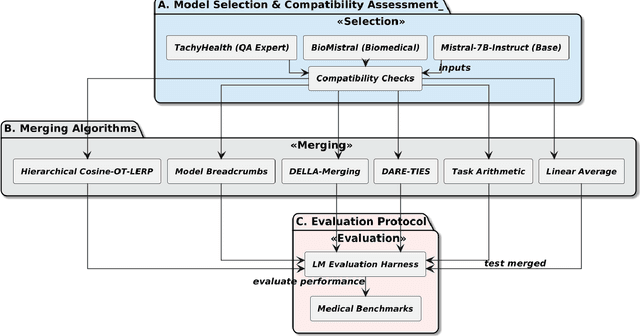
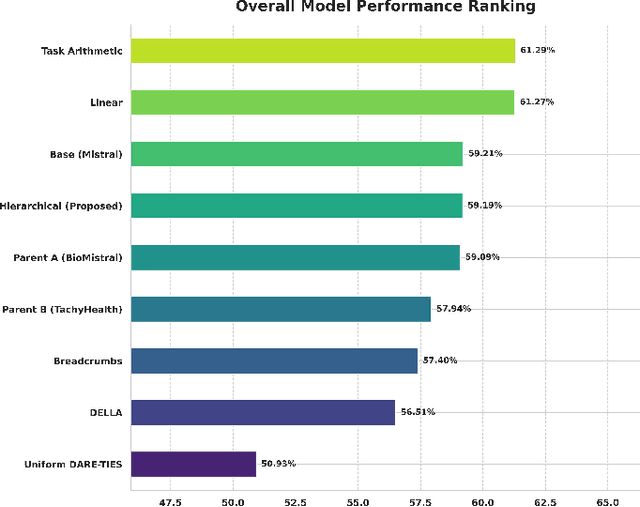
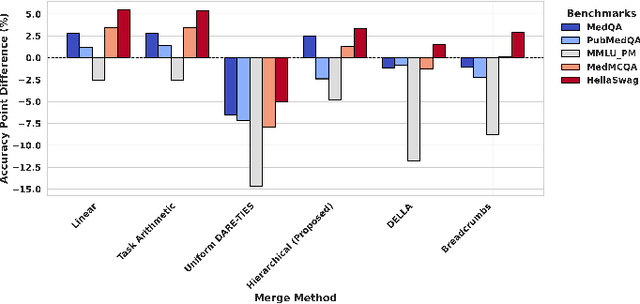
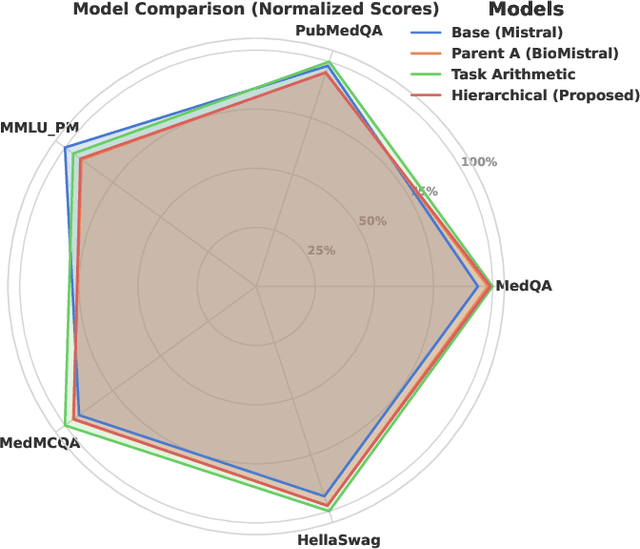
Large Language Models (LLMs) face significant challenges in distributed healthcare, including consolidating specialized domain knowledge across institutions while maintaining privacy, reducing computational overhead, and preventing catastrophic forgetting during model updates.This paper presents a systematic evaluation of six parameter-space merging techniques applied to two architecturally compatible medical LLMs derived from the Mistral-7B base model. We introduce a novel hierarchical method that combines selective Optimal Transport (OT) alignment for attention layers with cosine similarity-weighted interpolation, designed to address permutation variance while minimizing computational overhead for edge deployment scenarios. Our study evaluates Task Arithmetic, Linear Averaging, DARE-TIES, DELLA, Breadcrumbs, and our Hierarchical approach across five medical benchmarks. Results demonstrate that architecturally compatible models benefit significantly from simple averaging methods, with Task Arithmetic achieving 45.80% accuracy on MedQA, outperforming complex pruning-based approaches. These findings offer critical insights for the deployment of distributed medical AI in resource-constrained IoT environments, where computational efficiency and model compatibility are paramount. Our work establishes that for architecturally compatible models, simple averaging provides a robust and computationally efficient baseline for knowledge consolidation, offering a pragmatic path forward for scalable medical AI systems.