 Add to Chrome
 Add to Firefox
 Add to Edge
MIMO Zak-OTFS: Channel Estimation, Detection, and Throughput Analysis
Jun 24, 2026
Zak-Orthogonal Time Frequency Space (Zak-OTFS) modulation has demonstrated substantial performance gains over cyclic-prefix orthogonal frequency-division multiplexing (CP-OFDM) in highly time- and frequency-selective channels. In this paper, we extend Zak-OTFS to a multiple-input multiple-output (MIMO) framework. We first derive a complete system model for MIMO Zak-OTFS based directly on the physical multipath channel; ours is the first work to do so. We then propose an efficient channel estimation method using structured pilot placement in the delay-Doppler (DD) domain. The proposed approach is evaluated under the standardized CDL-C channel model, demonstrating that the advantages of Zak-OTFS observed in SISO scenarios extend to MIMO systems, particularly its robustness to Doppler and inter-carrier interference (ICI). We identify a fundamental crossover behavior: CP-OFDM performs slightly better at low SNR and low Doppler, while Zak-OTFS excels at higher SNR or under severe Doppler dispersion. Furthermore, we show that the crossover points for SNR and Doppler shift inversely to each other. We also observe that Zak-OTFS, particularly with MIMO, exhibits increased sensitivity to high values of pilot-to-data power ratio (PDR), but has a similar optimal PDR as CP-OFDM.

Zak-OTFS: Pulse Shaping and the Tradeoff between Time/Bandwidth Expansion and Predictability
May 04, 2024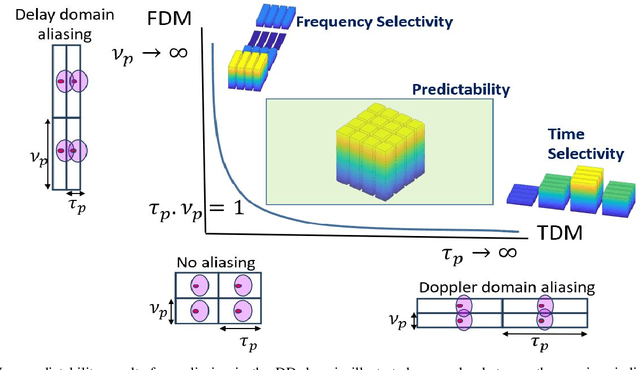
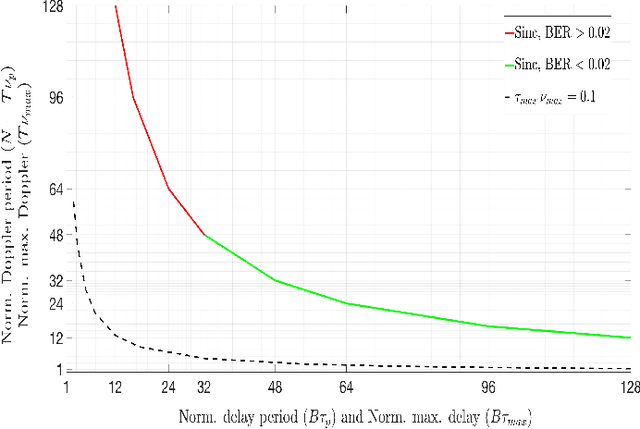
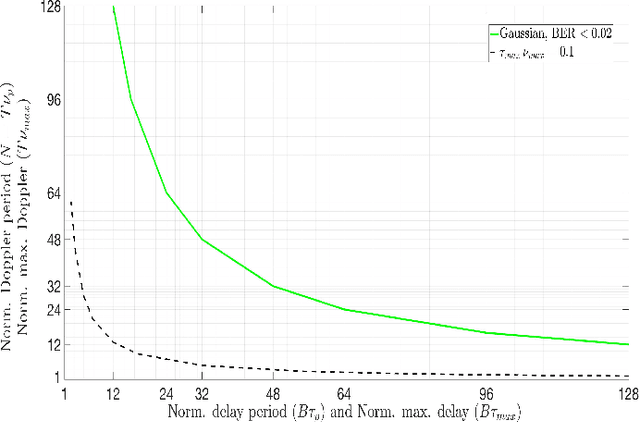
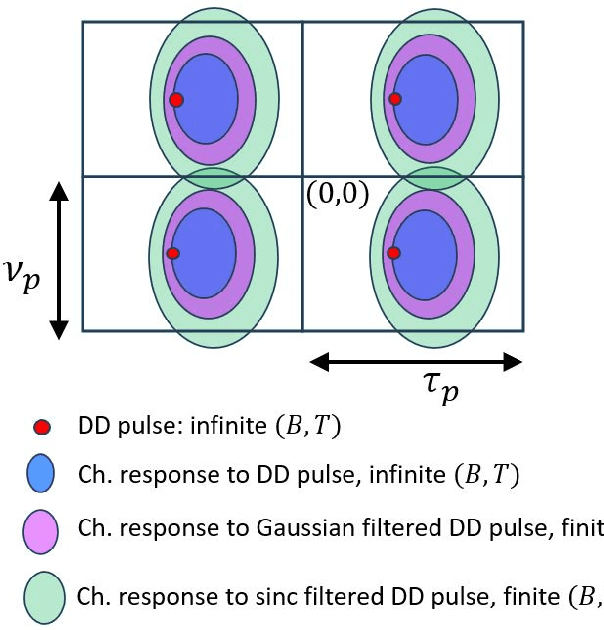
The Zak-OTFS input/output (I/O) relation is predictable and non-fading when the delay and Doppler periods are greater than the effective channel delay and Doppler spreads, a condition which we refer to as the crystallization condition. When the crystallization condition is satisfied, we describe how to integrate sensing and communication within a single Zak-OTFS subframe by transmitting a pilot in the center of the subframe and surrounding the pilot with a pilot region and guard band to mitigate interference between data symbols and pilot. At the receiver we first read off the effective channel taps within the pilot region, and then use the estimated channel taps to recover the data from the symbols received outside the pilot region. We introduce a framework for filter design in the delay-Doppler (DD) domain where the symplectic Fourier transform connects aliasing in the DD domain (predictability of the I/O relation) with time/bandwidth expansion. The choice of pulse shaping filter determines the fraction of pilot energy that lies outside the pilot region and the degradation in BER performance that results from the interference to data symbols. We demonstrate that Gaussian filters in the DD domain provide significant improvements in BER performance over the sinc and root raised cosine filters considered in previous work. We also demonstrate that, by limiting DD domain aliasing, Gaussian filters extend the region where the crystallization condition is satisfied. The Gaussian filters considered in this paper are a particular case of factorizable pulse shaping filters in the DD domain, and this family of filters may be of independent interest.
Biometric Recognition System (Algorithm)
Dec 08, 2018


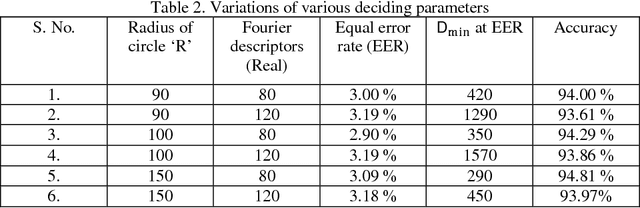
Fingerprints are the most widely deployed form of biometric identification. No two individuals share the same fingerprint because they have unique biometric identifiers. This paper presents an efficient fingerprint verification algorithm which improves matching accuracy. Fingerprint images get degraded and corrupted due to variations in skin and impression conditions. Thus, image enhancement techniques are employed prior to singular point detection and minutiae extraction. Singular point is the point of maximum curvature. It is determined by the normal of each fingerprint ridge, and then following them inward towards the centre. The local ridge features known as minutiae is extracted using cross-number method to find ridge endings and ridge bifurcations. The proposed algorithm chooses a radius and draws a circle with core point as centre, making fingerprint images rotationally invariant and uniform. The radius can be varied according to the accuracy depending on the particular application. Morphological techniques such as clean, spur and H-break is employed to remove noise, followed by removing spurious minutiae. Templates are created based on feature vector extraction and databases are made for verification and identification for the fingerprint images taken from Fingerprint Verification Competition (FVC2002). Minimum Euclidean distance is calculated between saved template and the test fingerprint image template and compared with the set threshold for matching decision. For the performance evaluation of the proposed algorithm various measures, equal error rate (EER), Dmin at EER, accuracy and threshold are evaluated and plotted. The measures demonstrate that the proposed algorithm is more effective and robust.