 Add to Chrome
 Add to Firefox
 Add to Edge
Leveraging Interpretable Tsetlin Machine for PDF Malware Detection
Jul 10, 2026
In the digital era, Portable Document Format (PDF) is one of the most widely used file formats for storing and exchanging digital documents due to its platform independence and rich functionality. However, these same capabilities have also made PDF files an attractive attack vector for cyberattackers, who embed malicious code within seemingly legitimate documents to compromise target systems. This paper presents a novel interpretable Tsetlin Machine (TM)-based framework for PDF malware detection. The proposed framework extracts salient features from PDF documents through static analysis without executing the files and employs rule-based learning to accurately classify benign and malicious PDF documents. Numerical evaluation on the RIT-PDFMal-2026 dataset demonstrates that the proposed framework achieves competitive performance, attaining an accuracy of 98.02% compared with several ML classifiers and existing methods. Moreover, the proposed framework provides intrinsic interpretability by transparently explaining its classification decisions. The combination of competitive detection performance, computational efficiency, and intrinsic interpretability makes the proposed framework a promising solution for practical PDF malware detection.

A Tsetlin Machine-driven Intrusion Detection System for Next-Generation IoMT Security
Apr 03, 2026The rapid adoption of the Internet of Medical Things (IoMT) is transforming healthcare by enabling seamless connectivity among medical devices, systems, and services. However, it also introduces serious cybersecurity and patient safety concerns as attackers increasingly exploit new methods and emerging vulnerabilities to infiltrate IoMT networks. This paper proposes a novel Tsetlin Machine (TM)-based Intrusion Detection System (IDS) for detecting a wide range of cyberattacks targeting IoMT networks. The TM is a rule-based and interpretable machine learning (ML) approach that models attack patterns using propositional logic. Extensive experiments conducted on the CICIoMT-2024 dataset, which includes multiple IoMT protocols and cyberattack types, demonstrate that the proposed TM-based IDS outperforms traditional ML classifiers. The proposed model achieves an accuracy of 99.5\% in binary classification and 90.7\% in multi-class classification, surpassing existing state-of-the-art approaches. Moreover, to enhance model trust and interpretability, the proposed TM-based model presents class-wise vote scores and clause activation heatmaps, providing clear insights into the most influential clauses and the dominant class contributing to the final model decision.
Detecting the Unexpected: AI-Driven Anomaly Detection in Smart Bridge Monitoring
Mar 30, 2026Bridges are critical components of national infrastructure and smart cities. Therefore, smart bridge monitoring is essential for ensuring public safety and preventing catastrophic failures or accidents. Traditional bridge monitoring methods rely heavily on human visual inspections, which are time-consuming and prone to subjectivity and error. This paper proposes an artificial intelligence (AI)-driven anomaly detection approach for smart bridge monitoring. Specifically, a simple machine learning (ML) model is developed using real-time sensor data collected by the iBridge sensor devices installed on a bridge in Norway. The proposed model is evaluated against different ML models. Experimental results demonstrate that the density-based spatial clustering of applications with noise (DBSCAN)-based model outperforms in accurately detecting the anomalous events (bridge accident). These findings indicate that the proposed model is well-suited for smart bridge monitoring and can enhance public safety by enabling the timely detection of unforeseen incidents.
Probabilistic analysis of solar cell optical performance using Gaussian processes
Jun 26, 2021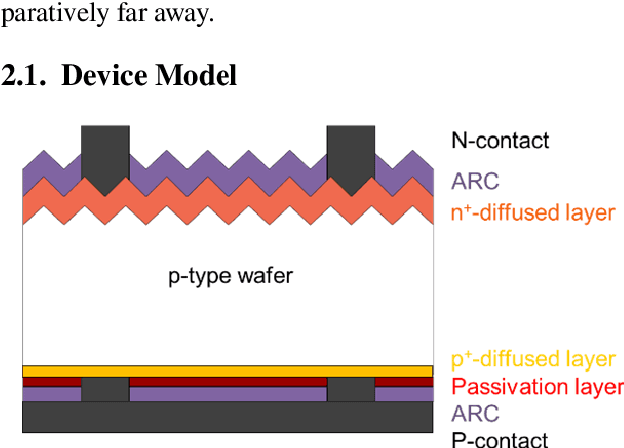
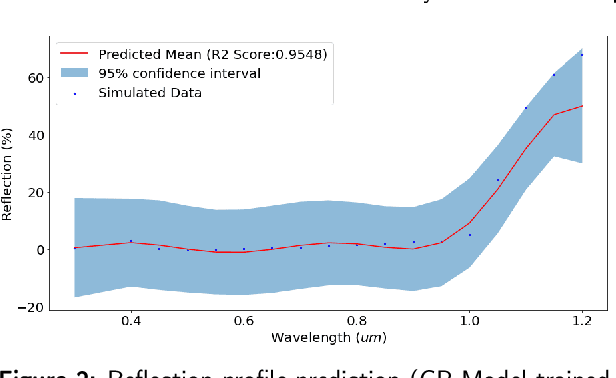
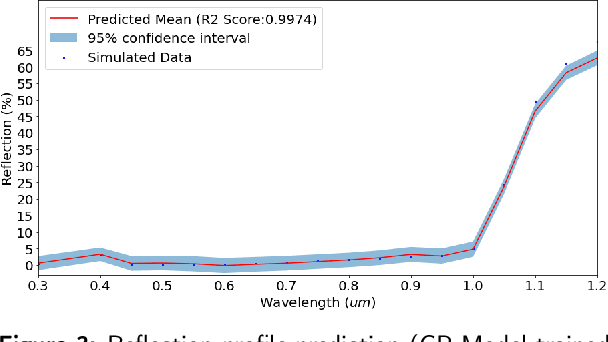
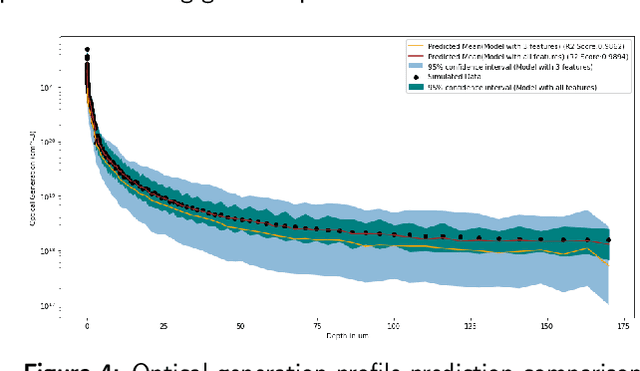
This work investigates application of different machine learning based prediction methodologies to estimate the performance of silicon based textured cells. Concept of confidence bound regions is introduced and advantages of this concept are discussed in detail. Results show that reflection profiles and depth dependent optical generation profiles can be accurately estimated using Gaussian processes with exact knowledge of uncertainty in the prediction values.It is also shown that cell design parameters can be estimated for a desired performance metric.