 Add to Chrome
 Add to Firefox
 Add to Edge
The cognitive companion: a lightweight parallel monitoring architecture for detecting and recovering from reasoning degradation in LLM agents
Apr 15, 2026
Large language model (LLM) agents on multi-step tasks suffer reasoning degradation, looping, drift, stuck states, at rates up to 30% on hard tasks. Current solutions include hard step limits (abrupt) or LLM-as-judge monitoring (10-15% overhead per step). This paper introduces the Cognitive Companion, a parallel monitoring architecture with two implementations: an LLM-based Companion and a novel zero-overhead Probe-based Companion. We report a three-batch feasibility study centered on Gemma 4 E4B, with an additional exploratory small-model analysis on Qwen 2.5 1.5B and Llama 3.2 1B. In our experiments, the LLM-based Companion reduced repetition on loop-prone tasks by 52-62% with approximately 11% overhead. The Probe-based Companion, trained on hidden states from layer 28, showed a mean effect size of +0.471 at zero measured inference overhead; its strongest probe result achieved cross-validated AUROC 0.840 on a small proxy-labeled dataset. A key empirical finding is that companion benefit appears task-type dependent: companions are most helpful on loop-prone and open-ended tasks, while effects are neutral or negative on more structured tasks. Our small-model experiments also suggest a possible scale boundary: companions did not improve the measured quality proxy on 1B-1.5B models, even when interventions fired. Overall, the paper should be read as a feasibility study rather than a definitive validation. The results provide encouraging evidence that sub-token monitoring may be useful, identify task-type sensitivity as a practical design constraint, and motivate selective companion activation as a promising direction for future work.

CLAIMED -- the open source framework for building coarse-grained operators for accelerated discovery in science
Jul 12, 2023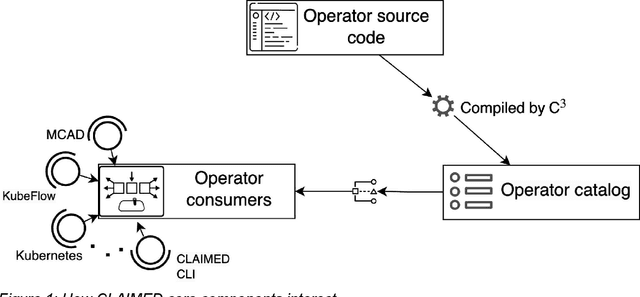
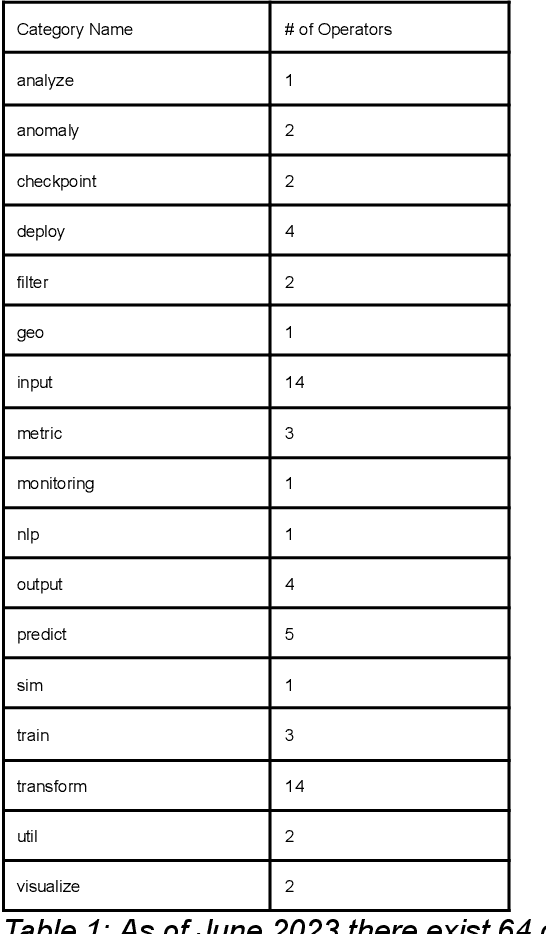
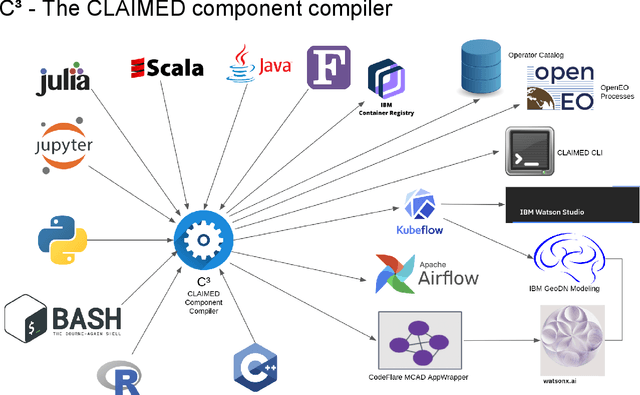
In modern data-driven science, reproducibility and reusability are key challenges. Scientists are well skilled in the process from data to publication. Although some publication channels require source code and data to be made accessible, rerunning and verifying experiments is usually hard due to a lack of standards. Therefore, reusing existing scientific data processing code from state-of-the-art research is hard as well. This is why we introduce CLAIMED, which has a proven track record in scientific research for addressing the repeatability and reusability issues in modern data-driven science. CLAIMED is a framework to build reusable operators and scalable scientific workflows by supporting the scientist to draw from previous work by re-composing workflows from existing libraries of coarse-grained scientific operators. Although various implementations exist, CLAIMED is programming language, scientific library, and execution environment agnostic.