 Add to Chrome
 Add to Firefox
 Add to Edge
Choreographing the Way of Water: A Computational Framework for Aquatic Robotic Art
Jul 02, 2026
Robotic choreography in open water is governed by nonlinear fluid dynamics, which impose significant challenges due to environmental disturbances and nonlinear system dynamics. This paper presents the cyber-physical architecture of Way of Water, a vertically integrated framework that orchestrates a fleet of autonomous surface vessels as a distributed choreographic platform. Moving beyond the surface-pixel paradigm, these vessels use laminar nozzles and multi-zone lighting to extend their expressive range from the 2D water plane into the 3D volumetric domain. Our primary contribution is the Way of Water Studio, a browser-based, timeline-compositing authoring paradigm that treats the fleet as a DAW-like instrument for music-responsive choreography. The Studio encapsulates Sequential Convex Programming for trajectory generation and Model Predictive Control for disturbance rejection presented through a visual timeline, broadening access to high-performance aquatic robotics for non-programmer artists. Grounding the Studio is the full cyber-physical stack: a custom holonomic chassis, a state-estimation and control stack tuned for the aquatic domain, and an LTE/MQTT fleet link with RTK-GPS time synchronization. We report on the system's validation across two distinct deployments: an 18-vessel Swan Lake interpretation at Lake Zurich and an 8-vessel Time Space Existence 2025 Venice Biennale demonstration at Forte Marghera, establishing a foundational reference for the design and deployment of fluidic robotic swarms.

Cross-Platform Control for Autonomous Surface Vehicles via Adaptive Reinforcement Learning
Jul 02, 2026Autonomous surface vehicles vary widely in hydrodynamic and actuation characteristics, yet most controllers are designed for single-platform deployment. We present an adaptive reinforcement learning approach for trajectory tracking that enables zero-shot cross-platform deployment using a single policy. Since the deployment platform's dynamics are unknown to the policy, we address cross-platform generalization with the standard partial-observability approach of conditioning on interaction history, employing a teacher-student architecture in which a learned module infers a latent representation of the platform dynamics. The policy is trained in simulation under randomized vessel dynamics and is deployed zero-shot to two real-world platforms without any fine-tuning, despite relying on a simple analytical dynamics model rather than a high-fidelity hydrodynamic simulator. In real-world experiments on two different platforms, the adaptive policy outperforms non-adaptive learning-based baselines by up to 58% in position mean absolute error while approaching the tracking accuracy of a platform-specific tuned controller.
Reinforcement Learning-Based Control for an Inline Skating Humanoid Robot
Jun 30, 2026As humanoid robots become increasingly dynamic, coupling them with reinforcement learning offers a promising approach to solving the complex, underactuated mechanics of passive inline skating. Equipping a humanoid robot with passive inline skating wheels presents an opportunity to combine the versatile agility of humanoids with the high-speed, energy-efficient locomotion strategies utilized by human skaters. In this paper, we train and deploy a reinforcement learning control policy that enables novel locomotion strategies for a humanoid robot modified to equip consumer inline skates instead of conventional feet. Unlike previous work limited to quadrupedal robots or actively driven wheels, our system allows for precise 6-DoF control of the skates to execute dynamic, edge-driven propulsion strategies. Our skating strategies emerge entirely from our reward structure, without reliance on human motion data, imitation learning, or kinematic priors. We overcome the inherent instability of passive wheels and simulation contact artifacts by utilizing different geometric wheel models (spherical and ellipsoidal) during training and validation, along with a custom success-based command curriculum and a specialized rolling reward. Consequently, our policy demonstrates up to a 50% reduction in Cost of Transport (CoT) compared to standard walking gaits. The resulting policy successfully transfers zero-shot to the physical Booster T1 hardware. Real-world deployments demonstrate dynamic balance, the ability to reject active physical perturbations, and agile locomotion strategies capable of turning at speed. A video of our results can be found at https://www.youtube.com/watch?v=-_APcOS7uFo.
Motion planning for hundreds of floating robots
Jun 08, 2026Planning collision-free motion for large robot fleets is difficult because collision avoidance induces strong inter-agent coupling that grows rapidly with team size. We consider omnidirectional floating robots on water, where choreographies are specified by sparse keyframes and an interactive tool must generate trajectories within seconds, even when transitions span minutes and thousands of time steps. We propose a scalable pipeline that builds a collision graph from an initialization, decomposes the coupled problem into interaction clusters, and solves clusters independently (and in parallel) with robustness mechanisms for common decomposition pathologies. We validate the approach in simulations up to 500 robots. The synthesized trajectories have also been deployed in two real-world demonstrations, on Lake Zürich with a fleet of 24 Way of Water crafts and at the Time Space Existence 2025 Venice Biennale.
Can we stabilize an inverted pendulum with feedback from a time-of-flight camera?
Jun 08, 2026Time-of-flight cameras are popular in robotics for providing direct depth information while being compact, inexpensive, and robust to lighting conditions, but their low spatial resolution and depth noise are widely believed to preclude precise feedback control. In this paper, we show that an inexpensive, low-resolution time-of-flight camera provides sufficient feedback to reliably and precisely balance an inverted pendulum on a cart--a canonical benchmark for fast, unstable dynamics.
Flow Gym
Dec 12, 2025Flow Gym is a toolkit for research and deployment of flow-field quantification methods inspired by OpenAI Gym and Stable-Baselines3. It uses SynthPix as synthetic image generation engine and provides a unified interface for the testing, deployment and training of (learning-based) algorithms for flow-field quantification from a number of consecutive images of tracer particles. It also contains a growing number of integrations of existing algorithms and stable (re-)implementations in JAX.
SynthPix: A lightspeed PIV images generator
Dec 10, 2025We describe SynthPix, a synthetic image generator for Particle Image Velocimetry (PIV) with a focus on performance and parallelism on accelerators, implemented in JAX. SynthPix supports the same configuration parameters as existing tools but achieves a throughput several orders of magnitude higher in image-pair generation per second. SynthPix was developed to enable the training of data-hungry reinforcement learning methods for flow estimation and for reducing the iteration times during the development of fast flow estimation methods used in recent active fluids control studies with real-time PIV feedback. We believe SynthPix to be useful for the fluid dynamics community, and in this paper we describe the main ideas behind this software package.
Using reinforcement learning to probe the role of feedback in skill acquisition
Dec 09, 2025Many high-performance human activities are executed with little or no external feedback: think of a figure skater landing a triple jump, a pitcher throwing a curveball for a strike, or a barista pouring latte art. To study the process of skill acquisition under fully controlled conditions, we bypass human subjects. Instead, we directly interface a generalist reinforcement learning agent with a spinning cylinder in a tabletop circulating water channel to maximize or minimize drag. This setup has several desirable properties. First, it is a physical system, with the rich interactions and complex dynamics that only the physical world has: the flow is highly chaotic and extremely difficult, if not impossible, to model or simulate accurately. Second, the objective -- drag minimization or maximization -- is easy to state and can be captured directly in the reward, yet good strategies are not obvious beforehand. Third, decades-old experimental studies provide recipes for simple, high-performance open-loop policies. Finally, the setup is inexpensive and far easier to reproduce than human studies. In our experiments we find that high-dimensional flow feedback lets the agent discover high-performance drag-control strategies with only minutes of real-world interaction. When we later replay the same action sequences without any feedback, we obtain almost identical performance. This shows that feedback, and in particular flow feedback, is not needed to execute the learned policy. Surprisingly, without flow feedback during training the agent fails to discover any well-performing policy in drag maximization, but still succeeds in drag minimization, albeit more slowly and less reliably. Our studies show that learning a high-performance skill can require richer information than executing it, and learning conditions can be kind or wicked depending solely on the goal, not on dynamics or policy complexity.
Adaptive Nonlinear Model Predictive Control for a Real-World Labyrinth Game
Jun 12, 2024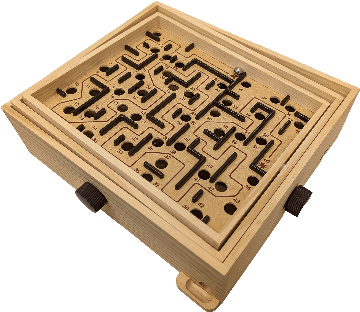
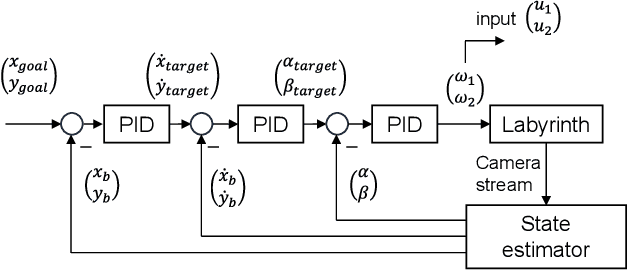
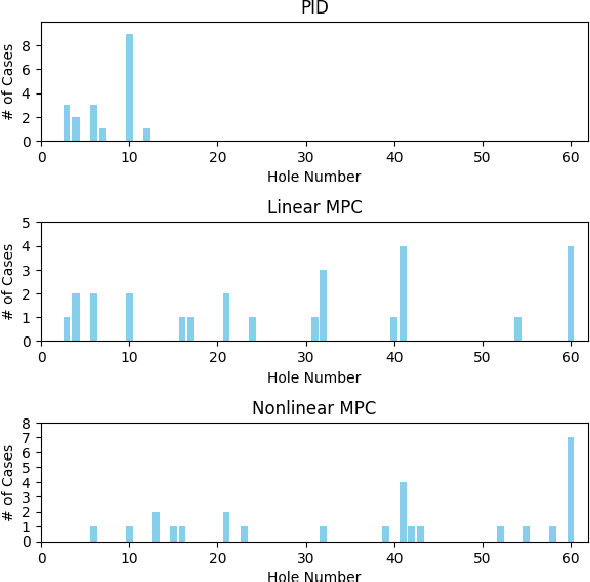
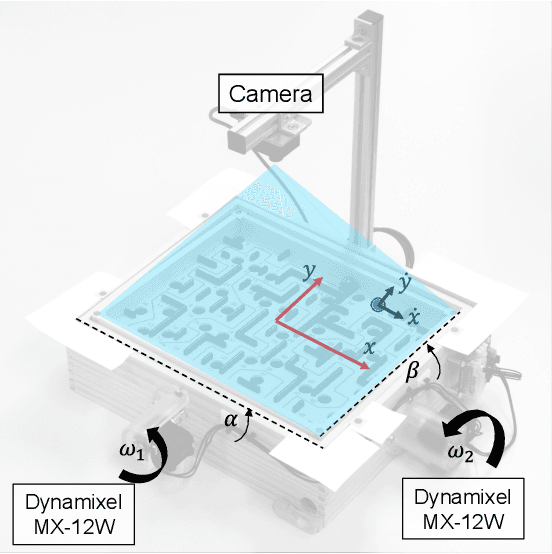
We present a nonlinear non-convex model predictive control approach to solving a real-world labyrinth game. We introduce adaptive nonlinear constraints, representing the non-convex obstacles within the labyrinth. Our method splits the computation-heavy optimization problem into two layers; first, a high-level model predictive controller which incorporates the full problem formulation and finds pseudo-global optimal trajectories at a low frequency. Secondly, a low-level model predictive controller that receives a reduced, computationally optimized version of the optimization problem to follow the given high-level path in real-time. Further, a map of the labyrinth surface irregularities is learned. Our controller is able to handle the major disturbances and model inaccuracies encountered on the labyrinth and outperforms other classical control methods.
Optical Tactile Sensing for Aerial Multi-Contact Interaction: Design, Integration, and Evaluation
Jan 30, 2024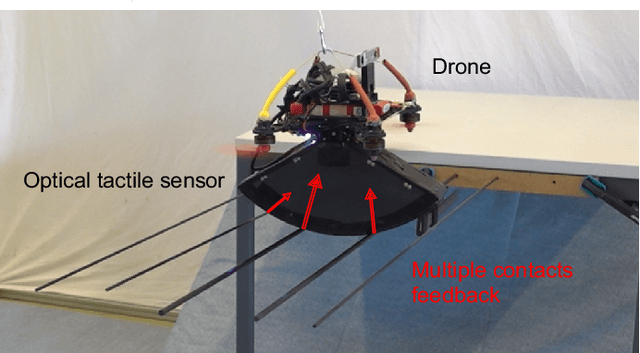
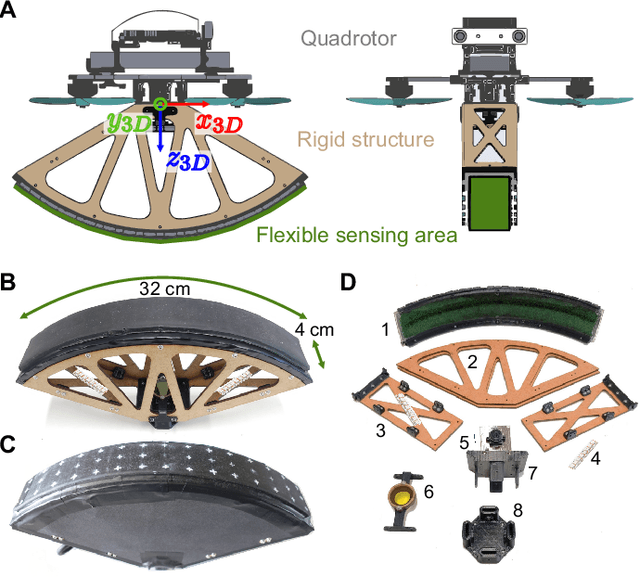
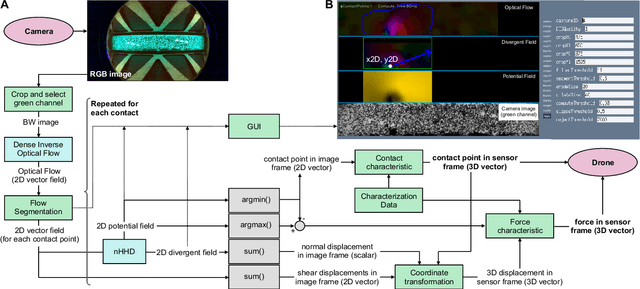
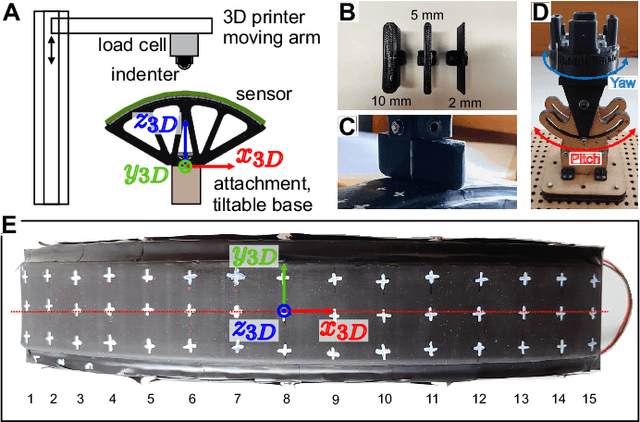
Distributed tactile sensing for multi-force detection is crucial for various aerial robot interaction tasks. However, current contact sensing solutions on drones only exploit single end-effector sensors and cannot provide distributed multi-contact sensing. Designed to be easily mounted at the bottom of a drone, we propose an optical tactile sensor that features a large and curved soft sensing surface, a hollow structure and a new illumination system. Even when spaced only 2 cm apart, multiple contacts can be detected simultaneously using our software pipeline, which provides real-world quantities of 3D contact locations (mm) and 3D force vectors (N), with an accuracy of 1.5 mm and 0.17 N respectively. We demonstrate the sensor's applicability and reliability onboard and in real-time with two demos related to i) the estimation of the compliance of different perches and subsequent re-alignment and landing on the stiffer one, and ii) the mapping of sparse obstacles. The implementation of our distributed tactile sensor represents a significant step towards attaining the full potential of drones as versatile robots capable of interacting with and navigating within complex environments.